

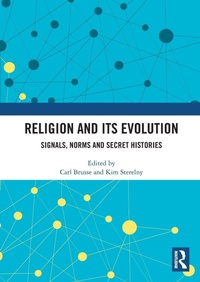
Religion and its Evolution
Signals, Norms and Secret Histories
1st Edition
Published on 6. May 2025
Book
Paperback/Softback
146 pages
978-1-032-62801-1 (ISBN)
Description
This book examines why individuals and communities invest heavily in their religious life through multi-disciplinary perspectives. It pursues philosophical, psychological, deep time historical and adaptive answers to this question.
Religion is a profoundly puzzling phenomenon from an evolutionary perspective. Commitment to religions are typically expensive, and most of the beliefs that motivate them cannot be true (since religious belief systems are inconsistent with one another). Yet some form of religion seems to be universal and resilient in historically known cultures - though not, if archaeology is to be trusted, in human communities early in the evolution of our species. We have collectively invented religion over about the last 100,000 years. Stemming from an interdisciplinary workshop, this book grapples with these challenges and features diverse contributions: some offer evolutionary and historical analyses, identifying hidden adaptive benefits to religion independent of the veracity of religious belief. Others see connections between religious commitment and commitment to the social norms that make cooperative life possible and explore aspects of human psychology that make religious belief tempting.
Broad in scope and theoretically ambitious, Religion and Its Evolution: Signals, Norms and Secret Histories will be a key resource for scholars and researchers of religious studies, sciences of religion, psychology, anthropology, the cultural evolution of religion and the sociology of religion. This book was originally published as a special issue of Religion, Brain & Behavior.
Religion is a profoundly puzzling phenomenon from an evolutionary perspective. Commitment to religions are typically expensive, and most of the beliefs that motivate them cannot be true (since religious belief systems are inconsistent with one another). Yet some form of religion seems to be universal and resilient in historically known cultures - though not, if archaeology is to be trusted, in human communities early in the evolution of our species. We have collectively invented religion over about the last 100,000 years. Stemming from an interdisciplinary workshop, this book grapples with these challenges and features diverse contributions: some offer evolutionary and historical analyses, identifying hidden adaptive benefits to religion independent of the veracity of religious belief. Others see connections between religious commitment and commitment to the social norms that make cooperative life possible and explore aspects of human psychology that make religious belief tempting.
Broad in scope and theoretically ambitious, Religion and Its Evolution: Signals, Norms and Secret Histories will be a key resource for scholars and researchers of religious studies, sciences of religion, psychology, anthropology, the cultural evolution of religion and the sociology of religion. This book was originally published as a special issue of Religion, Brain & Behavior.
More details
Language
English
Place of publication
London
United Kingdom
Publishing group
Taylor & Francis Ltd
Target group
College/higher education
Postgraduate, Undergraduate Advanced, and Undergraduate Core
Dimensions
Height: 246 mm
Width: 174 mm
Thickness: 9 mm
Weight
291 gr
ISBN-13
978-1-032-62801-1 (9781032628011)
Copyright in bibliographic data and cover images is held by Nielsen Book Services Limited or by the publishers or by their respective licensors: all rights reserved.
Schweitzer Classification
Other editions
Additional editions
E-Book
12/2023
1st Edition
Taylor & Francis
€60.49
Available for download
E-Book
12/2023
1st Edition
Taylor & Francis
€60.49
Available for download
Book
12/2023
1st Edition
Routledge
€205.80
Shipment within 10-20 days
Persons
Carl Brusse holds postdoctoral appointments at The Australian National University (School of Philosophy) and The University of Sydney (Department of Philosophy and The Charles Perkins Centre), Australia. He works on game theoretic and evolutionary explanation in the human sciences.
Kim Sterelny is Professor of Philosophy at the Australian National University, Australia. He is the author of The Evolved Apprentice: How Evolution Made Humans Unique (2012) and The Pleistocene Social Contract: Culture and Cooperation in Human Evolution (2021) among other books.
Kim Sterelny is Professor of Philosophy at the Australian National University, Australia. He is the author of The Evolved Apprentice: How Evolution Made Humans Unique (2012) and The Pleistocene Social Contract: Culture and Cooperation in Human Evolution (2021) among other books.
Content
Introduction to religion and its evolution: signals, norms, and secret histories 1. Minds of gods and human cognitive constraints: socio-ecological context shapes belief 2. A national-scale typology of orientations to religion poses new challenges for the cultural evolutionary study of religious groups 3. The coevolution of sacred value and religion 4. Signaling theories of religion: models and explanation 5. Did religion play a role in the evolution of morality? 6. Religion: costs, signals, and the Neolithic transition 7. Mysticism and reality in Aboriginal myth: evolution and dynamism in Australian Aboriginal religion 8. On the origins of enchantment: not such a puzzle