

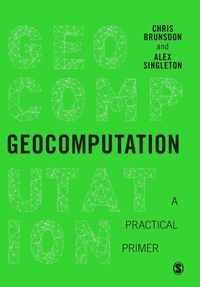
Geocomputation
A Practical Primer
1st Edition
Published on 22. January 2015
Book
Paperback/Softback
392 pages
978-1-4462-7293-0 (ISBN)
Description
Geocomputation is the use of software and computing power to solve complex spatial problems. It is gaining increasing importance in the era of the 'big data' revolution, of 'smart cities', of crowdsourced data, and of associated applications for viewing and managing data geographically - like Google Maps. This student focused book:
Provides a selection of practical examples of geocomputational techniques and 'hot topics' written by world leading practitioners.
Integrates supporting materials in each chapter, such as code and data, enabling readers to work through the examples themselves.
Chapters provide highly applied and practical discussions of:
Visualisation and exploratory spatial data analysis
Space time modelling
Spatial algorithms
Spatial regression and statistics
Enabling interactions through the use of neogeography
All chapters are uniform in design and each includes an introduction, case studies, conclusions - drawing together the generalities of the introduction and specific findings from the case study application - and guidance for further reading.
This accessible text has been specifically designed for those readers who are new to Geocomputation as an area of research, showing how complex real-world problems can be solved through the integration of technology, data, and geocomputational methods. This is the applied primer for Geocomputation in the social sciences.
Provides a selection of practical examples of geocomputational techniques and 'hot topics' written by world leading practitioners.
Integrates supporting materials in each chapter, such as code and data, enabling readers to work through the examples themselves.
Chapters provide highly applied and practical discussions of:
Visualisation and exploratory spatial data analysis
Space time modelling
Spatial algorithms
Spatial regression and statistics
Enabling interactions through the use of neogeography
All chapters are uniform in design and each includes an introduction, case studies, conclusions - drawing together the generalities of the introduction and specific findings from the case study application - and guidance for further reading.
This accessible text has been specifically designed for those readers who are new to Geocomputation as an area of research, showing how complex real-world problems can be solved through the integration of technology, data, and geocomputational methods. This is the applied primer for Geocomputation in the social sciences.
Reviews / Votes
This is a vital primer to what is 'Big' about geocomputation: new data (and lots of them), innovative methods of analysis, new geographic information technologies and, above all, an over-arching rethink of how we represent geography. It provides an important and strategic contribution to contemporary scientific geography and data analytics. -- Paul Longley, Professor of Geographic Information Science Brunsdon and Singleton offer a unique contribution to the zeitgeist of geocomputation. Geocomputation as a ubiquitous and quite novel field, is explored by the authors in a deductive and highly constructive fashion. The authors offer a wide array of applications brought by leading scholars in the field of Geographic Information Science, spatial analysis and spatial modelling. The role of new techniques that are revolutionizing the usage of geocomputation is well explored and the systematic approach the book adopts in envisioning available tools is appropriately constructed. This book is a great contribution for an advancing field, and a much welcomed achievement for the growth of a new kind of spatial science. -- Eric VazMore details
Series
Language
English
Place of publication
London
United Kingdom
Target group
College/higher education
Dimensions
Height: 244 mm
Width: 170 mm
Thickness: 25 mm
Weight
1000 gr
ISBN-13
978-1-4462-7293-0 (9781446272930)
Copyright in bibliographic data and cover images is held by Nielsen Book Services Limited or by the publishers or by their respective licensors: all rights reserved.
Schweitzer Classification
Other editions
Additional editions
Book
01/2015
1st Edition
SAGE Publications Ltd
€231.10
Shipment within 15-20 days
E-Book
01/2015
1st Edition
SAGE Publications Ltd
€110.99
Available for download
E-Book
01/2015
1st Edition
SAGE Publications Ltd
€111.99
Available for download
Persons
Chris Brunsdon is Professor of Geocomputation and Director of the National Centre for Geocomputation at the National University of Ireland, Maynooth, having worked previously in the Universities of Newcastle, Glamorgan, Leicester and Liverpool, variously in departments focusing on both geography and computing. He has interests that span both of these disciplines, including spatial statistics, geographical information science, and exploratory spatial data analysis, and in particular the application of these ideas to crime pattern analysis, the modelling of house prices, medical and health geography and the analysis of land use data. He was one of the originators of the technique of geographically weighted regression (GWR).
He has extensive experience of programming in R, going back to the late 1990s, and has developed a number of R packages which are currently available on CRAN, the Comprehensive R Archive Network. He is an advocate of free and open source software, and in particular the use of reproducible research methods, and has contributed to a large number of workshops on the use of R and of GWR in a number of countries, including the UK, Ireland, Japan, Canada, the USA, the Czech Republic and Australia.
When not involved in academic work he enjoys running, collecting clocks and watches, and cooking - the last of these probably cancelling out the benefits of the first.
Alex Singleton is Professor of Geographic Information Science at the University of Liverpool, where he entered as a lecturer in 2010. He holds a BSc (Hons) Geography from the University of Manchester and a PhD from University College London. To date, his research income totals around GBP15m, with two career highlights including the ESRC funded Consumer Data Research Centre; and the recently awarded ESRC Centre for Doctoral Training in New Forms of Data. Alex's research is embedded within the Geographic Data Science Lab (geographicdatascience.com) and concerns various aspects of urban analytics. In particular, his work has extended a tradition of area classification within Geography where he has developed an empirically informed critique of the ways in which geodemographic methods can be refined for effective yet ethical use in public resource allocation applications.
He has extensive experience of programming in R, going back to the late 1990s, and has developed a number of R packages which are currently available on CRAN, the Comprehensive R Archive Network. He is an advocate of free and open source software, and in particular the use of reproducible research methods, and has contributed to a large number of workshops on the use of R and of GWR in a number of countries, including the UK, Ireland, Japan, Canada, the USA, the Czech Republic and Australia.
When not involved in academic work he enjoys running, collecting clocks and watches, and cooking - the last of these probably cancelling out the benefits of the first.
Alex Singleton is Professor of Geographic Information Science at the University of Liverpool, where he entered as a lecturer in 2010. He holds a BSc (Hons) Geography from the University of Manchester and a PhD from University College London. To date, his research income totals around GBP15m, with two career highlights including the ESRC funded Consumer Data Research Centre; and the recently awarded ESRC Centre for Doctoral Training in New Forms of Data. Alex's research is embedded within the Geographic Data Science Lab (geographicdatascience.com) and concerns various aspects of urban analytics. In particular, his work has extended a tradition of area classification within Geography where he has developed an empirically informed critique of the ways in which geodemographic methods can be refined for effective yet ethical use in public resource allocation applications.
Content
Introduction
Describing how the world looks
Spatial Data Visualisation with R - James Cheshire and Robin Lovelace
Geographical Agents in Three Dimensions - Paul Torrens
Scale, Power Laws, and Rank Size in Spatial Analysis - Michael Batty
Exploring movements in space
Agent-Based Modeling and Geographical Information Systems - Andrew Crooks
Microsimulation Modelling for Social Scientists - Kirk Harland; and Mark Birkin
Spatio-Temporal Knowledge Discovery - Harvey Miller
Circular Statistics - David Rohde and Jonathan Corcoran
Making geographical decisions
Geodemographic Analysis - Alexandros Alexiou and Alexander Singleton
Social Area Analysis and Self Organizing Maps - Seth Spielman and David Folch
Kernel density estimation and Percent Volume Contours - Daniel Lewis
Location-Allocation Models - Melanie Tomintz, Graham Clarke and Nawaf Alfadhli
Explaining how the world works
Geographically Weighted Generalised Linear Modelling - Tomoki Nakaya
Spatial Interaction Models - Karyn Morrissey
Python Spatial Analysis Library (PySAL): An Update And Illustration - Sergio Rey
Reproducible Research: Concepts, Techniques and Issues - Chris Brunsdon and Alex Singleton
Enabling interactions
Using Crowd-Sourced Information to Analyse Changes in the Onset of the North American Spring - Chris Brunsdon and Lex Comber
Open Source GIS software - Oliver O'Brien
Public Participation in Geocomputation to Support Spatial Decision Making - Richard Kingston
Conclusion
References
Describing how the world looks
Spatial Data Visualisation with R - James Cheshire and Robin Lovelace
Geographical Agents in Three Dimensions - Paul Torrens
Scale, Power Laws, and Rank Size in Spatial Analysis - Michael Batty
Exploring movements in space
Agent-Based Modeling and Geographical Information Systems - Andrew Crooks
Microsimulation Modelling for Social Scientists - Kirk Harland; and Mark Birkin
Spatio-Temporal Knowledge Discovery - Harvey Miller
Circular Statistics - David Rohde and Jonathan Corcoran
Making geographical decisions
Geodemographic Analysis - Alexandros Alexiou and Alexander Singleton
Social Area Analysis and Self Organizing Maps - Seth Spielman and David Folch
Kernel density estimation and Percent Volume Contours - Daniel Lewis
Location-Allocation Models - Melanie Tomintz, Graham Clarke and Nawaf Alfadhli
Explaining how the world works
Geographically Weighted Generalised Linear Modelling - Tomoki Nakaya
Spatial Interaction Models - Karyn Morrissey
Python Spatial Analysis Library (PySAL): An Update And Illustration - Sergio Rey
Reproducible Research: Concepts, Techniques and Issues - Chris Brunsdon and Alex Singleton
Enabling interactions
Using Crowd-Sourced Information to Analyse Changes in the Onset of the North American Spring - Chris Brunsdon and Lex Comber
Open Source GIS software - Oliver O'Brien
Public Participation in Geocomputation to Support Spatial Decision Making - Richard Kingston
Conclusion
References