

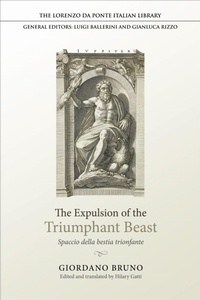
The Expulsion of the Triumphant Beast
Spaccio Della Bestia Trionfante
Published on 6. May 2024
Book
Paperback/Softback
466 pages
978-1-4875-5201-5 (ISBN)
Description
Published in London in 1584, The Expulsion of the Triumphant Beast is Giordano Bruno's first work of moral philosophy. It is dedicated with a long Explicatory Letter to Elizabeth I's most cultured courtier, Sir Philip Sidney. It is a book about moral reform, expelling the beasts of evil, and putting virtues in their place. Its theme is presented as an allegorical drama in which ancient myths assume modern meanings questioning the ways in which moral and religious reform have been conceived in both the ancient world and the cultures of Renaissance Europe.
This new Italian text, based on the original printed text of 1584 held in the British Library, presents a less modernized version than those presently available, while maintaining a modern page format. The aim is to provide a text closer to the sound of Bruno's original mix of classical Tuscan Italian and Neapolitan dialectical forms. This edition also presents a new translation designed to render Bruno's complex and baroque Italian into easily readable modern English.
Hilary Gatti introduces The Expulsion of the Triumphant Beast, underlining Bruno's meta-literary reflection on the nature of allegory and myth as well as the dramatic structure of his text. Drama, philosophy, and religion combine in this work to give an epic dimension to the perennial cosmic battle between evil and good.
This new Italian text, based on the original printed text of 1584 held in the British Library, presents a less modernized version than those presently available, while maintaining a modern page format. The aim is to provide a text closer to the sound of Bruno's original mix of classical Tuscan Italian and Neapolitan dialectical forms. This edition also presents a new translation designed to render Bruno's complex and baroque Italian into easily readable modern English.
Hilary Gatti introduces The Expulsion of the Triumphant Beast, underlining Bruno's meta-literary reflection on the nature of allegory and myth as well as the dramatic structure of his text. Drama, philosophy, and religion combine in this work to give an epic dimension to the perennial cosmic battle between evil and good.
Reviews / Votes
"We have no Empire, such as did the Romans, so powerful that subject cities spontaneously sought to emulate their rulers' speech ... Nonetheless it can clearly be seen how, in our present times, many diverse people of intelligence and refinement, outside Italy no less than within Italy, devote much effort and study to learning and speaking our language for no other reason than love." - Giovan Batista Gelli (Ragionamento sulla lingua, 1551)More details
Series
Language
English
Place of publication
Toronto
Canada
Target group
College/higher education
Professional and scholarly
Product notice
Paperback (trade)
Dimensions
Height: 227 mm
Width: 150 mm
Thickness: 29 mm
Weight
704 gr
ISBN-13
978-1-4875-5201-5 (9781487552015)
Copyright in bibliographic data and cover images is held by Nielsen Book Services Limited or by the publishers or by their respective licensors: all rights reserved.
Schweitzer Classification
Persons
Giordano Bruno (1548-1600), born Filippo Bruno, was an Italian Dominican friar, philosopher, mathematician, poet, and cosmological theorist. He is known for his cosmological theories, which conceptually extended the then-novel Copernican model. In addition to cosmology, Bruno also wrote extensively on the art of memory, a loosely organized group of mnemonic techniques and principles. Other studies of Bruno have focused on his qualitative approach to mathematics and his application of the spatial concepts of geometry to language.
Hilary Gatti is a former associate professor in the Faculty of Letters and Philosophy at the Universita di Roma La Sapienza.
Hilary Gatti is a former associate professor in the Faculty of Letters and Philosophy at the Universita di Roma La Sapienza.
Content
1. Introduction
2. A Note on the Text
3. Epistola esplicatoria (Text)
4. Epistola esplicatoria (Translation)
5. Dialogue 1 (Text)
6. Dialogue 1 (Translation)
7. Dialogue 2 (Text)
8. Dialogue 2 (Translation)
9. Dialogue 3 (Text)
10. Dialogue 3 (Translation)
Bibliography of Cited Works
Index
2. A Note on the Text
3. Epistola esplicatoria (Text)
4. Epistola esplicatoria (Translation)
5. Dialogue 1 (Text)
6. Dialogue 1 (Translation)
7. Dialogue 2 (Text)
8. Dialogue 2 (Translation)
9. Dialogue 3 (Text)
10. Dialogue 3 (Translation)
Bibliography of Cited Works
Index