

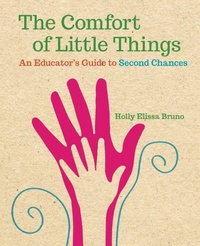
The Comfort of Little Things
Description
The Comfort of Little Things is a thought-provoking book that empowers educators to give themselves and the people in their lives second chances in order for themselves and the children they teach to learn and thrive. This book includes stories from the author and contributors to the author's blog posts.
Educators are among the most loving and nurturing people on earth. Yet those same caring adults are too often very hard on themselves. The Comfort of Little Things provides strategies and tips on how to give yourself a second chance. Drawing on the growing body of brain research along with personal experience and stories from educators, Holly Elissa Bruno fills her book with ideas that will help you see the world with the wonder of a child. You can learn to open yourself to the moment, to look at yourself anew, and to let go of negativity. As she writes, "Second chances come from letting go of what holds us back. These second chances take more work. The work is always rewarded. Fear not."
More details
Other editions
Additional editions
Person
Content
Part I:
The beauty and beast within. Why don't we give ourselves the second chances we give other people? What would it take for us to change?
Chapter 1: Lyra's Story-The teacher whose mistake led to a child's being hurt. When you can't forgive yourself. High stakes of being an educator. Can we fail with children? Consequences of judging ourselves as failures. What children learn by observing how we treat ourselves and others. Insights from Fred Rogers.
Chapter 2: Silly Me: When the drive to perfection kills the chance to grow; Words we use to drive ourselves: (what can we learn from) words we use with children when they fail; words that make an apology real, including to ourselves; replacing harsh words with soothing phrases like "Silly Me".
Chapter 3: Our brain on second chances: the beauty and the beast: Our internal systems crave predictability. Changing is a threat. Threats trigger knee-jerk, unthinking reactions. The amygdala is a harsh enforcer of consistency. That's the beast. The beauty is in the Executive Function, the imaginative, problem-solving, generous, humorous part of our brain that frees us through perspective: offers us meaning and the chance to be open.
Part II:
Opening ourselves to second chances. Stepping out of the grip of the amygdala. Stepping up to seeing our world anew
Chapter 4: Notice where you are. The art of claiming moments to see the gifts at your doorstep. The practice of noticing. Nature's model for second chances. Nature's continuous and endless gift of second chances.
Chapter 5: Notice how we are: Breaking the grip of judgment: Resetting brain pathways to notice how we are. Changing the repeated judgement with insistent encouragement.
Chapter 6: Notice life on life's terms. See though the eyes of a child. The salve of beauty. Soothing of integrity. Brilliance of honesty. Comfort of little things.
Part III:
Tools for staying open and creating a culture of second chances
Chapter 7: What do you do when the door is slammed in your face? Personality conflicts at work. Seemingly impossible parents. Acknowledging what pushes your buttons and using strategies to stay open.
Chapter 8: Paying it forward. Passing it on. The spirituality of second chances. "When we are in the presence of a spiritual being, we become spiritual". Mirror neurons and the beat of a heart: The neuroscience of compassion.
Chapter 9: Workplace second chances. What is within and beyond your control? Taking the action you can take, as a peer, as a supervisor, as a supervisee. Addressing "stuck" places. Courage to face discomfort of confronting underlying issues. Modeling second chances in unexpected places. (Creating a culture of second chances)
Chapter 10: Meeting up along the way. Finding, giving and taking second chances as a way of life. Staying open to seeing beyond your classroom, your building, your job, even our profession for new ways to see. Setting your course for renewal. Unexpected fellow travelers. Looking back on what you have learned.