

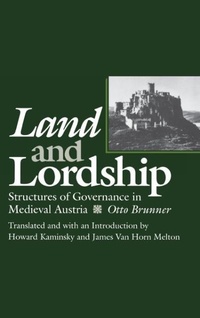
Land and Lordship
Structures of Governance in Medieval Austria
Published on 29. April 1992
Book
Hardback
498 pages
978-0-8122-8183-5 (ISBN)
Description
Otto Brunner contends that prevailing notions of medieval social and constitutional history had been shaped by the nineteenth-century nation state and its "liberal" order. Whereas a sharp distinction between the public and the private might be appropriate to descriptions of contemporary society, such a dichotomy could not be projected back onto the Middle Ages. Focusing particularly on forms of lordship in late medieval Austria, Brunner found neither a "state" in the modern sense nor any distinction between the public and private spheres.
Behind the apparent disorder of late medieval political life, however, Brunner discovered a coherent legal and constitutional order rooted in the the rights and obligations of noble lordship. In carefully reconstructing this order, Brunner's study weaves together social, legal, constitutional, and intellectual history.
Behind the apparent disorder of late medieval political life, however, Brunner discovered a coherent legal and constitutional order rooted in the the rights and obligations of noble lordship. In carefully reconstructing this order, Brunner's study weaves together social, legal, constitutional, and intellectual history.
More details
Series
Language
English
Place of publication
Pennsylvania
United States
Target group
College/higher education
Professional and scholarly
Product notice
Paper over boards
Dimensions
Height: 234 mm
Width: 155 mm
Thickness: 31 mm
Weight
806 gr
ISBN-13
978-0-8122-8183-5 (9780812281835)
Copyright in bibliographic data and cover images is held by Nielsen Book Services Limited or by the publishers or by their respective licensors: all rights reserved.
Schweitzer Classification
Other editions
Additional editions
E-Book
07/2015
1st Edition
University of Pennsylvania Press
€196.99
Available for download