

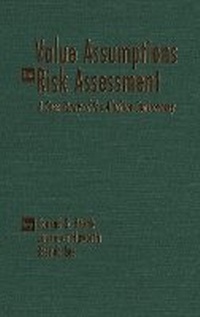
Value Assumptions in Risk Assessment
A Case Study of the Alachlor Controversy
Will be published approx. on 30. August 1991
Book
Hardback
166 pages
978-0-88920-200-9 (ISBN)
Description
Selected by Choice as one of the outstanding publications for 1991. Are risk debates disputes between those who accept the findings of science and those who do not? Between good and bad science? Or is it possible that opposing assessments of risk, by scientific experts as well as ordinary citizens, reflect and are guided by dominant values held by the assessors? The following analysis of one of these debates supports the latter view. In it we suggest what those dominant values are, how they work within a risk assessment, and some implications of reconceiving risk debates as primarily debates about values.
Reviews / Votes
"Any of us who have been involved in decision-making processes that involve risk assessment will immediately recognize the similarities between this example and our own experiences. It is very valuable to have this illuminating case study so thoroughly presented to us." -- John Jackson -- Alternatives, Vol. 19, No. 2, 1993 "Highly recommended for college and university libraries, and for technology-based entrepreneurs and their regulators." -- T.R. Blackburn, American Chemical Society -- Choice, 19920301More details
Language
English
Place of publication
Waterloo, Ontario
Canada
Target group
College/higher education
Dimensions
Height: 229 mm
Width: 152 mm
Thickness: 5715 mm
Weight
430 gr
ISBN-13
978-0-88920-200-9 (9780889202009)
Copyright in bibliographic data and cover images is held by Nielsen Book Services Limited or by the publishers or by their respective licensors: all rights reserved.
Schweitzer Classification
Persons
Conrad Brunk is professor of philosophy and former director of the Centre for Studies in Religion and Society at the University of Victoria (UVic). Dr. Brunk is a regular consultant to the Canadian government and international organizations on environmental and health risk management and biotechnology and is the author of numerous articles in journals and books on ethical issues in technology, the environment, law, and professional practice. Lawrence Haworth is a professor of philosophy at the University of Waterloo and a fellow of the Royal Society of Canada; he also holds the title of Distinguished Professor Emeritus. Articles of his have appeared in Dialogue, Philosophy of Science, American Philosophical Quarterly, Ethics, Canadian Journal of Philosophy, Harvard Business Review, American Institute of Planners Journal, Educational Theory, Leisure Studies, Environments, and Plan Canada, among others. He has contributed chapters to a number of books, including The Inner Citadel, The Possibility of Aesthetic Experience, Power, Poverty, and Urban Policy, Social Ethics, Urban Problems, and Concepts in Social and Political Philosophy. He is the author of Autonomy (1986), The Good City (1963), and Decadence and Objectivity (1977). Brenda Lee graduated with honors from Barnes Business Collage in Denver, Colorado. She is an active member of the Foothills Writers' group in Colorado. Brenda also produces and edits an internationally distributed monthly newsletter to help former cult members take flight. Today she joyfully embraces every moment with her son and two dogs, relishing her life out of the cocoon.
Content
Table of Contents for Value Assumptions in Risk Assessment: A Case Study of the Alachlor Controversy, by Conrad G. Brunk, Lawrence Haworth, and Brenda Lee Acknowledgements Introduction: Risk Assessment as Regulatory Science I. The Alachlor Controversy II. An Alternative Model of Risk Assessment III. The Arguments of the Government and Monsanto IV. The Alachlor Review Board's Estimation of Alachlor's Risks V. The Role of Values in Choice of a Risk-Benefit Standard VI. Value Frameworks in Risk Analysis Glossary Notes