

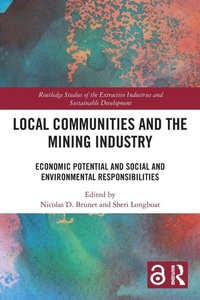
Local Communities and the Mining Industry
Economic Potential and Social and Environmental Responsibilities
1st Edition
Published on 4. October 2024
Book
Paperback/Softback
186 pages
978-1-032-02215-4 (ISBN)
Description
This book explores the challenges and opportunities at the intersection of the global mining sector and local communities by focusing on a number of international cases drawn from various locations in Canada, the Philippines, and Scandinavia.
Mining's contribution to economic development varies greatly across countries. In some, it has been a major engine of development, but in others, disputes have erupted over land use, property rights, environmental damage, and revenue sharing. Corporate social responsibility programs are increasingly relied upon to manage company-community relations, yet conflicts persist in many settings, with significant costs for companies and communities. Exploring the many factors and drivers that characterize relationships among different actors within the sector, the volume contributes towards the development of practical wisdom, collective understanding, common sense, and prudence required for the mining sector and community partners to realize the economic potential and social and environmental responsibilities of non-renewable resource development. The book examines case studies from Canada, Scandinavia, and the Philippines, three regions amongst the world's top countries of mining operations. Drawing on their extensive experience in these regions, the contributors explore distinctive mining sectors in the Global North and South, the variation surrounding different types of extractive industries, and at different scales, and the legal processes in place to protect local communities. Key themes include corporate social responsibility, impact assessment, foreign ownership, Indigenous Peoples, gender, local insurgency, and mining disasters as well as climate change. The book identifies areas of future research and pathways to achieving stronger, respectful, and mutually beneficial relationships at the nexus of global mineral extraction and local communities.
This book will be of great interest to students and scholars of the extractive industries, natural resource management, sustainable business and corporate social responsibility, Indigenous studies, and sustainable planning and development.
The Open Access version of this book, available at www.taylorfrancis.com, has been made available under a Creative Commons [Attribution-Non Commercial-No Derivatives (CC-BY-NC-ND)] 4.0 license.
Mining's contribution to economic development varies greatly across countries. In some, it has been a major engine of development, but in others, disputes have erupted over land use, property rights, environmental damage, and revenue sharing. Corporate social responsibility programs are increasingly relied upon to manage company-community relations, yet conflicts persist in many settings, with significant costs for companies and communities. Exploring the many factors and drivers that characterize relationships among different actors within the sector, the volume contributes towards the development of practical wisdom, collective understanding, common sense, and prudence required for the mining sector and community partners to realize the economic potential and social and environmental responsibilities of non-renewable resource development. The book examines case studies from Canada, Scandinavia, and the Philippines, three regions amongst the world's top countries of mining operations. Drawing on their extensive experience in these regions, the contributors explore distinctive mining sectors in the Global North and South, the variation surrounding different types of extractive industries, and at different scales, and the legal processes in place to protect local communities. Key themes include corporate social responsibility, impact assessment, foreign ownership, Indigenous Peoples, gender, local insurgency, and mining disasters as well as climate change. The book identifies areas of future research and pathways to achieving stronger, respectful, and mutually beneficial relationships at the nexus of global mineral extraction and local communities.
This book will be of great interest to students and scholars of the extractive industries, natural resource management, sustainable business and corporate social responsibility, Indigenous studies, and sustainable planning and development.
The Open Access version of this book, available at www.taylorfrancis.com, has been made available under a Creative Commons [Attribution-Non Commercial-No Derivatives (CC-BY-NC-ND)] 4.0 license.
More details
Series
Language
English
Place of publication
London
United Kingdom
Publishing group
Taylor & Francis Ltd
Target group
College/higher education
Professional and scholarly
Academic, Postgraduate, Professional Reference, and Undergraduate Advanced
Illustrations
6 s/w Abbildungen, 2 s/w Photographien bzw. Rasterbilder, 4 s/w Zeichnungen, 4 s/w Tabellen
4 Tables, black and white; 4 Line drawings, black and white; 2 Halftones, black and white; 6 Illustrations, black and white
Dimensions
Height: 234 mm
Width: 156 mm
Thickness: 11 mm
Weight
324 gr
ISBN-13
978-1-032-02215-4 (9781032022154)
Copyright in bibliographic data and cover images is held by Nielsen Book Services Limited or by the publishers or by their respective licensors: all rights reserved.
Schweitzer Classification
Other editions
Additional editions
Nicolas D. Brunet | Sheri Longboat
Local Communities and the Mining Industry
Economic Potential and Social and Environmental Responsibilities
Book
04/2023
1st Edition
Routledge
€185.90
Shipment within 10-20 days
Nicolas D. Brunet | Sheri Longboat
Local Communities and the Mining Industry
Economic Potential and Social and Environmental Responsibilities
E-Book
04/2023
Routledge
€0.00
Available for download
Nicolas D. Brunet | Sheri Longboat
Local Communities and the Mining Industry
Economic Potential and Social and Environmental Responsibilities
E-Book
04/2023
Routledge
€0.00
Available for download
Persons
Nicolas D. Brunet is an Associate Professor in the School of Environmental Design and Rural Development at the University of Guelph, Canada, where he holds the Latornell Professorship in Environmental Stewardship.
Sheri Longboat (Mohawk) Six Nations of the Grand River, is an Associate Professor in the School of Environmental Design and Rural Development at the University of Guelph, Canada.
Sheri Longboat (Mohawk) Six Nations of the Grand River, is an Associate Professor in the School of Environmental Design and Rural Development at the University of Guelph, Canada.
Content
Introduction: Mine-Community Relations in the Global North and South PART 1: Global Reviews 1 CSR, SLO, and Local Mining Communities 2 Applying Corporate Social Responsibilities: IBAs and Mining within the Traditional Territories of Indigenous Peoples 3 Digging for Accountability in Canada: Structural Power Inequalities in the Global South Mining Industry 4 Gender, Indigeneity and Mining PART 2: Local Cases 5 Corporate Social Responsibility, Indigenous Peoples and Mining in Scandinavia 6 After the Mine Has Left: The Case of Maricalum Mining Corp. 7 Indigenous People and the Uranium Mining Sector in Northern Saskatchewan 8 Mining, Climate Change and Indigenous Peoples in Ontario, Canada: Intersecting Impacts and the Role of Corporate Social Responsibility