

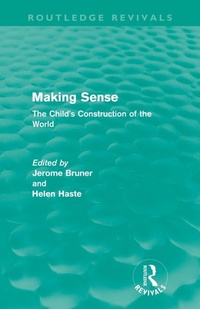
Making Sense (Routledge Revivals)
The Child's Construction of the World
1st Edition
Published on 29. August 2011
Book
Paperback/Softback
204 pages
978-0-415-61503-7 (ISBN)
Description
The growing child comes to understand the world, makes sense of experience and becomes a competent social individual. First published in 1978, Making Sense reflected the way in which developmental psychologists had begun to look at these processes in increasingly naturalistic, social situations. Rather than seeing the child as working in isolation, the authors of this collection take the view that 'making sense' involves social interaction and problem-solving. They particularly emphasize the role of language; its study both reveals the child's grasp of the frames of meaning in a particular culture, and demonstrates the subtleties of concept development and role-taking.
More details
Series
Language
English
Place of publication
London
United Kingdom
Publishing group
Taylor & Francis Ltd
Target group
College/higher education
Dimensions
Height: 216 mm
Width: 140 mm
Thickness: 12 mm
Weight
281 gr
ISBN-13
978-0-415-61503-7 (9780415615037)
Copyright in bibliographic data and cover images is held by Nielsen Book Services Limited or by the publishers or by their respective licensors: all rights reserved.
Schweitzer Classification
Other editions
Additional editions
Jerome S. Bruner | Helen Haste
Making Sense (Routledge Revivals)
The Child's Construction of the World
Book
10/2010
1st Edition
Routledge
€205.90
Shipment within 15-20 days
Jerome S. Bruner | Helen Haste
Making Sense (Routledge Revivals)
The Child's Construction of the World
E-Book
10/2010
Routledge
€73.49
Available for download
Jerome S. Bruner | Helen Haste
Making Sense (Routledge Revivals)
The Child's Construction of the World
E-Book
10/2010
Routledge
€73.99
Available for download
Persons
Content
1. Understanding Feelings: The Early Stages 2. Taking Roles 3. Some Benefits of Egocentrism 4. The Transactional Self 5. The Origins of Inference 6. The Early Emergence of Planning Skills in Children 7. Thought from Language: The Linguistic Construction of Cognitive Representations