

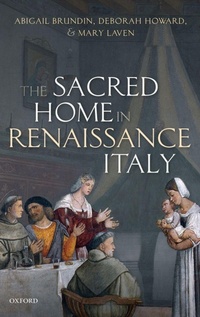
The Sacred Home in Renaissance Italy
Published on 19. July 2018
Book
Hardback
432 pages
978-0-19-881655-3 (ISBN)
Description
The Sacred Home in Renaissance Italy explores the rich devotional life of the Italian household between 1450 and 1600. Rejecting the enduring stereotype of the Renaissance as a secular age, this interdisciplinary study reveals the home to have been an important site of spiritual revitalization. Books, buildings, objects, spaces, images, and archival sources are scrutinized to cast new light on the many ways in which religion infused daily life within the household. Acts of devotion, from routine prayers to extraordinary religious experiences such as miracles and visions, frequently took place at home amid the joys and trials of domestic life -- from childbirth and marriage to sickness and death.
Breaking free from the usual focus on Venice, Florence, and Rome, The Sacred Home investigates practices of piety across the Italian peninsula, with particular attention paid to the city of Naples, the Marche, and the Venetian mainland. It also looks beyond the elite to consider artisanal and lower-status households, and reveals gender and age as factors that powerfully conditioned religious experience. Recovering a host of lost voices and compelling narratives at the intersection between the divine and the everyday, The Sacred Home offers unprecedented glimpses through the keyhole into the spiritual lives of Renaissance Italians.
Breaking free from the usual focus on Venice, Florence, and Rome, The Sacred Home investigates practices of piety across the Italian peninsula, with particular attention paid to the city of Naples, the Marche, and the Venetian mainland. It also looks beyond the elite to consider artisanal and lower-status households, and reveals gender and age as factors that powerfully conditioned religious experience. Recovering a host of lost voices and compelling narratives at the intersection between the divine and the everyday, The Sacred Home offers unprecedented glimpses through the keyhole into the spiritual lives of Renaissance Italians.
Reviews / Votes
The Sacred Home in Renaissance Italy articulates the thesis of a "domestication" of lay devotion with panache and will surely remain an indispensable guide. It will fall to future scholarship to integrate its insights more fully with the social and institutional contexts that conditioned domestic religion. In the end, the term "Renaissance religion" may be too limited or imprecise to capture the complexities of an era of cultural conflict and political transformation. * Wietse de Boer, Journal of Modern History * This study is both enlightening and encouraging in its use of familiar and unfamiliar resources, and shows how to draw compelling conclusions from difficult questions. * Jennifer Mara Desilva, Ball State University, Comptes Rendus * The amount of material in the book is astonishing ... Brundin, Howard and Laven consciously seek to compensate for long-standing blind spots in Italian Renaissance scholarship. They investigate rural as well as urban areas, indigents as well as elites, local artists from foreign backgrounds, men as well as women (especially important in a book about domestic life) ... The grat power of material objects lies in their capacity to encompass multiple uses and meanings, to cross boundaries, to embrace contradictions. The book shines most when it draws these out. * Emily Michelson, Times Higher Education Supplement * This is an impressive book, the product of a substantial research project conducted by a team of scholars, and it demonstrates the value of collaborative work in fields that do not often undertake it. By combining their and their postdoctoral fellows' research expertise in Italian literature, art history, and history, and linguistic skills in several Italian dialects, they have created a wide-ranging study of domestic devotion in the Venetian terrafirma, the Marche, and Naples. * Celeste McNamara, The Catholic Historical Review *More details
Language
English
Place of publication
Oxford
United Kingdom
Target group
Adult education
Illustrations
more than 200 black and white images
Dimensions
Height: 240 mm
Width: 161 mm
Thickness: 32 mm
Weight
1126 gr
ISBN-13
978-0-19-881655-3 (9780198816553)
Copyright in bibliographic data and cover images is held by Nielsen Book Services Limited or by the publishers or by their respective licensors: all rights reserved.
Schweitzer Classification
Other editions
Additional editions
Abigail Brundin | Deborah Howard | Mary Laven
The Sacred Home in Renaissance Italy
E-Book
07/2018
1st Edition
OUP eBook
€26.99
Available for download
Abigail Brundin | Deborah Howard | Mary Laven
The Sacred Home in Renaissance Italy
E-Book
07/2018
1st Edition
OUP eBook
€26.99
Available for download
Persons
Abigail Brundin specializes in the literature and culture of Renaissance and Early Modern Italy. She has written on many aspects of the period, from female convents to the Grand Tour, and is above all known for her work on the poet Vittoria Colonna, as the translator of the Sonnets for Michelangelo (2005) and author of Vittoria Colonna and the Spiritual Poetics of the Italian Reformation (2008). A Fellow of St Catharine's College, she has taught at the University of Cambridge since 2002 and is currently chair of the Faculty of Modern and Medieval Languages.
Deborah Howard is an architectural historian whose principal research interests revolve around the art and architecture of Venice and the Veneto, seen from an interdisciplinary perspective. Her books include Venice & the East (2000), Sound & Space in Renaissance Venice (2009, with L. Moretti) and Venice Disputed (2013). She is a Professor Emerita at the University of Cambridge, and a Fellow of St John's College. She was elected to the British Academy in 2010.
Mary Laven has published widely on the social and cultural history of religion. She is the author of Virgins of Venice: Enclosed Lives and Broken Vows in the Renaissance Convent (2002) and Mission to China: Matteo Ricci and the Jesuit Encounter with the East (2011). More recently, her attention has turned to material culture and she has been involved in two major exhibition projects at the Fitzwilliam Museum. She is Professor of Early Modern History at the University of Cambridge and a Fellow of Jesus College.
Deborah Howard is an architectural historian whose principal research interests revolve around the art and architecture of Venice and the Veneto, seen from an interdisciplinary perspective. Her books include Venice & the East (2000), Sound & Space in Renaissance Venice (2009, with L. Moretti) and Venice Disputed (2013). She is a Professor Emerita at the University of Cambridge, and a Fellow of St John's College. She was elected to the British Academy in 2010.
Mary Laven has published widely on the social and cultural history of religion. She is the author of Virgins of Venice: Enclosed Lives and Broken Vows in the Renaissance Convent (2002) and Mission to China: Matteo Ricci and the Jesuit Encounter with the East (2011). More recently, her attention has turned to material culture and she has been involved in two major exhibition projects at the Fitzwilliam Museum. She is Professor of Early Modern History at the University of Cambridge and a Fellow of Jesus College.
Author
Reader in Early Modern Literature and CultureReader in Early Modern Literature and Culture, Faculty of Modern and Medieval Languages, University of Cambridge
Professor Emerita of Architectural HistoryProfessor Emerita of Architectural History, University of Cambridge
Professor of Early Modern HistoryProfessor of Early Modern History, University of Cambridge
Content
Introduction
1: Regional perspectives
2: House and home
3: Prayer and meditation
4: Sacred Stuff
5: Reading at home
6: The Devotional Eye
7: Printing and Piety
8: Miracles
9: Thresholds
Conclusion
1: Regional perspectives
2: House and home
3: Prayer and meditation
4: Sacred Stuff
5: Reading at home
6: The Devotional Eye
7: Printing and Piety
8: Miracles
9: Thresholds
Conclusion