

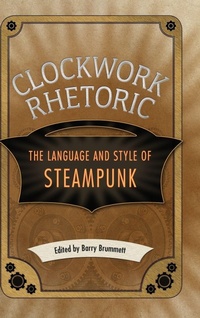
Clockwork Rhetoric
The Language and Style of Steampunk
Published on 2. September 2014
Book
Hardback
210 pages
978-1-62846-091-9 (ISBN)
Description
This unique book explores how the aesthetic and cultural movement ""Steampunk"" persuades audiences and wins new acolytes. Steampunk is an aesthetic style grounded in the Victorian era, in clothing and accoutrements modeled on a heightened and hyper-extended age of steam. In addition to its modeling of attire and other symbolic trappings, what is most distinctive is its adherents' use of a machined aesthetic based on steam engines and early electrical machinery: gears, pistons, shafts, wheels, induction motors, clockwork and so forth.
The aesthetic was first articulated in literature in the works of Jules Verne and H. G. Wells. The American West later contributed images to the aesthetic--revolvers, locomotives, and rifles of the late nineteenth century. Among young people steampunk has found common aesthetic cause with Goth style. Examples from literature and popular culture include William Gibson's fiction, China Mieville's novels, the classic film Metropolis, and the BBC series Doctor Who. This volume recognizes that steampunk, a unique popular culture phenomenon, presents a prime opportunity for rhetorical criticism.
Steampunk's art, style, and narratives convey complex social and political meanings. Chapters in Clockwork Rhetoric explore topics ranging from jewelry to Japanese anime to contemporary imperialism to fashion. Throughout, the book demonstrates how language influences consumers of steampunk to hold certain social and political attitudes and commitments.
The aesthetic was first articulated in literature in the works of Jules Verne and H. G. Wells. The American West later contributed images to the aesthetic--revolvers, locomotives, and rifles of the late nineteenth century. Among young people steampunk has found common aesthetic cause with Goth style. Examples from literature and popular culture include William Gibson's fiction, China Mieville's novels, the classic film Metropolis, and the BBC series Doctor Who. This volume recognizes that steampunk, a unique popular culture phenomenon, presents a prime opportunity for rhetorical criticism.
Steampunk's art, style, and narratives convey complex social and political meanings. Chapters in Clockwork Rhetoric explore topics ranging from jewelry to Japanese anime to contemporary imperialism to fashion. Throughout, the book demonstrates how language influences consumers of steampunk to hold certain social and political attitudes and commitments.
More details
Language
English
Place of publication
Jackson
United States
Illustrations
4 - 4 black & white illustrations
Dimensions
Height: 235 mm
Width: 157 mm
Thickness: 19 mm
Weight
552 gr
ISBN-13
978-1-62846-091-9 (9781628460919)
Copyright in bibliographic data and cover images is held by Nielsen Book Services Limited or by the publishers or by their respective licensors: all rights reserved.
Schweitzer Classification
Other editions
Additional editions
E-Book
09/2014
NYU Press
€29.49
Available for download
Person
Barry Brummett, Austin, Texas, is Charles Sapp Centennial Professor in Communication and Chair of the Department of Communication Studies at the University of Texas at Austin. He is the author of A Rhetoric of Style and Rhetorical Homologies: Form, Culture, Experience.