

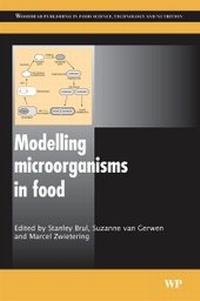
Modelling Microorganisms in Food
Published on 12. March 2007
Book
Hardback
320 pages
978-1-84569-006-9 (ISBN)
Description
Predicting the growth and behaviour of microorganisms in food has long been an aim in food microbiology research. In recent years, microbial models have evolved to become more exact and the discipline of quantitative microbial ecology has gained increasing importance for food safety management, particularly as minimal processing techniques have become more widely used. These processing methods operate closer to microbial death, survival and growth boundaries and therefore require even more precise models. Written by a team of leading experts in the field, Modelling microorganims in food assesses the latest developments and provides an outlook for the future of microbial modelling.
Part one discusses general issues involved in building models of microbial growth and inactivation in foods, with chapters on the historical background of the field, experimental design, data processing and model fitting, the problem of uncertainty and variability in models and modelling lag-time. Further chapters review the use of quantitative microbiology tools in predictive microbiology and the use of predictive microbiology in risk assessment.
The second part of the book focuses on new approaches in specific areas of microbial modelling, with chapters discussing the implications of microbial variability in predictive modelling and the importance of taking into account microbial interactions in foods. Predicting microbial inactivation under high pressure and the use of mechanistic models are also covered. The final chapters outline the possibility of incorporating systems biology approaches into food microbiology.
Modelling microorganisms in food is a standard reference for all those in the field of food microbiology.
Part one discusses general issues involved in building models of microbial growth and inactivation in foods, with chapters on the historical background of the field, experimental design, data processing and model fitting, the problem of uncertainty and variability in models and modelling lag-time. Further chapters review the use of quantitative microbiology tools in predictive microbiology and the use of predictive microbiology in risk assessment.
The second part of the book focuses on new approaches in specific areas of microbial modelling, with chapters discussing the implications of microbial variability in predictive modelling and the importance of taking into account microbial interactions in foods. Predicting microbial inactivation under high pressure and the use of mechanistic models are also covered. The final chapters outline the possibility of incorporating systems biology approaches into food microbiology.
Modelling microorganisms in food is a standard reference for all those in the field of food microbiology.
Reviews / Votes
"Modelling microorganisms in food will be a standard reference for all those craving for a sound knowledge in the field of food (predictive) microbiology." --Journal of Food and Nutrition ResearchMore details
Series
Language
English
Place of publication
Cambridge
United Kingdom
Publishing group
Elsevier Science & Technology
Target group
College/higher education
Professional and scholarly
Dimensions
Height: 234 mm
Width: 156 mm
Weight
600 gr
ISBN-13
978-1-84569-006-9 (9781845690069)
Copyright in bibliographic data and cover images is held by Nielsen Book Services Limited or by the publishers or by their respective licensors: all rights reserved.
Schweitzer Classification
Other editions
Additional editions
Stanley Brul | Suzanne van Gerwen | Marcel Zwietering
Modelling Microorganisms in Food
E-Book
03/2007
Woodhead Publishing
€195.00
Available for download
Persons
Stanley Brul is Professor of Molecular Biology at the University of Amsterdam. Dr Suzanne van Gerwen works for Unilever Foods in The Netherlands. Professor Marcel Zwietering teaches Food Microbiology at the highly regarded University of Wageningen, The Netherlands.
Content
Part 1 Building models for predictive microbiology: Predictive microbiology: Past, present and future; Experimental design, data processing and model fitting in predictive microbiology; Uncertainty and variability in predictive models of microorganisms in food; Modelling lag-time in predictive microbiology with special reference to the lag phase of bacterial spores; Application of models and other quantitative microbiology tools in predictive microbiology; Predictive models in food risk assessment. Part 2 New approaches to microbial modelling in specific areas of predictive microbiology: The non-linear kinetics of microbial inactivation and growth in foods; Modelling of high pressure inactivation of microorganisms in foods; Mechanistic models of microbial inactivation behaviour in foods; Modelling microbial interactions in foods; A kinetic model as a tool to understand the response of saccharomyces cerevisiae to heat exposure; Systems biology and food science.