

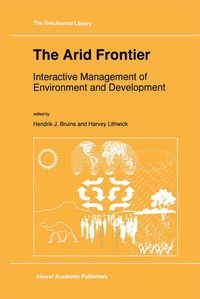
The Arid Frontier
Interactive Management of Environment and Development
Published on 16. October 2012
Book
Paperback/Softback
XI, 385 pages
978-94-010-6049-3 (ISBN)
Description
The arid frontier has been a challenge for humanity from time immemorial. Drylands cover more than one-third of the global land surface, distributed over Africa, Asia, Australia, America and Southern Europe. Disasters may develop as a result of complex interactions between drought, desertification and society. Therefore, proactive planning and interactive management, including disaster-coping strategies, are essential in dealing with arid-frontier development.
This book presents a conceptual framework with case studies in dryland development and management. The option of a rational and ethical discourse for development that is beneficial for both the environment and society is emphasized, avoiding extreme environmentalism and human destructionism, combating both desertification and human livelihood insecurity. Such development has to be based on appropriate ethics, legislation, policy, proactive planning and interactive management. Excellent scholars address theseissues, focusing on the principal interactions between people and dryland environments in terms of drought, food, land, water, renewable energy and housing.
Audience: This volume will be of great value to all those interested in Dryland Development and Management: professionals and policy-makers in governmental, international and non-governmental organizations (NGOs), as well as researchers, lecturers and students in Geography, Environmental Management, Regional Studies, Development Anthropology, Hazard and Disaster Management, Agriculture and Pastoralism, Land and Water Use, African Studies, and Renewable Energy Resources.
This book presents a conceptual framework with case studies in dryland development and management. The option of a rational and ethical discourse for development that is beneficial for both the environment and society is emphasized, avoiding extreme environmentalism and human destructionism, combating both desertification and human livelihood insecurity. Such development has to be based on appropriate ethics, legislation, policy, proactive planning and interactive management. Excellent scholars address theseissues, focusing on the principal interactions between people and dryland environments in terms of drought, food, land, water, renewable energy and housing.
Audience: This volume will be of great value to all those interested in Dryland Development and Management: professionals and policy-makers in governmental, international and non-governmental organizations (NGOs), as well as researchers, lecturers and students in Geography, Environmental Management, Regional Studies, Development Anthropology, Hazard and Disaster Management, Agriculture and Pastoralism, Land and Water Use, African Studies, and Renewable Energy Resources.
More details
Series
Edition
Softcover reprint of the original 1st ed. 1998
Language
English
Place of publication
Dordrecht
Netherlands
Target group
Professional and scholarly
Research
Illustrations
XI, 385 p.
Dimensions
Height: 240 mm
Width: 160 mm
Thickness: 22 mm
Weight
637 gr
ISBN-13
978-94-010-6049-3 (9789401060493)
DOI
10.1007/978-94-011-4888-7
Schweitzer Classification
Other editions
Additional editions
Hendrik J. Bruins | Harvey Lithwick
The Arid Frontier
Interactive Management of Environment and Development
E-Book
12/2012
Springer
€149.79
Available for download
Hendrik J. Bruins | Harvey Lithwick
The Arid Frontier
Interactive Management of Environment and Development
Book
12/1997
Kluwer Academic Publishers
€160.49
Shipment within 15-20 days
Content
One: A Management Approach to Environment and Development.- 1. Proactive Planning and Interactive Management in Arid Frontier Development.- Two: Environmental Policy, Planning and Management: National, Regional and Multinational Dimensions.- 2. Drought Planning in the United States: Status and Future Directions.- 3. Interregional Environmental Policy in Australia's Murray-Darling Basin.- 4. Environmental Law and Management in the Gulf of Aqaba.- Three: Desertification and Climatic Variability in Arid Environments.- 5. Bioclimatic Aridity, Climatic Variability, Drought and Desertification: Definitions and Management Options.- 6. Environmental Science and Desertification at the Arid Frontier.- 7. Human-made Desertification in the Aral Sea Basin: Planning and Management Failures.- 8. Drought Risk Assessment for Dryland Agriculture in Semi-arid Telengana, Andhra Pradesh, India.- Four: Drought, Food and Land Management in Africa.- 9. Traditional Management of Drought and Famine in Kenya.- 10. Land Tenure Frontiers and Food Security among Maasai Pastoralists in Kenya.- 11. Gestion de Terroir at the Frontier: Village Land Management of Peasants and Pastoralists in Benin.- 12. Wild Plants as Food Security in Namibia and Senegal.- Five: Management of Water Resources.- 13. Irrigation Development: Proactive Planning and Interactive Management.- 14. Drought and Water Management in California.- 15. Cost-Benefit Analysis of Water Management Mega-Projects in India and China.- Six: Renewable Energy for Development of Arid Lands.- 16. Solar Energy in Arid Frontiers: Designing a Photovoltaic Power Plant for Kibbutz Samar, Israel.- 17. Rural Electrification with Renewable Energy: Geothermal Power in Arid Regions.- 18. The Fuelwood Crisis in Arid Zones: Runoff Agriculture for Renewable Energy Production.- 19. Lightweight Housing in Arid Zones: Thermal Comfort and Energy Use.