

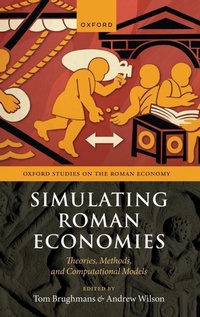
Simulating Roman Economies
Theories, Methods, and Computational Models
Published on 14. September 2022
Book
Hardback
356 pages
978-0-19-285782-8 (ISBN)
Description
The use of formal modelling and computational simulation in studies of the Roman economy has become more common over the last decade. But detailed critical evaluations of this innovative approach are still missing and much needed. What kinds of insights about the Roman economy can it lead to that could not have been obtained through more established approaches, and how do simulation methods constructively enhance research processes in Roman Studies?
This edited volume addresses this need through critical discussion and convincing examples. It presents the Roman economy as a highly complex system, traditionally studied through critical examinations of material and textual sources, and understood through a wealth of diverging theories. A key contribution of simulation lies in its ability to formally represent diverse theories of Roman economic phenomena, and test them against empirical evidence. Critical simulation studies rely on collaboration across Roman data, theory, and method specialisms, and can constructively enhance multivocality of theoretical debates of the Roman economy. This potential is illustrated, avoiding computational and mathematical language, through simulation studies of a wealth of Roman economic phenomena: from maritime trade and terrestrial transport infrastructures, through the economic impacts of the Antonine Plague and demography, to local cult economies and grain trade.
Through these examples and discussions, this volume aims to provide the common ground, guidance, and inspiration needed to make simulation methods part of the tools of the trade in Roman Studies, and to allow them to make constructive contributions to our understanding of the Roman economy.
This edited volume addresses this need through critical discussion and convincing examples. It presents the Roman economy as a highly complex system, traditionally studied through critical examinations of material and textual sources, and understood through a wealth of diverging theories. A key contribution of simulation lies in its ability to formally represent diverse theories of Roman economic phenomena, and test them against empirical evidence. Critical simulation studies rely on collaboration across Roman data, theory, and method specialisms, and can constructively enhance multivocality of theoretical debates of the Roman economy. This potential is illustrated, avoiding computational and mathematical language, through simulation studies of a wealth of Roman economic phenomena: from maritime trade and terrestrial transport infrastructures, through the economic impacts of the Antonine Plague and demography, to local cult economies and grain trade.
Through these examples and discussions, this volume aims to provide the common ground, guidance, and inspiration needed to make simulation methods part of the tools of the trade in Roman Studies, and to allow them to make constructive contributions to our understanding of the Roman economy.
Reviews / Votes
This is the eighteenth volume in the series "Oxford Studies on the Roman Economy" that Alan Bowman and Andrew Wilson launched in 2009, and arguably the most innovative to date. It sends a strong message that computational modeling has now sufficiently matured to make a substantial contribution to our understanding of Roman economic history, and even more importantly to our understanding of how to study that history. * Walter Scheidel, Stanford University * The present volume serves as a guide for those scholars (present and future) who aim to reunite the field. * Bart Danon, Groningen University, JRS * It should be emphasised that the volume is a valuable entry in the debate on Roman economic performance. It offers ample ground and inspiration for future research in Roman economic history and ancient history in general, demonstrating the potential of computer models and simulations in constructively enhancing research processes and providing new insights that cannot be obtained by traditional approaches. * Paulina Komar, Classical Review * Simulating Roman Economie, co-edited by Tom Brughmans and Andrew Wilson, illustrates much that makes the series distinctive. It represents a careful but insistent call to arms. * James Corke - Webster, Greece & Rome * Simulating Roman Economies, co-edited by Tom Brughmans and Andrew Wilson (the latter the indefatigable engine behind the Oxford Roman Economy Project and this series, its published legacy), illustrates much that makes the series distinctive. It represents a careful but insistent call to arms. * James Corke-Webster, Kings College London, UK *More details
Series
Language
English
Place of publication
Oxford
United Kingdom
Target group
Professional and scholarly
Product notice
sewn/stitched
Cloth over boards
Illustrations
multiple black and white figures/illustrations
Dimensions
Height: 235 mm
Width: 157 mm
Thickness: 24 mm
Weight
748 gr
ISBN-13
978-0-19-285782-8 (9780192857828)
Copyright in bibliographic data and cover images is held by Nielsen Book Services Limited or by the publishers or by their respective licensors: all rights reserved.
Schweitzer Classification
Other editions
Additional editions
E-Book
08/2022
1st Edition
OUP eBook
€75.49
Available for download
E-Book
08/2022
1st Edition
OUP eBook
€75.49
Available for download
Persons
Tom Brughmans is an associate professor at Aarhus University's Centre for Urban Network Evolutions (UrbNet) and Classical Archaeology. His research interests include the study of Roman economic and urban phenomena, past social networks, and visual signalling systems. He performs much of his work by applying computational methods such as network science, agent-based simulation, and geographical information systems. His research projects MERCURY and SIMREC developed educational resources and case studies to make simulation studies of the Roman economy more common (Leverhulme Early Career Fellowship and Marie-Curie Individual Fellowship). His ongoing project MINERVA aims to develop a highly detailed network model of the Roman road system, and to perform simulation experiments to explore the centuries-long distribution patterns revealed by Roman tableware and amphora data.
Andrew Wilson is Professor of the Archaeology of the Roman Empire and Fellow of All Souls College, Oxford. His research focuses on the Roman economy, ancient technology, urbanism, and settlement. He has excavated in Italy, Libya, Tunisia, Syria, Cyprus, and Turkey. He is co-director (with Alan Bowman) of the Oxford Roman Economy Project (OxREP), and (with Chris Howgego) of the OxREP-Ashmolean Coin Hoards of the Roman Empire project; and he is also Principal Investigator of the Endangered Archaeology in the Middle East and North Africa project (EAMENA).
Andrew Wilson is Professor of the Archaeology of the Roman Empire and Fellow of All Souls College, Oxford. His research focuses on the Roman economy, ancient technology, urbanism, and settlement. He has excavated in Italy, Libya, Tunisia, Syria, Cyprus, and Turkey. He is co-director (with Alan Bowman) of the Oxford Roman Economy Project (OxREP), and (with Chris Howgego) of the OxREP-Ashmolean Coin Hoards of the Roman Empire project; and he is also Principal Investigator of the Endangered Archaeology in the Middle East and North Africa project (EAMENA).
Editor
Associate Professor, Classical Archaeology and Centre for Urban Network Evolutions (UrbNet)Associate Professor, Classical Archaeology and Centre for Urban Network Evolutions (UrbNet), Aarhus University
Professor of the Archaeology of the Roman EmpireProfessor of the Archaeology of the Roman Empire, University of Oxford
Content
INTRODUCTION
1: Tom Brughmans: Why simulate Roman economies?
CASE STUDIES
2: Pascal Warnking: Simulating Roman maritime trade: modelling sailing times and shipping routes
3: Marek Vlach: The Antonine Plague: A Case Study of Epidemiological Modelling and Impact Evaluation
4: John William Hanson and Tom Brughmans: Settlement scale and economic networks in the Roman Empire
5: Simon Carrignon, Tom Brughmans, and Iza Romanowska: Transmission of cultural and economic strategies in inter-regional tableware trade
6: Xavier Rubio-Campillo and Maria Coto-Sarmiento: New approaches to old questions: the exploration of large-scale trade dynamics using hypothesis-testing frameworks
7: Brian Dermody, Alexander Chiu Smit, and Rens L.P.H. van Beek: A Model of Grain Production and Trade in the Roman World
8: Pau de Soto and Cesar Carreras: The economic and social evolution of the Iberian Peninsula as revealed through analysis of Roman transport infrastructure
9: Mark Groenhuijzen: Evaluating hypotheses about local transport systems through spatial and network analysis: the Dutch part of the Lower Rhine limes and its hinterland
10: Philip Verhagen: Modelling the basics of Roman demography: the case of the Dutch limes
DISCUSSION
11: Shawn Graham: Mapping the landscape of our ignorance
12: Andrew Wilson: Positioning computational modelling in Roman studies
1: Tom Brughmans: Why simulate Roman economies?
CASE STUDIES
2: Pascal Warnking: Simulating Roman maritime trade: modelling sailing times and shipping routes
3: Marek Vlach: The Antonine Plague: A Case Study of Epidemiological Modelling and Impact Evaluation
4: John William Hanson and Tom Brughmans: Settlement scale and economic networks in the Roman Empire
5: Simon Carrignon, Tom Brughmans, and Iza Romanowska: Transmission of cultural and economic strategies in inter-regional tableware trade
6: Xavier Rubio-Campillo and Maria Coto-Sarmiento: New approaches to old questions: the exploration of large-scale trade dynamics using hypothesis-testing frameworks
7: Brian Dermody, Alexander Chiu Smit, and Rens L.P.H. van Beek: A Model of Grain Production and Trade in the Roman World
8: Pau de Soto and Cesar Carreras: The economic and social evolution of the Iberian Peninsula as revealed through analysis of Roman transport infrastructure
9: Mark Groenhuijzen: Evaluating hypotheses about local transport systems through spatial and network analysis: the Dutch part of the Lower Rhine limes and its hinterland
10: Philip Verhagen: Modelling the basics of Roman demography: the case of the Dutch limes
DISCUSSION
11: Shawn Graham: Mapping the landscape of our ignorance
12: Andrew Wilson: Positioning computational modelling in Roman studies