

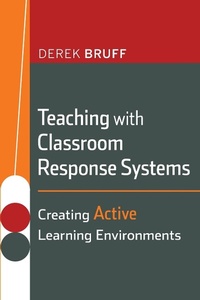
Teaching with Classroom Response Systems
Creating Active Learning Environments
1st Edition
Published on 10. March 2009
Book
Paperback/Softback
240 pages
978-0-470-28893-1 (ISBN)
Description
There is a need in the higher education arena for a book that responds to the need for using technology in a classroom of tech-savvy students. This book is filled with illustrative examples of questions and teaching activities that use classroom response systems from a variety of disciplines (with a discipline index). The book also incorporates results from research on the effectiveness of the technology for teaching. Written for instructional designers and re-designers as well as faculty across disciplines. A must-read for anyone interested in interactive teaching and the use of clickers. This book draws on the experiences of countless instructors across a wide range of disciplines to provide both novice and experienced teachers with practical advice on how to make classes more fun and more effective."--Eric Mazur, Balkanski Professor of Physics and Applied Physics, Harvard University, and author, Peer Instruction: A User's Manual
"Those who come to this book needing practical advice on using 'clickers' in the classroom will be richly rewarded: with case studies, a refreshing historical perspective, and much pedagogical ingenuity. Those who seek a deep, thoughtful examination of strategies for active learning will find that here as well-in abundance. Dr. Bruff achieves a marvelous synthesis of the pragmatic and the philosophical that will be useful far beyond the life span of any single technology." --Gardner Campbell, Director, Academy for Teaching and Learning, and Associate Professor of Literature, Media, and Learning, Honors College, Baylor University
"Those who come to this book needing practical advice on using 'clickers' in the classroom will be richly rewarded: with case studies, a refreshing historical perspective, and much pedagogical ingenuity. Those who seek a deep, thoughtful examination of strategies for active learning will find that here as well-in abundance. Dr. Bruff achieves a marvelous synthesis of the pragmatic and the philosophical that will be useful far beyond the life span of any single technology." --Gardner Campbell, Director, Academy for Teaching and Learning, and Associate Professor of Literature, Media, and Learning, Honors College, Baylor University
Reviews / Votes
"Good teachers constantly look for ways to improve instruction. Bruff, Assistant Director of the Vanderbilt University Center for Teaching, surveys how classroom response systems, commonly known as "clicker technology," can improve teaching and learning. Bruff supplements his points on engagement and assessment with a classified array of clicker questions for a variety of teaching contexts. He also provides helpful advice on teaching choices with response systems: when to grade clicker questions, how to use them for summative assessment, and how to address cheating and lack of participation. He provides additional helpful suggestions on dealing with logistical issues such as system choice and troubleshooting. Throughout, the reader benefits from the copious examples gleaned from teachers.This book convincingly demonstrates that clicker technology allows teachers and students to adapt quickly to emerging learning needs....Bruff's work is an enthusiastic, accessible, and detailed introduction for all educators interested in this popular educational technology tool."
-NACADA Journal, Issue 30(1) (Spring 2010)
More details
Language
English
Place of publication
New York
United States
Publishing group
John Wiley & Sons Inc
Target group
Professional and scholarly
Product notice
Paperback (trade)
Unsewn / adhesive bound
Illustrations
Tables: 1 B&W, 0 Color; Exhibits: 7 B&W, 0 Color; Graphs: 9 B&W, 0 Color
Dimensions
Height: 229 mm
Width: 152 mm
Thickness: 13 mm
Weight
360 gr
ISBN-13
978-0-470-28893-1 (9780470288931)
Copyright in bibliographic data and cover images is held by Nielsen Book Services Limited or by the publishers or by their respective licensors: all rights reserved.
Schweitzer Classification
Other editions
Additional editions
E-Book
10/2009
Jossey-Bass
€33.99
Available for download
E-Book
10/2009
Jossey-Bass
€33.99
Available for download
Person
The author Derek Bruff is an assistant director at the Vanderbilt University Center for Teaching and a senior lecturer in the Vanderbilt Department of Mathematics. Formerly he was a faculty preceptor in the Harvard University Department of Mathematics, teaching several courses and coordinating multisection calculus courses.
Content
Preface. The Author.
1. Engaging Students with Clickers.
Generating Classwide Discussions.
Generating Small-Group Discussions.
Creating Times for Telling.
Structuring Class Time.
Making Class More Fun.
2. Assessing Students with Clickers.
Uncovering Student Learning.
Evaluating Student Learning.
3. A Taxonomy of Clicker Questions.
Content Questions.
Process Questions.
4. Teaching Choices.
Use of Class Time.
Writing Questions.
Student Response, Participation, and Grading.
Classroom Choices.
Small Classes.
5. Technical and Logistical Choices.
Technical Challenges.
Vendor Selection and Adoption.
Supporting and Promoting the Use of Clickers.
Low-Tech Options.
High-Tech Options.
6. Why Use Clickers?
Increased Student Participation.
Increased Student Engagement.
Frequent Feedback on Student Learning.
Final Suggestions.
References.
Index.
1. Engaging Students with Clickers.
Generating Classwide Discussions.
Generating Small-Group Discussions.
Creating Times for Telling.
Structuring Class Time.
Making Class More Fun.
2. Assessing Students with Clickers.
Uncovering Student Learning.
Evaluating Student Learning.
3. A Taxonomy of Clicker Questions.
Content Questions.
Process Questions.
4. Teaching Choices.
Use of Class Time.
Writing Questions.
Student Response, Participation, and Grading.
Classroom Choices.
Small Classes.
5. Technical and Logistical Choices.
Technical Challenges.
Vendor Selection and Adoption.
Supporting and Promoting the Use of Clickers.
Low-Tech Options.
High-Tech Options.
6. Why Use Clickers?
Increased Student Participation.
Increased Student Engagement.
Frequent Feedback on Student Learning.
Final Suggestions.
References.
Index.