

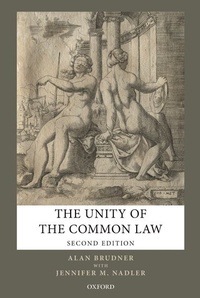
The Unity of the Common Law
2nd Edition
Published on 6. July 2017
Book
Paperback/Softback
378 pages
978-0-19-881240-1 (ISBN)
Description
In this classic study, Alan Brudner investigates the basic structure of the common law of transactions. For decades, that structure has been the subject of intense debate between formalists, who say that transactional law is a private law for interacting parties, and functionalists, who say that it is a public law serving the collective ends of society. Against both camps, Brudner proposes a synthesis of formalism and functionalism in which private law is modified by a common good without being subservient to it. Drawing on Hegel's legal philosophy, the author exhibits this synthesis in each of transactional law's main divisions: property, contract, unjust enrichment, and tort. Each is a whole composed of private-law and public-law parts that complement each other, and the idea connecting the parts to each other is also latently present in each. Moreover, Brudner argues, a single narrative thread connects the divisions of transactional law to each other. Not a row of disconnected fields, transactional law is rather a story about the realization in law of the agent's claim to be a dignified end-master of its body, its acquisitions, and the shape of its life. Transactional law's divisions are stages in the progress toward that goal, each generating a potential developed by the next. Thus, contract law fulfils what is incompletely realized in property law, negligence law what is germinal in contract law, public insurance what is seminal in negligence law, and transactional law as a whole what is underdeveloped in public insurance. The end point is the limit of what a transactional law can contribute to a life sufficient for dignity.
Reconfigured and expanded with a contribution by Jennifer Nadler, The Unity of the Common Law stands out among contemporary theories of private law in that it depicts private law as purposive without being instrumental and as autonomous without being emptily formal.
Reconfigured and expanded with a contribution by Jennifer Nadler, The Unity of the Common Law stands out among contemporary theories of private law in that it depicts private law as purposive without being instrumental and as autonomous without being emptily formal.
Reviews / Votes
By translating the theoretical content of Hegel's Philosophy of Right into a modern idiom, by applying Hegel's political theory to the detail of modern common law doctrine, and by using that theory to critique and relativize the leading schools of legal theory in each of the main branches of law, Brudner has made an unrivalled contribution to legal theory. * Peter Ramsay, London School of Economics and Political Science, Critical Analysis of Law * The publication of a revised edition of Alan Brudner's The Unity of the Common Law deserves an intellectual celebration. Brudner's book is a tour de force of Hegelian jurisprudence. It offers a profound-and profoundly challenging-account of private law (or, as he calls it, transactional law) in its entirety as well as no less ambitious accounts of the nature of both adjudication and legal theory, and a harsh critique of both formalism and functionalism. * Hanoch Dagan, Tel Aviv University, Critical Analysis of Law *More details
Edition
2nd Revised edition
Language
English
Place of publication
Oxford
United Kingdom
Target group
College/higher education
Edition type
Revised edition
Dimensions
Height: 234 mm
Width: 155 mm
Thickness: 21 mm
Weight
584 gr
ISBN-13
978-0-19-881240-1 (9780198812401)
Copyright in bibliographic data and cover images is held by Nielsen Book Services Limited or by the publishers or by their respective licensors: all rights reserved.
Schweitzer Classification
Other editions
Additional editions
Alan Brudner
The Unity of the Common Law
Book
10/2013
2nd Edition
Oxford University Press
€173.32
Shipment within 15-20 days
Person
Alan Brudner is Professor Emeritus of Law and Political Science at the University of Toronto. He is the author of The Owl and the Rooster: Hegel's Transformative Political Science (Cambridge, 2017), Punishment and Freedom (Oxford, 2009), and Constitutional Goods (Oxford, 2004). He was elected to the Royal Society of Canada in 2011.
Content
PART 1; PART 2; PART 3