

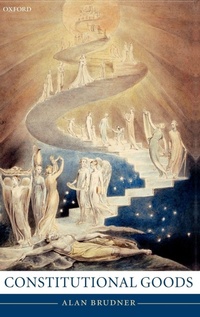
Constitutional Goods
Published on 2. September 2004
Book
Hardback
464 pages
978-0-19-927466-6 (ISBN)
Description
This book aims to distil the essentials of liberal constitutionalism from the jurisprudence and practice of contemporary liberal-democratic states. Most constitutional theorists have despaired of a liberal consensus on the fundamental goals of constitutional order. Instead they have contented themselves either with agreement on lower-level principles on which those who disagree on fundamentals may coincidentally converge, or, alternatively with a process for translating fundamental disgreement into acceptable laws.
Alan Brudner suggests a conception of fundamental justice that liberals of competing philosophic schools may accept as fulfilling their own basic commitments. He argues that the model liberal-democratic constitution is best understood as a unity of three constitutional frameworks: libertarian, egalitarian, and communitarian. Each of these has a particular conception of public reason. Brudner criticizes each of these frameworks insofar as its organizing conception claims to be fundamental, and moves forward to suggest an Hegelian conception of public reason within which each framework is contained as a constituent element of a whole.
When viewed in this light, the liberal constitution embodies a surprising synthesis. It reconciles a commitment to individual liberty and freedom of conscience with the perfectionist idea that the state ought to cultivate a type of personality whose fundamental ends are the goods essential to dignity. Such a reconciliation, the author suggests, may attract competing liberalisms to a consensus on an inclusive conception of public reason under which political authority is validated for those who share a confidence in the individual's inviolable worth.
Alan Brudner suggests a conception of fundamental justice that liberals of competing philosophic schools may accept as fulfilling their own basic commitments. He argues that the model liberal-democratic constitution is best understood as a unity of three constitutional frameworks: libertarian, egalitarian, and communitarian. Each of these has a particular conception of public reason. Brudner criticizes each of these frameworks insofar as its organizing conception claims to be fundamental, and moves forward to suggest an Hegelian conception of public reason within which each framework is contained as a constituent element of a whole.
When viewed in this light, the liberal constitution embodies a surprising synthesis. It reconciles a commitment to individual liberty and freedom of conscience with the perfectionist idea that the state ought to cultivate a type of personality whose fundamental ends are the goods essential to dignity. Such a reconciliation, the author suggests, may attract competing liberalisms to a consensus on an inclusive conception of public reason under which political authority is validated for those who share a confidence in the individual's inviolable worth.
Reviews / Votes
Addressing fundamental issues in public law, [the book] also engages with a host of questions in political philosophy and is not afraid to develop a sweeping and original line of argument that challenges current orthodoxy. * Nigel Simmonds, The Cambridge Law Journal * The author of Constitutional Goods has made a major contribution to political philosophy and constitutional theory. The book provides a fascinating and persuasive exposition of the foundations of liberal constitutionalism, supporting its majestic ambitions with powerful abstract analysis and finely nuanced detail...It is altogether a superb achievement, and no serious constitutional theorist can ignore its powerful claim on his attention. * T.R.S. Allan, University of Toronto Law Journal * There can be no doubting the fact that this is a major contribution to constitutional scholarship, one that bears comparison with any work of constitutional scholarship to have been published in recent times. * Martin Loughlin, Public Law *More details
Language
English
Place of publication
Oxford
United Kingdom
Target group
Professional and scholarly
Dimensions
Height: 240 mm
Width: 161 mm
Thickness: 30 mm
Weight
863 gr
ISBN-13
978-0-19-927466-6 (9780199274666)
Copyright in bibliographic data and cover images is held by Nielsen Book Services Limited or by the publishers or by their respective licensors: all rights reserved.
Schweitzer Classification
Other editions
Additional editions
Alan Brudner
Constitutional Goods
Book
03/2007
Oxford University Press
€85.42
Shipment within 15-20 days
Person
Alan Brudner is Albert Abel Professor of Law at the University of Toronto.
Content
Preface ; Introduction: The Aim of Constitutional Theory ; PART ONE: LIBERTY ; 1. The Libertarian Conception of the Public ; 2. Constitutional Principles: Civil Rights ; 3. Constitutional Principles: Political Rights ; PART TWO: EQUALITY ; 4. The Egalitarian Principle of Fundamental Justice ; 5. Self-Authorship and Substantive Justice ; 6. Self-Rule and Procedural Justice ; 7. Social and Economic Rights ; PART THREE: COMMUNITY ; 8. Hegel's Idea of Sittlichkeit ; 9. Sex, Family, and Self-Authorship ; 10. The Liberal Duty to Recognize Cultures ; 11. Consociationalism ; Conclusion