

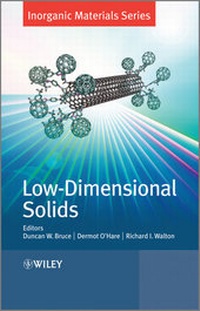
Low-Dimensional Solids
Published on 27. August 2010
Book
Hardback
308 pages
978-0-470-99751-2 (ISBN)
Description
While knowledge of the origin of physical properties of many simple solids is comprehensive, this is not the case for low-dimensional solids. This field, however, has seen tremendous development in the last couple of years and the materials have a wide range of applications such as in display devices. Low-Dimensional Solids discusses the importance of low-dimensional solids for theoretical and computational theories. The book covers intercalation in layered materials, boride/carbide/fulleride superconductors, inorganic fullerenes and nanotubes, and oxide nanorods and nanotubes.
Reviews / Votes
"Introducing topics such as novel layered superconductors, inorganic-DNA delivery systems and the chemistry and physics of inorganic nanotubes and nanosheets, Low-Dimensional Solids discusses some of the most exciting concepts in this developing field". (Centre Daily Times, 19 January 2011)More details
Other editions
Additional editions
Duncan W. Bruce | Dermot O'Hare | Richard I. Walton
Low-Dimensional Solids
E-Book
03/2011
Wiley
€103.99
Available for download
Duncan W. Bruce | Dermot O'Hare | Richard I. Walton
Low-Dimensional Solids
E-Book
08/2010
Wiley
€103.99
Available for download
Persons
Professor Duncan Bruce graduated from the University of Liverpool (UK), where he also gained his PhD. In 1984, he took up a Temporary Lectureship in Inorganic Chemistry at the University of Sheffield and was awarded a Royal Society Warren Research Fellowship. He was then appointed Lecturer in Chemistry and later Senior Lecturer and co-director of the Sheffield Centre for Molecular Materials. In 1995, he was appointed Professor of Inorganic Chemistry at the University of Exeter. Following the closure of Exeter's chemistry department in 2005, Professor Bruce took up his present position as Professor of Materials Chemistry in York. He is currently Chair of the Royal Society of Chemistry Materials Chemistry Forum. His current research interests include liquid crystals and silicates. His work has been recognized by various awards including the British Liquid Crystal Society's first Young Scientist prize and the RSC's Sir Edward Frankland Fellowship and Corday-Morgan Medal and Prize. He has held visiting positions in Australia, France, Japan and Italy. Dr. Richard Walton, who was also formerly based in the Department of Chemistry at the University of Exeter, now works in the Department of Chemistry at the University of Warwick. His research group works in the area of solid-state materials chemistry and has a number of projects focusing upon the synthesis, structural characterization and properties of inorganic materials.
Dermot O'Hare is Professor in the Chemistry Research Laboratory at the University of Oxford.
His research group has a wide range of research interests. They all involve synthetic chemistry ranging from organometallic chemistry to the synthesis of new microporous solids.
Duncan Bruce and Dermot O'Hare have edited several editions of Inorganic Materials published by John Wiley & Sons Ltd.
Dermot O'Hare is Professor in the Chemistry Research Laboratory at the University of Oxford.
His research group has a wide range of research interests. They all involve synthetic chemistry ranging from organometallic chemistry to the synthesis of new microporous solids.
Duncan Bruce and Dermot O'Hare have edited several editions of Inorganic Materials published by John Wiley & Sons Ltd.
Content
Inorganic Materials Series Preface.
Preface.
List of Contributors.
1 Metal Oxide Nanoparticles (Alan V. Chadwick and Shelly L.P. Savin).
1.1 Introduction.
1.2 Oxide Types; Point Defects and Electrical Conductivity.
1.3 Preparation of Nanoionic Materials.
1.4 Characterisation.
1.4.1 Determination of Particle Size and Dispersion.
1.4.2 Characterisation of Microstructure.
1.4.3 Transport Measurements.
1.5 Review of the Current Experimental Data and their Agreement with Theory.
1.5.1 Microstructure.
1.5.2 Transport.
1.5.3 Mechanical Properties.
1.5.4 Magnetic Properties.
1.6 Applications.
1.6.1 Gas Sensors.
1.6.2 Batteries.
1.6.3 Fuel Cells.
1.6.4 Catalysis and Adsorption.
1.6.5 Biomedical Applications of Magnetic Nanocrystalline Oxides.
1.7 Overview and Prospects.
References.
2 Inorganic Nanotubes and Nanowires (C.N.R. Rao, S.R.C. Vivekchand and A. Govindaraj).
2.1 Introduction.
2.2 Inorganic Nanotubes.
2.2.1 Synthesis.
2.2.2 Functionalisation and Solubilisation.
2.2.3 Properties and Applications.
2.3 Nanowires.
2.3.1 Synthesis.
2.3.2 Self-Assembly and Functionalisation.
2.3.3 Properties and Applications.
2.4 Outlook.
References.
3 Biomedical Applications of Layered Double Hydroxides (Jin-Ho Choy, Jae-Min Oh and Dae-Hwan Park).
3.1 Introduction.
3.1.1 Layered Nanohybrids.
3.1.2 Layered Nanomaterials.
3.2 Nanomaterials for Biological Applications.
3.2.1 Layered Nanoparticles for Biomedical Applications.
3.2.2 Cellular Uptake Pathway of Drug-Inorganic Nanohybrids.
3.2.3 Targeting Effect of Drug-Inorganic Nanohybrids.
3.3 Nanomaterials for DNA Molecular Code System.
3.3.1 Genetic Molecular Code in DNA.
3.3.2 Chemically and Biologically Stabilised DNA in Layered Nanoparticles.
3.3.3 Invisible DNA Molecular Code System for Ubiquitous Application.
3.4 Conclusion.
References.
4 Carbon Nanotubes and Related Structures (M. Angeles Herranz, Juan Luis Delgado and Nazario Mart1n).
4.1 Introduction.
4.2 Endohedral Fullerenes.
4.2.1 Endohedral Metallofullerenes.
4.2.2 Surgery of Fullerenes.
4.3 Carbon Nanotubes.
4.3.1 Covalent Functionalisation.
4.3.2 Noncovalent Functionalisation.
4.3.3 Endohedral Functionalisation.
4.4 Other Carbon Nanotube Forms.
4.4.1 Cup-Stacked Carbon Nanotubes.
4.4.2 Carbon Nanohorns.
4.4.3 Carbon Nanobuds.
4.4.4 Carbon Nanotori.
4.5 Carbon Nano-Onions.
4.6 Graphenes.
4.7 Summary and Outlook.
Acknowledgements.
References.
5 Magnesium Diboride MgB2: A Simple Compound with Important Physical Properties (Michael Pissas).
5.1 Introduction.
5.1.1 Electronic Structure of MgB2.
5.1.2 Substitutions in MgB2 Superconductor.
5.2 Preparation of Pure and Alloyed MgB2.
5.2.1 Preparation of Pure and Alloyed Polycrystalline MgB2.
5.2.2 Single Crystal Growth of Pristine and Alloyed MgB2.
5.3 Physical Properties of MgB2.
5.3.1 Boron Isotope Effect.
5.3.2 Evidence for Two Energy Gaps in MgB2.
5.3.3 Dependence of the Superconducting Transition Temperature on Hydrostatic Pressure.
5.3.4 Resistivity Measurements in MgB2.
5.4 Flux Line Properties in Single Crystals of MgB2, Mg1-xAlxB2 and MgB2-xCx.
5.4.1 Type II Superconductors.
5.4.2 Flux Line Properties of Pristine MgB2.
5.4.3 Aluminium Substituted Single Crystals.
5.4.4 Carbon Substituted Single Crystals.
5.4.5 Two-Band Superconductivity and Possible Implications on the Vortex Matter Phase Diagram.
5.5 Conclusions.
References.
Index.