

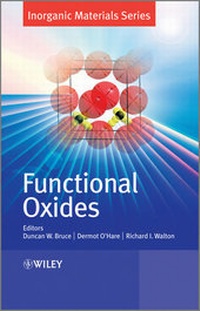
Functional Oxides
Published on 11. June 2010
Book
Hardback
318 pages
978-0-470-99750-5 (ISBN)
Description
Functional oxides have a wide variety of applications in the electronic industry. The discovery of new metal oxides with interesting and useful properties continues to drive much research in chemistry, physics, and materials science. Functional Oxides highlights structural chemistry, magnetic and electronic properties, ionic conduction, and other emerging areas of importance, such as thermoelectricity and spintronics. This book covers these complex concepts in a clear and accessible manner providing an excellent introduction to this broad subject area.
More details
Product info
gebunden
Series
Edition
1. Auflage
Language
English
Place of publication
New York
United States
Target group
Professional and scholarly
Product notice
Cloth
Dimensions
Height: 22.9 cm
Width: 15.2 cm
Thickness: 2.2 cm
Weight
592 gr
ISBN-13
978-0-470-99750-5 (9780470997505)
Schweitzer Classification
Other editions
Additional editions
Duncan W. Bruce | Dermot O'Hare | Richard I. Walton
Functional Oxides
E-Book
03/2011
Wiley
€103.99
Available for download
Duncan W. Bruce | Dermot O'Hare | Richard I. Walton
Functional Oxides
E-Book
05/2010
Wiley
€103.99
Available for download
Persons
Professor Duncan Bruce graduated from the University of Liverpool (UK), where he also gained his PhD. In 1984, he took up a Temporary Lectureship in Inorganic Chemistry at the University of Sheffield and was awarded a Royal Society Warren Research Fellowship. He was then appointed Lecturer in Chemistry and was promoted Senior Lecturer in 1994, in which year he became co-director of the Sheffield Centre for Molecular Materials. In 1995, he was appointed Professor of Inorganic Chemistry at the University of Exeter. Following the closure of Exeter's chemistry department in 2005, Professor Bruce took up his present position as Professor of Materials Chemistry in York. He is currently Chair of the Royal Society of Chemistry Materials Chemistry Forum. His current research interests include liquid crystals and nanoparticle-doped, nanostructured, mesoporous silicates. His work has been recognized by various awards including the British Liquid Crystal Society's first Young Scientist prize and the RSC's Sir Edward Frankland Fellowship and Corday-Morgan Medal and Prize. He has held visiting positions in Australia, France, Japan and Italy. Dr. Richard Walton, who was also formerly based in the Department of Chemistry at the University of Exeter, now works in the Department of Chemistry at the University of Warwick. His research group works in the area of solid-state materials chemistry and has a number of projects focusing upon the synthesis, structural characterization and properties of inorganic materials.
Dermot O'Hare is Professor in the Chemistry Research Laboratory at the University of Oxford.
His research group has a wide range of research interests. They all involve synthetic chemistry ranging from organometallic chemistry to the synthesis of new microporous solids.
Duncan Bruce and Dermot O'Hare have edited several editions of Inorganic Materials published by John Wiley & Sons Ltd.
Dermot O'Hare is Professor in the Chemistry Research Laboratory at the University of Oxford.
His research group has a wide range of research interests. They all involve synthetic chemistry ranging from organometallic chemistry to the synthesis of new microporous solids.
Duncan Bruce and Dermot O'Hare have edited several editions of Inorganic Materials published by John Wiley & Sons Ltd.
Content
Inorganic Materials Preface.
Preface.
List of Contributors.
1. Noncentrosymmetric Inorganic Oxide Materials: Synthetic Strategies and Characterization Techniques (P. Shiv Halasyamani).
1.1 Introduction.
1.2 Strategies toward Synthesising Noncentrosymmetric Inorganic Materials
1.3 Electronic Distortions
1.4 Properties Associated with Noncentrosymmetric Materials
1.5 Outlook - Multifunctional Materials
1.6 Concluding Thoughts
Acknowledgements.
References.
2. Geometrically Frustrated Magnetic Materials (John E. Greedan).
2.2 Geometric Frustration
2.3 Real Materials
2.4 Concluding Remarks
References.
3. Lithium Ion Conduction in Oxides (E. J. Cussen).
3.1 Introduction.
3.2 Sodium and Lithium ß-Alumina.
3.3 Akali Metal Sulfates and the Effect of Anion Disorder on Conductivity.
3.4 LISICON and Related Phases.
3.5 Lithium conduction in NaSICON-Related phases.
3.6 Doped Analogues of LiZr2 (PO4)3.
3.7 Lithium conduction in the Perovskite Structure.
3.8 Lithium Containing Garnets.
References.
4. Thermoelectric Oxides (Sylvie Hébert and Antoine Maignan).
4.1. Introduction.
4.2. How to Optimise Thermoelectric Generators (TEG).
4.3. Thermoelectric Oxides.
4.4. Conclusion.
Acknowledgments.
References
5. Transition Metal Oxides - Magnetoresistance and Half-Metallicity (Tapas Kumar Mandal and Martha Greenblatt).
5.1 Introduction.
5.2 Magnetoresistance: Concepts and Developments.
5.3 Half-Metallicity.
5.4 Oxides Exhibiting Half-Metallicity.
5.5 Magnetoresistance and Half-Metallicity of Double Perovskites.
5.6 Spintronics - The Emerging Magneto-electronics.
5.7 Summary.
Acknowledgments.
References.>
Index.