

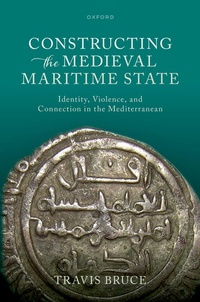
Constructing the Medieval Maritime State
Identity, Violence, and Connection in the Mediterranean
Will be published approx. on 16. July 2026
Book
Hardback
208 pages
978-0-19-891015-2 (ISBN)
Description
Constructing the Medieval Maritime State: Identity, Violence, and Connection in the Mediterranean explores how the small medieval kingdom of Denia in Spain became a powerful maritime state after the collapse of the Umayyad Caliphate. Its rulers built authority, not only through war and seafaring raids but also by connecting Denia to wider Mediterranean trade, diplomacy, and culture.
The rise and evolution of the taifa of Denia is a powerful case study for understanding the construction of medieval maritime states in the Mediterranean. Travis Bruce situates Denia within the collapse of the Umayyad Caliphate and explores how its rulers forged legitimacy through identity formation, maritime violence, and regional connectivity. Denia's identity was negotiated through rulership, unfreedom, and cultural hybridity, and violence ^-^particularly predatory warfare and maritime jihad ^-^ functioned as both statecraft and economic extraction. At the same time, Denia's entanglement in commercial, diplomatic, and intellectual networks positioned it as a key node linking the Islamic Mediterranean and the Latin West. The state's trajectory cannot be reduced to narratives of decline or simple religious conflict but instead reveals a process of negotiation shaped by mobility, interdependence, and the fluid boundaries between public and private power. This narrative reframes Mediterranean history beyond Eurocentric paradigms and underscores the significance of Islamic maritime states within the wider medieval world.
The rise and evolution of the taifa of Denia is a powerful case study for understanding the construction of medieval maritime states in the Mediterranean. Travis Bruce situates Denia within the collapse of the Umayyad Caliphate and explores how its rulers forged legitimacy through identity formation, maritime violence, and regional connectivity. Denia's identity was negotiated through rulership, unfreedom, and cultural hybridity, and violence ^-^particularly predatory warfare and maritime jihad ^-^ functioned as both statecraft and economic extraction. At the same time, Denia's entanglement in commercial, diplomatic, and intellectual networks positioned it as a key node linking the Islamic Mediterranean and the Latin West. The state's trajectory cannot be reduced to narratives of decline or simple religious conflict but instead reveals a process of negotiation shaped by mobility, interdependence, and the fluid boundaries between public and private power. This narrative reframes Mediterranean history beyond Eurocentric paradigms and underscores the significance of Islamic maritime states within the wider medieval world.
More details
Series
Language
English
Place of publication
Oxford
United Kingdom
Target group
College/higher education
Product notice
sewn/stitched
Cloth over boards
Dimensions
Height: 234 mm
Width: 156 mm
ISBN-13
978-0-19-891015-2 (9780198910152)
Copyright in bibliographic data and cover images is held by Nielsen Book Services Limited or by the publishers or by their respective licensors: all rights reserved.
Schweitzer Classification
Person
Travis Bruce is Associate Professor of Medieval History at McGill University. His research interests include the eleventh-century taifa of Denia and the communications networks and intercultural relations in the Western Mediterranean, particularly the role of translators in medieval Mediterranean commerce. He is currently president of the American Academy of Research Historians of Medieval Spain.
Content
Introduction 1: Identity 2: Violence 3: Connections Conclusion