

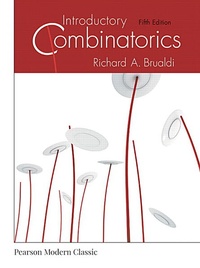
Introductory Combinatorics (Classic Version)
Description
Appropriate for one- or two-semester, junior- to senior-level combinatorics courses.
This title is part of the Pearson Modern Classics series. Pearson Modern Classics are acclaimed titles at a value price. Please visit www.pearsonhighered.com/math-classics-series for a complete list of titles.
This trusted best-seller covers the key combinatorial ideas-including the pigeon-hole principle, counting techniques, permutations and combinations, Pólya counting, binomial coefficients, inclusion-exclusion principle, generating functions and recurrence relations, combinatortial structures (matchings, designs, graphs), and flows in networks. The 5th Edition incorporates feedback from users to the exposition throughout and adds a wealth of new exercises.
More details
Other editions
Previous edition
Persons
Richard A. Brualdi is Bascom Professor of Mathematics, Emeritus at the University of Wisconsin - Madison. He served as Chair of the Department of Mathematics from 1993-1999. His research interests lie in matrix theory and combinatorics/graph theory. Professor Brualdi is the author or co-author of 6 books, and has published extensively. He is one of the editors-in-chief of the journal "Linear Algebra and its Applications" and of the journal "Electronic Journal of Combinatorics." He is a member of the American Mathematical Society, the Mathematical Association of America, the International Linear Algebra Society, and the Institute for Combinatorics and its Applications. He is also a Fellow of the Society for Industrial and Applied Mathematics.
Content
- 1. What is Combinatorics?
- 2. The Pigeonhole Principle
- 3. Permutations and Combinations
- 4. Generating Permutations and Combinations
- 5. The Binomial Coefficients
- 6. The Inclusion-Exclusion Principle and Applications
- 7. Recurrence Relations and Generating Functions
- 8. Special Counting Sequences
- 9. Systems of Distinct Representatives
- 10. Combinatorial Designs
- 11. Introduction to Graph Theory
- 12. More on Graph Theory
- 13. Digraphs and Networks
- 14. Pólya Counting