

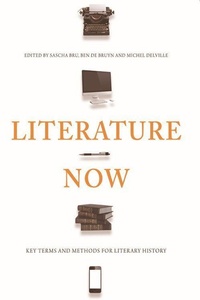
Literature Now
Key Terms and Methods for Literary History
Published on 19. January 2016
Book
Hardback
320 pages
978-1-4744-0990-2 (ISBN)
Description
Introduces the most important terms for understanding literature, past and present.
Literature Now argues that modern literary history is currently the main site of theoretical and methodological reflection in literary studies. Via 19 key terms, the book takes stock of recent scholarship and demonstrates how analyses of particular historical phenomena have modified our understanding of crucial notions like archive, book, event, media, objects, style and the senses. The book not only reveals a rich diversity of subjects and approaches but also identifies the most salient traits of literature and literary studies today.
Leading literary critics and historians offer thought-provoking arguments as well as authoritative explorations of the key terms of literary studies providing students as well as scholars with a rich resource for exploring theoretical issues from a historically informed perspective.
Key Features
Organised around the key terms used in literary studies today: archive, book, medium, translation, subjects, senses, animals, objects, politics, time, invention, event, generation, period, beauty, mimesis, style, popular and genrePuts literary history at the forefront of theoretical and methodological reflection in literary studiesOriginal chapters by leading literary critics, theorists and historians
Literature Now argues that modern literary history is currently the main site of theoretical and methodological reflection in literary studies. Via 19 key terms, the book takes stock of recent scholarship and demonstrates how analyses of particular historical phenomena have modified our understanding of crucial notions like archive, book, event, media, objects, style and the senses. The book not only reveals a rich diversity of subjects and approaches but also identifies the most salient traits of literature and literary studies today.
Leading literary critics and historians offer thought-provoking arguments as well as authoritative explorations of the key terms of literary studies providing students as well as scholars with a rich resource for exploring theoretical issues from a historically informed perspective.
Key Features
Organised around the key terms used in literary studies today: archive, book, medium, translation, subjects, senses, animals, objects, politics, time, invention, event, generation, period, beauty, mimesis, style, popular and genrePuts literary history at the forefront of theoretical and methodological reflection in literary studiesOriginal chapters by leading literary critics, theorists and historians
Reviews / Votes
The ingeniously organised essays in Literature Now provide an up-to-the-moment examination of recent trends in literary theory. The volume covers a comprehensive range of topics, including digital humanities and eco-critical studies, as well as welcome assessments of revisionist developments in such fields as genre studies, book history and narratology. As such, the collection promises to provide a thorough mapping of the central concepts that arise in contemporary discussions of literary history. -- Professor Phillip Sicker * Fordham University *More details
Language
English
Place of publication
Edinburgh
United Kingdom
Target group
College/higher education
Product notice
sewn/stitched
Cloth over boards
Illustrations
1 black and white illustration
Dimensions
Height: 231 mm
Width: 163 mm
Thickness: 28 mm
Weight
771 gr
ISBN-13
978-1-4744-0990-2 (9781474409902)
Copyright in bibliographic data and cover images is held by Nielsen Book Services Limited or by the publishers or by their respective licensors: all rights reserved.
Schweitzer Classification
Other editions
Additional editions
Sascha Bru | Ben De Bruyn | Michel Delville
Literature Now
Key Terms and Methods for Literary History
E-Book
01/2016
1st Edition
Edinburgh University Press
€29.49
Available for download
Sascha Bru | Ben De Bruyn | Michel Delville
Literature Now
Key Terms and Methods for Literary History
E-Book
01/2016
1st Edition
Edinburgh University Press
€0.00
Available for download
Persons
Sascha Bru is professor at the Faculty of Arts of the University of Leuven (Belgium). He has produced over a dozen books on European avant-gardes and modernisms, including Democracy, Law and the Modernist Avant-Gardes: Writing in the State of Exception (EUP, 2009) and the co-edited volume The Oxford Critical and Cultural History of Modernist Magazines: Europe, 1880-1940 (OUP, 2016). Ben De Bruyn is an associate professor of comparative literature at Maastricht University. Mainly interested in twentieth and twenty-first century fiction, he has published on three sets of topics, namely theories and histories of reading practices, the representation of space, place and planet and the literary imagination of commodities and various lifestyle practices. He is the author of Wolfgang Iser. A Companion (New York/Berlin: De Gruyter, 2012). Michel Delville teaches English and American literatures, as well as comparative literature, at the University of Liege. He is the author or co-author of The American Prose Poem, J.G. Ballard, Hamlet & Co, Frank Zappa, Captain Beefheart, and the Secret History of Maximalism, Food, Poetry, and the Aesthetics of Consumption: Eating the Avant-Garde and Crossroads Poetics: Text, Image, Music, Film & Beyond. He has also co-edited several volumes of essays on contemporary poetics.
Content
Introduction (Sascha Bru, Ben de Bruyn, Michel Delville); I. Channels; Archive (Ed Folsom); Book (Sydney J. Shep); Medium (Julian Murphet); Translation (Thomas O. Beebee); II. Subjects / Objects; Subjects (Ortwin de Graef); Senses (Michel Delville); Animals (Carrie Rohman); Objects (Timothy Morton); Politics (David Ayers); III. Temporalities; Time (Tyrus Miller); Invention (Jed Rasula); Event (Scott McCracken); Generation (Julian Hanna); Period (Ben de Bruyn); IV. Aesthetics; Beauty (Sascha Bru); Mimesis (Thomas Pavel); Style (Sarah Posman); Popular (David Glover); Genre (Jonathan Monroe); Notes; Index.