

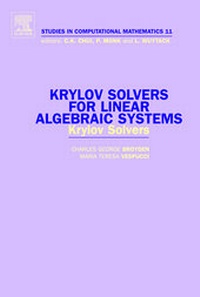
Krylov Solvers for Linear Algebraic Systems: Volume 11
Krylov Solvers
Published on 8. September 2004
Book
Hardback
342 pages
978-0-444-51474-5 (ISBN)
Description
The first four chapters of this book give a comprehensive and unified theory of the Krylov methods. Many of these are shown to be particular examples ofthe block conjugate-gradient algorithm and it is this observation thatpermits the unification of the theory. The two major sub-classes of thosemethods, the Lanczos and the Hestenes-Stiefel, are developed in parallel asnatural generalisations of the Orthodir (GCR) and Orthomin algorithms. Theseare themselves based on Arnoldi's algorithm and a generalised Gram-Schmidtalgorithm and their properties, in particular their stability properties,are determined by the two matrices that define the block conjugate-gradientalgorithm. These are the matrix of coefficients and the preconditioningmatrix.In Chapter 5 the"transpose-free" algorithms based on the conjugate-gradient squared algorithm are presented while Chapter 6 examines the various ways in which the QMR technique has been exploited. Look-ahead methods and general block methods are dealt with in Chapters 7 and 8 while Chapter 9 is devoted to error analysis of two basic algorithms.In Chapter 10 the results of numerical testing of the more important algorithms in their basic forms (i.e. without look-ahead or preconditioning) are presented and these are related to the structure of the algorithms and the general theory. Graphs illustrating the performances of various algorithm/problem combinations are given via a CD-ROM.Chapter 11, by far the longest, gives a survey of preconditioning techniques. These range from the old idea of polynomial preconditioning via SOR and ILU preconditioning to methods like SpAI, AInv and the multigrid methods that were developed specifically for use with parallel computers. Chapter 12 is devoted to dual algorithms like Orthores and the reverse algorithms of Hegedus. Finally certain ancillary matters like reduction to Hessenberg form, Chebychev polynomials and the companion matrix are described in a series of appendices.
More details
Series
Language
English
Place of publication
Oxford
United Kingdom
Publishing group
Elsevier Science & Technology
Target group
Professional and scholarly
Numerical analysts and engineers.
Dimensions
Height: 240 mm
Width: 165 mm
Weight
780 gr
ISBN-13
978-0-444-51474-5 (9780444514745)
Copyright in bibliographic data and cover images is held by Nielsen Book Services Limited or by the publishers or by their respective licensors: all rights reserved.
Schweitzer Classification
Other editions
Additional editions
C. G Broyden | Charles George Broyden | Maria Teresa Vespucci
Krylov Solvers for Linear Algebraic Systems
Krylov Solvers
E-Book
05/2014
Elsevier
€180.00
Available for download
Persons
Content
Contents 1. Introduction. 2. The long recurrences. 3. The short recurrences. 4. The Krylov aspects. 5. Transpose-free methods. 6. More on QMR. 7. Look-ahead methods. 8. General block methods. 10. And in practice?? 11. Preconditioning. 12. Duality. Appendices. A. Reduction of upper Hessenberg matrix to upper triangular form by plane rotations. B. Schur complements. C. The Jordan form. D. Chebychev polynomials. E. The companion matrix. F. Algorithmic details.