

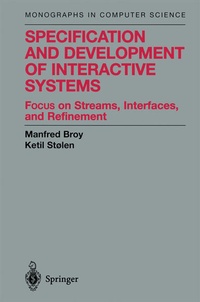
Specification and Development of Interactive Systems
Focus on Streams, Interfaces, and Refinement
Published on 17. October 2012
Book
Paperback/Softback
XV, 348 pages
978-1-4612-6518-4 (ISBN)
Description
This book presents a fundamental mathematical and logical approach to soft ware and systems engineering. Considering the large number of books de scribing mathematical approaches to program development, it is important to explain what we consider to be the specific contribution of our book, to identify our goals, and to characterize our intended target audience. Most books dealing with the mathematics and logics of programming and system development are mainly devoted to programming in the small. This is in contrast to our book where the emphasis is on modular system development with the help of component specifications with precisely identified interfaces and refinement concepts. Our book aims at systems development carried out in a systematic way, based on a clear mathematical theory. We do not claim that this book presents a full-blown engineering method. In fact, this is certainly not a book for the application-driven software engi neer looking for a practical method for system development in an industrial context. It is much rather a book for the computer scientist and the scientifi cally interested engineer who looks for basic principles of system development and, moreover, its mathematical foundations. It is also a book for method builders interested in a proper mathematical foundation on which they can build a practical development method and industrial-strength support tools.
More details
Series
Edition
Softcover reprint of the original 1st ed. 2001
Language
English
Place of publication
New York
United States
Target group
Professional and scholarly
Research
Illustrations
XV, 348 p.
Dimensions
Height: 235 mm
Width: 155 mm
Thickness: 20 mm
Weight
557 gr
ISBN-13
978-1-4612-6518-4 (9781461265184)
DOI
10.1007/978-1-4613-0091-5
Schweitzer Classification
Other editions
Additional editions
Manfred Broy | Ketil Stølen
Specification and Development of Interactive Systems
Focus on Streams, Interfaces, and Refinement
Book
04/2001
Springer
€53.49
Shipment within 5-7 days
Persons
Prof. Dr. Dr. h.c. Manfred Broy ist Inhaber des Lehrstuhls für Software & Systems Engineering an der Technischen Universität München. Seine Schwerpunkte in Forschung und Lehre sind die Entwicklung sicherheitskritischer eingebetteter Systeme, mobile und kontextadaptive Softwaresysteme, und Entwicklungsmethoden für leistungsfähige industriell einsetzbare Softwaresysteme. In zahlreichen Industriekooperationen konnte die Arbeiten des Lehrstuhls angewendet und evaluiert werden. Für seine Arbeit wurde Manfred Broy vielfach ausgezeichnet.
Dr. Marco Kuhrmann ist wissenschaftlicher Assistent am Lehrstuhl Software & Systems Engineering an der Technischen Universität München. Seine Schwerpunkte in Forschung und Lehre sind die Entwicklung und das Management von Prozessmodellen sowie das systematische Vorgehen in global verteilten Softwareentwicklungsprojekten. Er ist einer der Entwickler des V-Modell® XT, dessen Anpassung und Einführung in Organisationen und Projekten erbereits vielfach begleitet hat.
Content
1. Introduction.- 1.1 Systems.- 1.2 Specifications.- 1.3 Refinement.- 1.4 Application Domains.- 1.5 Development Process and Methodology.- 1.6 Rationale of Focus.- 1.7 Overview of the Book.- 1.8 How the Book Should Be Read.- 2. A Guided Tour.- 2.1 Plan for the Tour.- 2.2 Station 1: Unbounded Buffer.- 2.3 Station 2: Unbounded Lossy Buffer.- 2.4 Station 3: Driver.- 2.5 Station 4: Composite Specifications.- 2.6 Station 5: Time-Sensitive Buffer.- 2.7 Station 6: Timed Lossy Buffer.- 2.8 Station 7: Timed Driver.- 2.9 Station 8: Timed Composite Specification.- 3. Basics.- 3.1 Sets.- 3.2 Tuples.- 3.3 Functions.- 3.4 Types.- 3.5 Logic.- 4. Streams.- 4.1 Formal Definition of Streams.- 4.2 Basic Operators on Streams.- 4.3 Additional Operators on Streams.- 4.4 Formal Definition of Timed Streams.- 4.5 Operators on Timed Streams.- 5. Specifications.- 5.1 Classification of Specifications.- 5.2 Elementary Specifications.- 5.3 Composite Specifications.- 5.4 Black-Box and Glass-Box Views.- 5.5 Parameterized Specifications.- 5.6 Sheafs and Replications.- 6. Examples.- 6.1 Alternating Bit Protocol.- 6.2 Steam Boiler.- 6.3 Memory Components.- 7. Properties of Specifications.- 7.1 Safety and Liveness Properties.- 7.2 Realizability.- 7.3 Causality for Specifications.- 8. Equational Specification of State Transitions.- 8.1 I/O Transitions.- 8.2 Local States.- 8.3 Control States.- 8.4 Oracles.- 9. Access Control System.- 9.1 System Architecture.- 9.2 Functional Properties of the Controllers.- 9.3 Introducing Exception Handling.- 9.4 Imposing Timing Constraints.- 10. Tables and Diagrams.- 10.1 State Transition Tables.- 10.2 State Transition Diagrams.- 10.3 Semantics of State Transition Tables and Diagrams.- 11. Abracadabra Protocol.- 11.1 Informal Specification.- 11.2 Formalization.- 12. A/G Specifications.- 12.1 Simple Examples.- 12.2 Semantics.- 12.3 More Examples.- 13. Memory with Locking.- 13.1 Black-Box Description.- 13.2 Distributed Implementation.- 14. Refinement.- 14.1 Behavioral Refinement.- 14.2 Interface Refinement.- 14.3 Conditional Refinement.- 14.4 Verification.- 14.5 Glass-Box Refinement.- 14.6 Development Method.- 15. Behavioral Refinement.- 15.1 Definition.- 15.2 Simple Examples.- 15.3 Logical Properties.- 15.4 More Examples.- 15.5 Synchronizing the Communication.- 16. Interface Refinement.- 16.1 Definition.- 16.2 A Priming Convention for Channel Identifiers.- 16.3 Simple Examples.- 16.4 Methodological Issues.- 16.5 Logical Properties.- 16.6 More Examples.- 16.7 Generalizing Interface Refinement.- 17. Conditional Refinement.- 17.1 Definition.- 17.2 Simple Examples.- 17.3 Logical Properties.- 17.4 More Examples.- 18. Final Remarks.- 18.1 How Our Approach Generalizes.- 18.2 What We Did Not Cover.- A. Operators for Stream Tuples.- A.l Generalized Operators.- A.2 Tuple Filtering Operator.- A.3 Timed Filtering Operator.- B. Glossary of Terms.- B.l Sets.- B.2 Tuples.- B.3 Functions.- B.4 Types.- B.5 Logic.- B.6 Arithmetics.- B.7 Streams.- B.8 Tuples of Streams.- B.9 Specifications.- B.10 Strategies.