

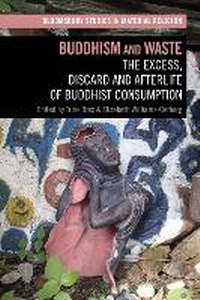
Buddhism and Waste
The Excess, Discard, and Afterlife of Buddhist Consumption
Published on 29. June 2023
Book
Paperback/Softback
208 pages
978-1-350-19557-8 (ISBN)
Description
In what ways do Buddhists recognize, define, and sort waste from non-waste? What happens to Buddhist-related waste? How do new practices of Buddhist consumption result in new forms of waste and consequently new ways of dealing with waste?
This book explores these questions in a close examination of a religion that is often portrayed as anti-materialist and non-economic. It provides insight into the complexity of Buddhist consumption, conceptions of waste, and waste care. Examples include scripture that has been torn and cannot be read, or an amulet that has disintegrated, as well as garbage left behind on a pilgrimage, or the offerings of food and prayer scarves that create ecological contamination.
Chapters cover mass-production and over-consumption, the wastefulness of consumerism, the by-products of Buddhist practices like rituals and festivals, and the impact of increased Buddhist consumption on religious practices and social relations. The book also looks at waste in terms of what is discarded, exploring issues of when and why particular objects and practices are sorted and handled as sacred and disposable. Contributors address how sacred materiality is destined to wear and decay, as well as ideas about redistribution, regeneration or recycling, and the idea of waste as afterlife.
This book explores these questions in a close examination of a religion that is often portrayed as anti-materialist and non-economic. It provides insight into the complexity of Buddhist consumption, conceptions of waste, and waste care. Examples include scripture that has been torn and cannot be read, or an amulet that has disintegrated, as well as garbage left behind on a pilgrimage, or the offerings of food and prayer scarves that create ecological contamination.
Chapters cover mass-production and over-consumption, the wastefulness of consumerism, the by-products of Buddhist practices like rituals and festivals, and the impact of increased Buddhist consumption on religious practices and social relations. The book also looks at waste in terms of what is discarded, exploring issues of when and why particular objects and practices are sorted and handled as sacred and disposable. Contributors address how sacred materiality is destined to wear and decay, as well as ideas about redistribution, regeneration or recycling, and the idea of waste as afterlife.
Reviews / Votes
An original and timely volume that discusses the materiality of Buddhism from the point of view of waste and discarded objects. An excellent source of insight. * Fabio Rambelli, Professor of Japanese Religions and Cultural History and ISF Endowed Chair in Shinto Studies at the University of California, Santa Barbara, USA * This groundbreaking interdisciplinary book offers an important contribution to the study of Buddhism and materiality by looking at waste as excess, discard, and afterlife. Case studies from a broad range of ethnographies provide thought-provoking analysis and new insights. Highly recommended. * Erica Baffelli, Professor of Japanese Studies, University of Manchester, UK * This book represents a pioneering exploration of the intricate relationship between Buddhism and waste management across diverse cultural landscapes ... Buddhism and Waste not only advances scholarly discourse but also has practical implications for environmental stewardship, consumers, and spiritual practitioners within the Buddhist community and beyond in the modern world. * Religious Studies Review *More details
Series
Language
English
Place of publication
London
United Kingdom
Publishing group
Bloomsbury Publishing PLC
Target group
College/higher education
Illustrations
10 bw illus
Dimensions
Height: 232 mm
Width: 150 mm
Thickness: 14 mm
Weight
320 gr
ISBN-13
978-1-350-19557-8 (9781350195578)
Copyright in bibliographic data and cover images is held by Nielsen Book Services Limited or by the publishers or by their respective licensors: all rights reserved.
Schweitzer Classification
Other editions
Additional editions
Trine Brox | Elizabeth Williams-Oerberg
Buddhism and Waste
The Excess, Discard, and Afterlife of Buddhist Consumption
E-Book
01/2022
1st Edition
Bloomsbury Academic
€32.99
Available for download
Trine Brox | Elizabeth Williams-Oerberg
Buddhism and Waste
The Excess, Discard, and Afterlife of Buddhist Consumption
E-Book
01/2022
1st Edition
Bloomsbury Academic
€32.99
Available for download
Persons
Trine Brox is Associate Professor of Modern Tibetan Studies at the University of Copenhagen, Denmark.
Elizabeth Williams-Oerberg is Affiliate Researcher of Cross-cultural and Regional Studies at the University of Copenhagen, Denmark.
Elizabeth Williams-Oerberg is Affiliate Researcher of Cross-cultural and Regional Studies at the University of Copenhagen, Denmark.
Content
List of Figures
Acknowledgments
Note on Sanskrit Diacritics
Introduction: A Framework for Studying Buddhism and Waste, Trine Brox (University of Copenhagen, Denmark)
1. Generosity's Limits: Buddhist Excess and Waste in Northeast Tibet, Jane Caple (University of Copenhagen, Denmark)
2. Modern Minimalism and the Magical Buddhist Art of Disposal, Hannah Gould (University of Melbourne, Australia)
3. The Afterlives of Butsudan: Ambivalence and the Disposal of Home Altars in the United States and Canada, Jeff Wilson (University of Waterloo, Canada)
4. The Great Heisei Doll Massacre: Disposal and the Production of Ignorance in Contemporary Japan, Fabio Gygi (SOAS, University of London, UK)
5. Reincarnating Sacred Objects: The Recycling of Generative Efficacy and the Question of Waste in Tibetan and Himalayan Buddhist Material Cultures, Amy Holmes-Tagchungdarpa (Occidental College, Los Angeles, USA)
6. Zombie Rubbish and Mummy Materiality: The Undead and the Fate of Mongolian Waste, Saskia Abrahms-Kavunenko (University of Copehagen, Denmark)
7. Something Rotten in Shangri-La: Green Buddhism, Brown Buddhism, and the Problem of Waste in Ladakh, India, Elizabeth Williams-Oerberg (University of Copenhagen, Denmark)
List of Contributors
Index
Acknowledgments
Note on Sanskrit Diacritics
Introduction: A Framework for Studying Buddhism and Waste, Trine Brox (University of Copenhagen, Denmark)
1. Generosity's Limits: Buddhist Excess and Waste in Northeast Tibet, Jane Caple (University of Copenhagen, Denmark)
2. Modern Minimalism and the Magical Buddhist Art of Disposal, Hannah Gould (University of Melbourne, Australia)
3. The Afterlives of Butsudan: Ambivalence and the Disposal of Home Altars in the United States and Canada, Jeff Wilson (University of Waterloo, Canada)
4. The Great Heisei Doll Massacre: Disposal and the Production of Ignorance in Contemporary Japan, Fabio Gygi (SOAS, University of London, UK)
5. Reincarnating Sacred Objects: The Recycling of Generative Efficacy and the Question of Waste in Tibetan and Himalayan Buddhist Material Cultures, Amy Holmes-Tagchungdarpa (Occidental College, Los Angeles, USA)
6. Zombie Rubbish and Mummy Materiality: The Undead and the Fate of Mongolian Waste, Saskia Abrahms-Kavunenko (University of Copehagen, Denmark)
7. Something Rotten in Shangri-La: Green Buddhism, Brown Buddhism, and the Problem of Waste in Ladakh, India, Elizabeth Williams-Oerberg (University of Copenhagen, Denmark)
List of Contributors
Index