

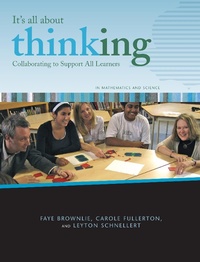
Collaborating to Support All Learners in Mathematics and Science
Will be published approx. on 4. August 2011
Book
Paperback/Softback
332 pages
978-1-55379-269-7 (ISBN)
Description
In this second volume of It's All About Thinking, the authors focus their expertise on the disciplines of mathematics and science, translating principles into practices that help other educators with their students. How can we help students develop the thinking skills they need to become successful learners? How does this relate to deep learning of important concepts in mathematics and science? How can we engage and support diverse learners in inclusive classrooms where they develop understanding and thinking skills?
In this book, Faye, Leyton and Carole explore these questions and offer classroom examples to help busy teachers develop communities where all students learn. This book is written by three experienced educators who offer a welcoming and "can-do" approach to the big ideas in math and science education today. In this book you will find:
insightful ways to teach diverse learners (Information circles, open-ended strategies, inquiry, manipulatives and models)
lessons crafted using curriculum design frameworks (udl and backwards design)
assessment for, as, and of learning
fully fleshed-out lessons and lesson sequences
inductive teaching to help students develop deep learning and thinking skills in Math and Science
assessment tools (and student samples) for concepts drawn from learning outcomes in Math and Science curricula
excellent examples of theory and practice made accessible real school examples of collaboration - teachers working together to create better learning opportunities for their students.
In this book, Faye, Leyton and Carole explore these questions and offer classroom examples to help busy teachers develop communities where all students learn. This book is written by three experienced educators who offer a welcoming and "can-do" approach to the big ideas in math and science education today. In this book you will find:
insightful ways to teach diverse learners (Information circles, open-ended strategies, inquiry, manipulatives and models)
lessons crafted using curriculum design frameworks (udl and backwards design)
assessment for, as, and of learning
fully fleshed-out lessons and lesson sequences
inductive teaching to help students develop deep learning and thinking skills in Math and Science
assessment tools (and student samples) for concepts drawn from learning outcomes in Math and Science curricula
excellent examples of theory and practice made accessible real school examples of collaboration - teachers working together to create better learning opportunities for their students.
More details
Language
English
Place of publication
Canada
Target group
Children/juvenile
US School Grade: Kindergarten, Interest Age: From 5 to 12 years
Product notice
Paperback (trade)
Illustrations
Illustrations
Dimensions
Height: 267 mm
Width: 203 mm
Thickness: 18 mm
Weight
680 gr
ISBN-13
978-1-55379-269-7 (9781553792697)
Copyright in bibliographic data and cover images is held by Nielsen Book Services Limited or by the publishers or by their respective licensors: all rights reserved.
Schweitzer Classification
Other editions
Additional editions
Faye Brownlie | Carole Fullerton | Layton Schnellert
It's All about Thinking (Math and Science)
Collaborating to Support All Learners
E-Book
06/2011
Portage & Main Press
€28.49
Available for download
Persons
Faye Brownlie's (she/her/hers) goal is to build capacity with teachers, co-planning and co-teaching, providing seminars, workshops, and keynote presentations in Canada, the United States, Europe, and Asia. Passionate about including and supporting all learners, her work focuses on literacy, teaching for thinking, assessment, and inclusion. She has co-authored many books for teachers, including It's All About Thinking series for Portage & Main Press and most recently, a 2nd edition of Grand Conversations Thoughtful Responses. Faye believes, 'We know enough, collectively, to teach all our students to read, and more importantly, to create readers who not only can read but want to read."
Carole Fullerton is passionate about mathematics instruction. Carole is a teacher-leader working in K-12 classrooms to support the development of numeracy instruction across BC, Alberta, Manitoba, Yukon, the Northwest Territories and beyond. Addressing student diversity through rich questions, teaching through problem-solving and planning around the Big Math Ideas are essential aspects of her practice. In her collaborative work, she strives to engage students and their teachers in thoughtful investigations of what it means to DO math, learning through exploration, talk and play. Carole has presented extensively both nationally and internationally throughout her 28 year career, was a featured speaker at the NCTM conference in New Orleans and a keynote speaker at the North West Math Conference in Whistler, BC. Her graduate research on spatial thinking was featured at the Psychology of Mathematics Conferences in Prague, Czech Republic and also in Bergen, Norway. She has authored and co-authored more than 20 teacher resources, all of which are grounded in a teaching-though-problem-solving approach, focused on mathematical thinking, on mastery of the facts, and on the operations. She was a Faculty Associate at Simon Fraser University where she taught in a Numeracy Graduate Diploma Program, and enjoyed shepherding teachers on their pedagogical journey.
But her biggest accomplishment is her son Cameron - a confident, capable and flexible mathematician in his own right.
Leyton Schnellert, PhD, (he/his/him) is an associate professor in UBC's Department of Curriculum & Pedagogy and Eleanor Rix Professor in Rural Teacher Education. He focuses on how teachers and teaching and learners and learning can mindfully embrace student diversity and inclusive education. Dr. Schnellert is the Pedagogy and Participation research cluster lead in UBC's Institute for Community Engaged Research, inclusive education research lead in the Canadian Institute for Inclusion and Citizenship, and co-chair of BC's Rural Education Advisory. His community-based collaborative work contributes a counter argument to top-down approaches that operate from deficit models, instead drawing from communities' funds of knowledge to build participatory, place-conscious, and culturally responsive practices. Leyton works and learns on the traditional, ancestral, and unceded territory of the Sinixt who were declared extinct by Canada's government in 1956 and stands in solidarity with the Sinixt in their reclamation efforts.
Leyton has been a middle and secondary years classroom teacher and a learning resource teacher for grades K-12. His books, films, and research articles are widely referenced locally, nationally, and globally.
Carole Fullerton is passionate about mathematics instruction. Carole is a teacher-leader working in K-12 classrooms to support the development of numeracy instruction across BC, Alberta, Manitoba, Yukon, the Northwest Territories and beyond. Addressing student diversity through rich questions, teaching through problem-solving and planning around the Big Math Ideas are essential aspects of her practice. In her collaborative work, she strives to engage students and their teachers in thoughtful investigations of what it means to DO math, learning through exploration, talk and play. Carole has presented extensively both nationally and internationally throughout her 28 year career, was a featured speaker at the NCTM conference in New Orleans and a keynote speaker at the North West Math Conference in Whistler, BC. Her graduate research on spatial thinking was featured at the Psychology of Mathematics Conferences in Prague, Czech Republic and also in Bergen, Norway. She has authored and co-authored more than 20 teacher resources, all of which are grounded in a teaching-though-problem-solving approach, focused on mathematical thinking, on mastery of the facts, and on the operations. She was a Faculty Associate at Simon Fraser University where she taught in a Numeracy Graduate Diploma Program, and enjoyed shepherding teachers on their pedagogical journey.
But her biggest accomplishment is her son Cameron - a confident, capable and flexible mathematician in his own right.
Leyton Schnellert, PhD, (he/his/him) is an associate professor in UBC's Department of Curriculum & Pedagogy and Eleanor Rix Professor in Rural Teacher Education. He focuses on how teachers and teaching and learners and learning can mindfully embrace student diversity and inclusive education. Dr. Schnellert is the Pedagogy and Participation research cluster lead in UBC's Institute for Community Engaged Research, inclusive education research lead in the Canadian Institute for Inclusion and Citizenship, and co-chair of BC's Rural Education Advisory. His community-based collaborative work contributes a counter argument to top-down approaches that operate from deficit models, instead drawing from communities' funds of knowledge to build participatory, place-conscious, and culturally responsive practices. Leyton works and learns on the traditional, ancestral, and unceded territory of the Sinixt who were declared extinct by Canada's government in 1956 and stands in solidarity with the Sinixt in their reclamation efforts.
Leyton has been a middle and secondary years classroom teacher and a learning resource teacher for grades K-12. His books, films, and research articles are widely referenced locally, nationally, and globally.
Content
Introduction xi
Chapter 1 Meeting the Needs of All Learners 1
Chapter 2 Working Together as a School 23
Chapter 3 Assessment that Supports Learning 35
Chapter 4 Frameworks and Approaches to Support Diverse Learners 53
Chapter 5 Introduction to Electricity 69
Chapter 6 A Cross-Curricular Collaboration 101
Chapter 7 Diversity of Life 135
Chapter 8 Authentic Research 179
Chapter 9 Thinking about Polynomials Concretely, Pictorially, and Abstractly 205
Chapter 10 Thinking about Surface Area and Volume 239
Chapter 11 Thinking about Data Management 261
Chapter 12 From Ratios to Trigonometry 295
Professional References 321
Student Texts and Related Resources 327
Index of Frameworks, Stuctures, Approaches, and Stategies 329
Chapter 1 Meeting the Needs of All Learners 1
Chapter 2 Working Together as a School 23
Chapter 3 Assessment that Supports Learning 35
Chapter 4 Frameworks and Approaches to Support Diverse Learners 53
Chapter 5 Introduction to Electricity 69
Chapter 6 A Cross-Curricular Collaboration 101
Chapter 7 Diversity of Life 135
Chapter 8 Authentic Research 179
Chapter 9 Thinking about Polynomials Concretely, Pictorially, and Abstractly 205
Chapter 10 Thinking about Surface Area and Volume 239
Chapter 11 Thinking about Data Management 261
Chapter 12 From Ratios to Trigonometry 295
Professional References 321
Student Texts and Related Resources 327
Index of Frameworks, Stuctures, Approaches, and Stategies 329