

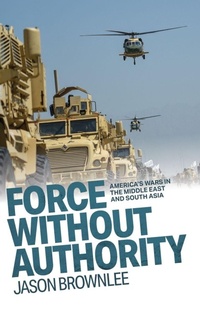
Force Without Authority
America's Wars in the Middle East and South Asia
Published on 27. February 2026
Book
Hardback
260 pages
978-0-19-780863-4 (ISBN)
Description
Force Without Authority explores why the United States' costliest military operations since Vietnam came up short and pushed Republican and Democratic leaders toward withdrawal and retrenchment. Covering the sweep of US armed interventions since the end of the Cold War, Jason Brownlee sets America's post-9/11 invasions in a thirty-five-year foreign-policy arc--from caution to bravado--and back. The al-Qaeda attacks suspended America's traditional aversion to high-risk military missions abroad. For the better part of a decade, presidents from both parties poured US troops into nation-building in Afghanistan and Iraq, only to return, in the 2010s, to a less hazardous and less ambitious program of eliminating enemies from a distance without reshaping politics on the ground. This same calculus pushed successive administrations toward diplomacy with America's most formidable foes. Critical and wide-sweeping, the book delivers a bracing audit of America's unipolar moment and a compelling case for statecraft over bluster.
More details
Language
English
Place of publication
New York
United States
Product notice
sewn/stitched
Cloth over boards
Dimensions
Height: 234 mm
Width: 156 mm
Thickness: 19 mm
Weight
544 gr
ISBN-13
978-0-19-780863-4 (9780197808634)
Copyright in bibliographic data and cover images is held by Nielsen Book Services Limited or by the publishers or by their respective licensors: all rights reserved.
Schweitzer Classification
Other editions
Additional editions
Book
04/2026
Oxford University Press Inc
€26.00
Shipment within 15-20 days
Person
Jason Brownlee is a professor of government at the University of Texas at Austin, where he writes and teaches about the comparative politics of the Global South and US foreign policy. His academic research and travels focus on the Muslim-majority countries of South Asia and West Asia (the Middle East).
Content
1. Introduction
The Argument
What This Book Is Not
Imposed Costs and Foreign-Policy Consequences
Road Map
2. Aggression and Resistance (1898-1989)
Weak Occupiers, Strong Societies
German and Japanese Exceptionalism
Echoes of Imperialism
Domestic Constraints on US Intervention
Conclusion
3. Cautious Goliath (1989-2001)
Toppling Noriega
Isolating Saddam
Somalia Syndrome
Battling Milosevic
Engaging Iran
Caging Iraq
Dividing Serbia Terrorists Beyond Reach
Conclusion
4. Warpath (2001-2004)
"An Urge for Reprisal"
Invading Afghanistan
Targeting Iraq
Invading Iraq
Conclusion
5. Compelled to Compromise (2004-2011)
Foreign Provocations
Compromising with Insurgents
Nation-Building Redux Obama's Surge Conclusion
6. Force Without Authority (2011-2014)
America's War, Pakistan's Fight
Getting Bin Laden
The Arab Spring and American Ambivalence
State Collapse in Yemen
Regime Change and Its Aftermath in Libya
Condemning, But Not Confronting Syria
Conclusion
7. Victory Without Invasion (2014-2018)
No More Nation-Building
Fertile Terrain for "Islamic State"
Retribution and Risk-Sharing
Prudence Over Panic
New President, Same Policy
Conclusion
8. Security in Retreat (2018-2025)
Indigenous Regime Change in Syria
Iran Nears the Nuclear Threshold
Pushing Iran to the Brink
Postponing Defeat in Afghanistan
Return of the Emirate
Conclusion
9. Conclusion
The Reemergence of Risk Aversion
Persistent Patterns of Regime Change
Lessons Learned by Rivals
The Dangers of Asymmetric Force References
The Argument
What This Book Is Not
Imposed Costs and Foreign-Policy Consequences
Road Map
2. Aggression and Resistance (1898-1989)
Weak Occupiers, Strong Societies
German and Japanese Exceptionalism
Echoes of Imperialism
Domestic Constraints on US Intervention
Conclusion
3. Cautious Goliath (1989-2001)
Toppling Noriega
Isolating Saddam
Somalia Syndrome
Battling Milosevic
Engaging Iran
Caging Iraq
Dividing Serbia Terrorists Beyond Reach
Conclusion
4. Warpath (2001-2004)
"An Urge for Reprisal"
Invading Afghanistan
Targeting Iraq
Invading Iraq
Conclusion
5. Compelled to Compromise (2004-2011)
Foreign Provocations
Compromising with Insurgents
Nation-Building Redux Obama's Surge Conclusion
6. Force Without Authority (2011-2014)
America's War, Pakistan's Fight
Getting Bin Laden
The Arab Spring and American Ambivalence
State Collapse in Yemen
Regime Change and Its Aftermath in Libya
Condemning, But Not Confronting Syria
Conclusion
7. Victory Without Invasion (2014-2018)
No More Nation-Building
Fertile Terrain for "Islamic State"
Retribution and Risk-Sharing
Prudence Over Panic
New President, Same Policy
Conclusion
8. Security in Retreat (2018-2025)
Indigenous Regime Change in Syria
Iran Nears the Nuclear Threshold
Pushing Iran to the Brink
Postponing Defeat in Afghanistan
Return of the Emirate
Conclusion
9. Conclusion
The Reemergence of Risk Aversion
Persistent Patterns of Regime Change
Lessons Learned by Rivals
The Dangers of Asymmetric Force References