

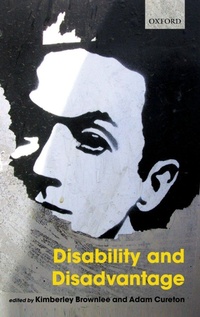
Disability and Disadvantage
Published on 4. June 2009
Book
Hardback
416 pages
978-0-19-923450-9 (ISBN)
Description
This book offers a much-needed investigation of moral and political issues concerning disability, and explores how the experiences of people with disabilities can lead to reconsideration of prominent positions on normative issues. Thirteen new essays examine such topics as the concept of disability, the conditions of justice, the nature of autonomy, healthcare distribution, and reproductive choices. The contributors are Norman Daniels, Ellen Daniels Zide, Leslie P. Francis, Christie Hartley, Richard Hull, Guy Kahane, F. M. Kamm, Rosalind McDougall, Jeff McMahan, Douglas MacLean, Susannah Rose, Anita Silvers, Julian Savulescu, Lorella Terzi, David Wasserman, and Jonathan Wolff.
Reviews / Votes
Disability studies is an exciting and expanding field within philosophy and bioethics, and anyone interested in this rich area of research will find rewarding reading in this volume * Jeffrey Blustein, Journal of Moral Philosophy * It makes a contribution to the contemporary literature on disability by confronting a number of difficult issues head on. * Mark Priestley Journal of Social Policy, Volume 40/1 2011 * In this thoughtfully assembled volume on philosophical issues in disability and disadvantage, editors Kimberley Brownlee and Adam Cureton have brought together an exciting mix of established and up and coming philosophers to address issues ranging from how to understand disability to whether and when to create children with disabilities * Rebecca L. Walker, Mind *More details
Language
English
Place of publication
Oxford
United Kingdom
Target group
College/higher education
Dimensions
Height: 240 mm
Width: 161 mm
Thickness: 27 mm
Weight
778 gr
ISBN-13
978-0-19-923450-9 (9780199234509)
Copyright in bibliographic data and cover images is held by Nielsen Book Services Limited or by the publishers or by their respective licensors: all rights reserved.
Schweitzer Classification
Other editions
Additional editions
Kimberley Brownlee | Adam Cureton
Disability and Disadvantage
Book
10/2011
1st Edition
Oxford University Press
€66.00
Shipment within 15-20 days
Persons
Kimberley Brownlee is a Professor of Philosophy at the University of British Columbia. Her current research focuses on sociability, social rights, loneliness, and freedom of association. She is the author of Being Sure of Each Other: An Essay on Social Rights and Freedoms (Oxford 2020), Conscience and Conviction: The Case for Civil Disobedience (Oxford 2012), co-editor of Disability and Disadvantage (Oxford 2009, with Adam Cureton), and co-editor of The Blackwell Companion to Applied Philosophy (Wiley 2016, with David Coady and Kasper Lippert-Rasmussen).
Adam Cureton is a doctoral candidate in philosophy at the University of North Carolina at Chapel Hill. He holds a BPhil in philosophy from Oxford University where he studied as a Rhodes Scholar. Adam is a fellow at the Parr Center for Ethics and holds fellowships from the National Science Foundation, the Dolores Zohrab Liebmann Foundation and the Institute for Humane Studies. His research interests lie primarily in ethics, metaethics and the history of ethics.
Adam Cureton is a doctoral candidate in philosophy at the University of North Carolina at Chapel Hill. He holds a BPhil in philosophy from Oxford University where he studied as a Rhodes Scholar. Adam is a fellow at the Parr Center for Ethics and holds fellowships from the National Science Foundation, the Dolores Zohrab Liebmann Foundation and the Institute for Humane Studies. His research interests lie primarily in ethics, metaethics and the history of ethics.
Content
Introduction ; 1. The welfarist account of disability ; 2. Disability, adaptation and inclusion ; 3. Vagaries of the natural lottery? Human diversity, disability and justice: A capability perspective ; 4. Disability among equals ; 5. An inclusive contractualism: Obligations to the mentally disabled* ; 6. No talent? Beyond the worst off!: A diverse theory of justice for disability ; 7. Understanding Autonomy in Light of Intellectual Disability ; 8. Respect Without Reason: Relating to Alzheimer's ; 9. Radical cognitive limitation ; 10. Disability, discrimination and irrelevant goods ; 11. Ethical constraints on allowing or causing the existence of people with disabilities ; 12. Impairment, flourishing and the moral nature of parenthood ; 13. Projected disability and parental responsibilities