

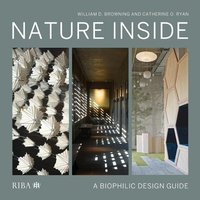
Nature Inside
A biophilic design guide
1st Edition
Published on 1. September 2020
Book
Hardback
288 pages
978-1-85946-903-3 (ISBN)
Description
Biophilic
design brings positive experiences of nature into the built environment -
whether in a domestic, work, leisure, healthcare, education or retail setting.
Written by proponents, who are also leading expert practitioners, this book is
the first design guide to biophilia for architects and interior designers.
By
raising awareness of biophilic design as a strategy to support psychological
and physiological wellbeing, Nature Inside illustrates how it can be
implemented, across a range of international case studies. It offers a plethora
of practical insight and real-world solutions for all designers.
Starting
with the principles and processes of biophilic design in practice, it showcases
a variety of interior spaces - residential, retail, workplace, hospitality,
education, healthcare and manufacturing. The final chapter looks 'outside the
walls', by providing a case study at the campus and city scale, concluding with
an essential practical toolkit.
Featured
projects include:
The London home of Kelly Hoppen MBE
Seesaw Coffee, Beijing, by nota architects
The Assemblage, New York, by Meyer Davis Studio
Central Library, Calgary, Canada, by Snohetta
Bank of America Tower, New York, by COOKFOX
TRi
Restaurant, Hong Kong, by IBUKU
design brings positive experiences of nature into the built environment -
whether in a domestic, work, leisure, healthcare, education or retail setting.
Written by proponents, who are also leading expert practitioners, this book is
the first design guide to biophilia for architects and interior designers.
By
raising awareness of biophilic design as a strategy to support psychological
and physiological wellbeing, Nature Inside illustrates how it can be
implemented, across a range of international case studies. It offers a plethora
of practical insight and real-world solutions for all designers.
Starting
with the principles and processes of biophilic design in practice, it showcases
a variety of interior spaces - residential, retail, workplace, hospitality,
education, healthcare and manufacturing. The final chapter looks 'outside the
walls', by providing a case study at the campus and city scale, concluding with
an essential practical toolkit.
Featured
projects include:
The London home of Kelly Hoppen MBE
Seesaw Coffee, Beijing, by nota architects
The Assemblage, New York, by Meyer Davis Studio
Central Library, Calgary, Canada, by Snohetta
Bank of America Tower, New York, by COOKFOX
TRi
Restaurant, Hong Kong, by IBUKU
More details
Language
English
Place of publication
London
United Kingdom
Target group
College/higher education
Professional and scholarly
Professional Practice & Development
Product notice
Paper over boards
Dimensions
Height: 214 mm
Width: 211 mm
Thickness: 27 mm
Weight
1060 gr
ISBN-13
978-1-85946-903-3 (9781859469033)
Copyright in bibliographic data and cover images is held by Nielsen Book Services Limited or by the publishers or by their respective licensors: all rights reserved.
Schweitzer Classification
Other editions
New editions

Book
approx. 07/2026
2nd Edition
RIBA Publishing
€62.00
Not yet published
Additional editions

E-Book
10/2020
1st Edition
RIBA Publishing
€61.99
Available for download

E-Book
10/2020
1st Edition
RIBA Publishing
€61.99
Available for download
Persons
William D. Browning co-founded the sustainability
consulting firm Terrapin Bright Green. He is a founding board member of the US
Green Building Council and an Honorary member of the American Institute of
Architects. He received the 2015 American Society of Interior Designers
national Design for Humanity award for work in biophilic and green building
design.
Catherine O. Ryan is the director of projects at
Terrapin Bright Green with twenty years' experience in design and environmental
sustainability. She is a leading international biophilic design consultant for
buildings, landscape and master planning projects. She has published
extensively on biophilic design for which she received the 2014 Environmental
Design Research Association's Achievement Award.
consulting firm Terrapin Bright Green. He is a founding board member of the US
Green Building Council and an Honorary member of the American Institute of
Architects. He received the 2015 American Society of Interior Designers
national Design for Humanity award for work in biophilic and green building
design.
Catherine O. Ryan is the director of projects at
Terrapin Bright Green with twenty years' experience in design and environmental
sustainability. She is a leading international biophilic design consultant for
buildings, landscape and master planning projects. She has published
extensively on biophilic design for which she received the 2014 Environmental
Design Research Association's Achievement Award.
Content
Acknowledgements
Foreword
Introduction What is biophilia, and what does it mean for buildings and
spaces?
PART 1
Chapter 1 The scientific and business case for biophilic design
Chapter 2 Biophilic design in practice: principles, processes and
outcomes
Chapter 3 At the small scale: fixtures, fittings, fabrics and finishes
PART 2
Case
studies, illustrating different aspects of the biophilic design process, and
outcomes including, where available, post-occupancy data
Chapter 4 In the home: residential design
Chapter 5 In school: learning environments
Chapter 6 In the store: retail experience
Chapter 7 In the office: workplace experience
Chapter 8 In the hotel: hospitality experience
Chapter 9 In the hospital: healing environments
Chapter 10 In the factory: manufacturing facilities
Chapter 11 In the community: civic spaces and transit hubs
Chapter 12 Outside the walls: biophilic design at campus, neighbourhood
and city scale
APPENDICES
Toolkit
Endnotes
Glossary
Index
Bibliography
Foreword
Introduction What is biophilia, and what does it mean for buildings and
spaces?
PART 1
Chapter 1 The scientific and business case for biophilic design
Chapter 2 Biophilic design in practice: principles, processes and
outcomes
Chapter 3 At the small scale: fixtures, fittings, fabrics and finishes
PART 2
Case
studies, illustrating different aspects of the biophilic design process, and
outcomes including, where available, post-occupancy data
Chapter 4 In the home: residential design
Chapter 5 In school: learning environments
Chapter 6 In the store: retail experience
Chapter 7 In the office: workplace experience
Chapter 8 In the hotel: hospitality experience
Chapter 9 In the hospital: healing environments
Chapter 10 In the factory: manufacturing facilities
Chapter 11 In the community: civic spaces and transit hubs
Chapter 12 Outside the walls: biophilic design at campus, neighbourhood
and city scale
APPENDICES
Toolkit
Endnotes
Glossary
Index
Bibliography