

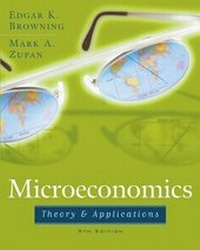
Microeconomic Theory & Applications
9th Edition
Published on 1. December 2005
Book
Paperback/Softback
624 pages
978-0-471-67943-1 (ISBN)
Description
Written by distinguished authorities in the field, this book offers the liveliest writing, the right sequence of topics, and exceptionally well developed graphs with unusually thorough explanations. all at the right level for people learning microeconomics. It follows a practical, real-world approach through a wealth of applications that demonstrate the relevance of microeconomics to everyday life. Completely updated with the latest information in the field, the new ninth edition also continues the tradition of superior quality and precise technical coverage.
More details
Edition
9., Auflage
Language
English
Place of publication
New York
United States
Publishing group
John Wiley and Sons Ltd
Target group
College/higher education
Edition type
Revised edition
Illustrations
ill
Dimensions
Height: 25.6 cm
Width: 20.3 cm
Thickness: 21 mm
Weight
970 gr
ISBN-13
978-0-471-67943-1 (9780471679431)
Schweitzer Classification
Other editions
New editions
Book
09/2009
10th Edition
Wiley
€225.30
Article exhausted; check for reprint
Previous edition
Book
05/2003
8th Edition
Wiley
€135.00
Article exhausted; check for reprint
Persons
Edgar K. Browning is the Alfred F. Chalk Professor in Economics at Texas A&M University and his specialty is Public Economics. He earned a B.A. in Economics from the University of Virginia and a Ph.D. in Economics from Princeton University in 1971. A selected list of his publications includes " A Neglected Welfare Cost of Monopoly- and Most other Product Market Distortions," Journal of Public Economics, 1997; The Non-Tax Wedge," Journal of Public Economics, 1994; "The Marginal Cost of Redistribution," Public Finance Quarterly, 1993; "On the Marginal Welfare Cost of Taxation," American Economic Review, 1987; "The Trade-Off Between Equality and Efficiency," Journal of Political Economy, 1984.
Mark A. Zupan is currently the Dean of the William E. Simon Graduate School of Business Administration at the University of Rochester. Previously, he was dean of the University of Arizona's Eller College of Business and Public Administration since 1997. He earned a B.A. in Economics from Harvard University and a Ph.D. in Economics from the Massachusetts Institute of Technology. Dr. Zupan's fields of specialization are industrial organization, regulation and political economy. He is the co-author on two books and more than 20 articles in journals such as American Economic Review, Public Choice, and the Journal of Law and Economics. He's also the recipient of several teaching awards at both USC and Harvard.
Mark A. Zupan is currently the Dean of the William E. Simon Graduate School of Business Administration at the University of Rochester. Previously, he was dean of the University of Arizona's Eller College of Business and Public Administration since 1997. He earned a B.A. in Economics from Harvard University and a Ph.D. in Economics from the Massachusetts Institute of Technology. Dr. Zupan's fields of specialization are industrial organization, regulation and political economy. He is the co-author on two books and more than 20 articles in journals such as American Economic Review, Public Choice, and the Journal of Law and Economics. He's also the recipient of several teaching awards at both USC and Harvard.
Content
Chapter 1: An Introduction to Microeconomics
Chapter 2: Supply and Demand
Chapter 3: The Theory of Consumer Choice
Chapter 4: Individual and Market Demand
Chapter 5: Using Consumer Choice Theory
Chapter 6: Exchange, Efficiency, and Prices
Chapter 7: Production.
Chapter 8: The Cost of Production
Chapter 9: Profit Maximization in Perfectly Competitive Markets
Chapter 10: Using the Competitive Model
Chapter 11: Monopoly
Chapter 12: Product Pricing with Monopoly Power
Chapter 13: Monopolistic Competition and Oligopoly
Chapter 14: Game Theory and the Economics of Information.
Chapter 15: Using Noncompetitive Market Models.
Chapter 16: Employment and Pricing of Inputs.
Chapter 17: Wages, Rent, Interest, and Profit.
Chapter 18: Using Input Market Analysis.
Chapter 19: General Equilibrium Analysis and Economic Efficiency.
Chapter 20: Public Goods and Externalities.
Answers to Selected Problems
Glossary (new in the 9th edition) Index
Chapter 2: Supply and Demand
Chapter 3: The Theory of Consumer Choice
Chapter 4: Individual and Market Demand
Chapter 5: Using Consumer Choice Theory
Chapter 6: Exchange, Efficiency, and Prices
Chapter 7: Production.
Chapter 8: The Cost of Production
Chapter 9: Profit Maximization in Perfectly Competitive Markets
Chapter 10: Using the Competitive Model
Chapter 11: Monopoly
Chapter 12: Product Pricing with Monopoly Power
Chapter 13: Monopolistic Competition and Oligopoly
Chapter 14: Game Theory and the Economics of Information.
Chapter 15: Using Noncompetitive Market Models.
Chapter 16: Employment and Pricing of Inputs.
Chapter 17: Wages, Rent, Interest, and Profit.
Chapter 18: Using Input Market Analysis.
Chapter 19: General Equilibrium Analysis and Economic Efficiency.
Chapter 20: Public Goods and Externalities.
Answers to Selected Problems
Glossary (new in the 9th edition) Index