

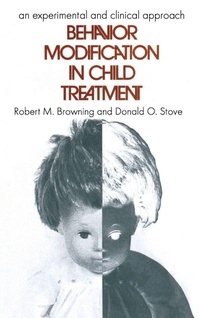
Behavior Modification in Child Treatment
An Experimental and Clinical Approach
1st Edition
Published on 20. September 2017
Book
Hardback
432 pages
978-1-138-51931-2 (ISBN)
Description
This book is the first attempt to validate behavior modification techniques in a carefully controlled experimental treatment environment for emotionally disturbed children. Such special settings permit carefully conducted research experiments can be carried out. This is the first book to synthesize scientific and clinical approaches to human behavior, indicating that behavior modification may one day be as much an applied science as engineering or medicine.
This experimental approach introduces scientific rigor to the clinical setting, as evidenced by precise measurement of behavior variables, detailed specification of treatment procedures, and the use of sophisticated experimental designs to provide objective evaluation of the effectiveness of treatment programs. In this approach, series of idiographic (single-subject) case studies are conducted in a precise manner with each patient-subject admitted to the treatment program. The general research methodology is similar to that used in the broad area of operant conditioning, and most work reported in the book was conducted within a learning theory or behavior-modification framework.
Browning and Stover discuss the general problems of developing and controlling a total therapeutic milieu, presenting practical discussions of problems of data collection, decisions about treatment programs to be used, staffing problems, and documental opinion on the relative values of various treatment techniques. Throughout attention is devoted to developing a method for answering common questions of parent, child-care worker, and professional. The authors conducted symposia on the material contained in this book at various national and regional meetings and have lectured extensively on college campuses. It is a ground-breaking study.
This experimental approach introduces scientific rigor to the clinical setting, as evidenced by precise measurement of behavior variables, detailed specification of treatment procedures, and the use of sophisticated experimental designs to provide objective evaluation of the effectiveness of treatment programs. In this approach, series of idiographic (single-subject) case studies are conducted in a precise manner with each patient-subject admitted to the treatment program. The general research methodology is similar to that used in the broad area of operant conditioning, and most work reported in the book was conducted within a learning theory or behavior-modification framework.
Browning and Stover discuss the general problems of developing and controlling a total therapeutic milieu, presenting practical discussions of problems of data collection, decisions about treatment programs to be used, staffing problems, and documental opinion on the relative values of various treatment techniques. Throughout attention is devoted to developing a method for answering common questions of parent, child-care worker, and professional. The authors conducted symposia on the material contained in this book at various national and regional meetings and have lectured extensively on college campuses. It is a ground-breaking study.
More details
Language
English
Place of publication
London
United Kingdom
Publishing group
Taylor & Francis Ltd
Target group
College/higher education
Dimensions
Height: 235 mm
Width: 157 mm
Thickness: 28 mm
Weight
773 gr
ISBN-13
978-1-138-51931-2 (9781138519312)
Copyright in bibliographic data and cover images is held by Nielsen Book Services Limited or by the publishers or by their respective licensors: all rights reserved.
Schweitzer Classification
Other editions
Additional editions
E-Book
09/2017
Routledge
€69.99
Available for download
E-Book
09/2017
Routledge
€69.99
Available for download
Book
01/2009
1st Edition
AldineTransaction
€77.80
Shipment within 10-15 days
Person
Robert M. Browning
Content
Preface, 1. The Experimental-Clinical Method, 2. The Residential Setting and Treatment Groups, 3. Measurement, 4. Same-Subject Experimental Designs, 5. Treatment Techniques, 6. Unexpected Values of Social Reinforcers, 7. Case Studies, 1. Heidi, 2. Jim, 3. Sharon, 4. Will, 5. Dan, 8. Conclusion, References, Index