

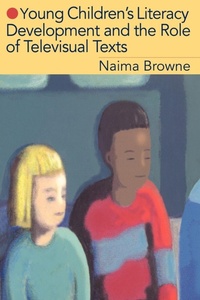
Young Children's Literacy Development and the Role of Televisual Texts
1st Edition
Published on 10. June 1999
Book
Paperback/Softback
218 pages
978-0-7507-0856-2 (ISBN)
Description
Explores and analyses the ways in which very young children's developing literacy can be supported by their experience of watching TV and videos. This book addresses ways teachers can use children's experience of watching stories on video or TV to feed back into their own story-writing, reading, story-telling and role-play in the classroom. Explores areas specifically highlighted in the National Curriculum for English, and will benefit teachers developing their literacy teaching in light of the government Literacy Hour initiative.
Reviews / Votes
'... presents a lively and imaginative exploration of children's literacy and their responses to televisual texts. The text makes a useful contribution to the literature of children and television and provides a well focused account of the area with particularl reference to early years. Early years specialists will appreciate the synoptic approach to the key issues and will enjoy the voices of the researched as they speak from the text.' - Richard Eke, Early Years JournalMore details
Language
English
Place of publication
London
United Kingdom
Publishing group
Taylor & Francis Ltd
Target group
Professional and scholarly
Postgraduate and Professional
Dimensions
Height: 234 mm
Width: 156 mm
Thickness: 12 mm
Weight
342 gr
ISBN-13
978-0-7507-0856-2 (9780750708562)
Copyright in bibliographic data and cover images is held by Nielsen Book Services Limited or by the publishers or by their respective licensors: all rights reserved.
Schweitzer Classification
Other editions
Additional editions
E-Book
06/2005
1st Edition
Routledge
€68.49
Available for download
E-Book
06/2005
1st Edition
Routledge
€68.49
Available for download
Book
06/1999
1st Edition
Routledge Falmer
€294.20
Article not available for order
Person
Browne, Naima
Content
Chapter 1 Introduction; Chapter 2 Teachers and Schools; Chapter 3 Children and Parents; Chapter 4 Children's Perspectives; Chapter 5 Reading Different Texts; Chapter 6 Storytelling and the Moves into Writing; Chapter 7 Gender Issues;