

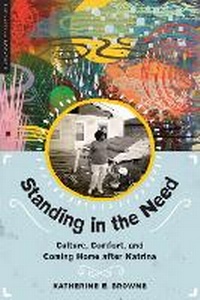
Standing in the Need
Culture, Comfort, and Coming Home After Katrina
Published on 1. September 2015
Book
Paperback/Softback
281 pages
978-1-4773-0737-3 (ISBN)
Description
Standing in the Need presents an intimate account of an African American family's ordeal after Hurricane Katrina. Before the storm struck, this family of one hundred fifty members lived in the bayou communities of St. Bernard Parish just outside New Orleans. Rooted there like the wild red iris of the coastal wetlands, the family had gathered for generations to cook and share homemade seafood meals, savor conversation, and refresh their interconnected lives.
In this lively narrative, Katherine Browne weaves together voices and experiences from eight years of post-Katrina research. Her story documents the heartbreaking struggles to remake life after everyone in the family faced ruin. Cast against a recovery landscape managed by outsiders, the efforts of family members to help themselves could get no traction; outsiders undermined any sense of their control over the process. In the end, the insights of the story offer hope. Written for a broad audience and supported by an array of photographs and graphics, Standing in the Need offers readers an inside view of life at its most vulnerable.
In this lively narrative, Katherine Browne weaves together voices and experiences from eight years of post-Katrina research. Her story documents the heartbreaking struggles to remake life after everyone in the family faced ruin. Cast against a recovery landscape managed by outsiders, the efforts of family members to help themselves could get no traction; outsiders undermined any sense of their control over the process. In the end, the insights of the story offer hope. Written for a broad audience and supported by an array of photographs and graphics, Standing in the Need offers readers an inside view of life at its most vulnerable.
Reviews / Votes
"The book's close ethnographic style gives us a textured view of the daily practices through which those most impacted by disasters make their lives meaningful and assist one another. . . . The book features an innovative use of graphic art that familiarizes readers with the experiences as well as the historical and environmental contexts of Katrina's displaced." (Current Anthropology) "This book answers the question of what people need in order to recover from disasters like Hurricane Katrina...(it) is distinguished by the comprehensive nature of its ethnographic methods, the eight-year time period of the in-depth research, and the recommendations for how people can support families who undergo devastating trauma from events like a hurricane." (Choice) ". . . her text reads like good journalism - sharp, clear, observant, insightful, and meaningful. Browne's seasoned expertise as a cultural anthropologist and keen writing skills allow her to produce a book that offers much to disaster recovery professionals, policymakers, and academics outside her field about disaster recovery politics, the complexities and variability of African-Americans' social lives and experiences, as well as the continuities of institutionalized racism in the United States." (Ethnic and Racial Studies) "Drawing on the post-storm experience of the St. Bernard family, Browne suggests that recovery agencies could reduce suffering and speed healing by learning about the history, culture, and distinctive customs and needs of disaster-impacted communities. The provision of places to gather, places to cook big meals, and places to care for children could assist in repairing frayed cultural bonds and offer a roadmap for recovery." (Contemporary Sociology)More details
Series
Language
English
Place of publication
Austin, TX
United States
Target group
College/higher education
Dimensions
Height: 229 mm
Width: 152 mm
Thickness: 18 mm
Weight
399 gr
ISBN-13
978-1-4773-0737-3 (9781477307373)
Copyright in bibliographic data and cover images is held by Nielsen Book Services Limited or by the publishers or by their respective licensors: all rights reserved.
Schweitzer Classification
Person
KATHERINE E. BROWNE is a professor of anthropology at Colorado State University. She has published two previous books and produced two documentary films, including Still Waiting: Life After Katrina, which also portrays the family in this book. It has been broadcast on PBS stations in the United States and Canada. Browne is the recipient of the American Anthropological Association's 2018 Franz Boas Award for Exemplary Service to Anthropology.
Content
Preface
Acknowledgments
Figures
Introduction
Part I. Shock Wave
1. When They Say Go
2. The Culture Broker
3. Not Just Any Red Beans
Part II. Wave of Trouble
4. Ruin and Relief
5. Trial by Trailer
6. Bayou Speech and Bayou Style
7. Whose Road Home?
8. Almost to the Ground
Part III. Wave of Reckoning
9. Settling
10. Call to Race
11. By and By
Coda
Appendix. Methodology
Notes
Bibliography
About the Author and Series Editor
Index
Acknowledgments
Figures
Introduction
Part I. Shock Wave
1. When They Say Go
2. The Culture Broker
3. Not Just Any Red Beans
Part II. Wave of Trouble
4. Ruin and Relief
5. Trial by Trailer
6. Bayou Speech and Bayou Style
7. Whose Road Home?
8. Almost to the Ground
Part III. Wave of Reckoning
9. Settling
10. Call to Race
11. By and By
Coda
Appendix. Methodology
Notes
Bibliography
About the Author and Series Editor
Index