

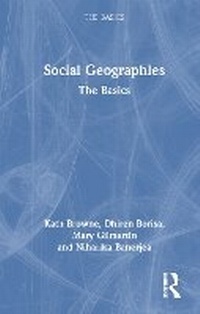
Social Geographies
The Basics
1st Edition
Published on 24. April 2024
Book
Hardback
190 pages
978-1-032-20183-2 (ISBN)
Description
Social Geographies: The Basics introduces what social geography is, and what it might be. It outlines the key contours of social geographies, and also disrupts some of the conventions of the discipline in both its content and structure.
This book approaches social geographies by beginning with the resistances, contestations and 'solutions' that communities use to challenge exclusions in place and space in order to create equitable societies. It then addresses the inequalities, precarities, and 'problems' that prompt these interventions. This allows the book to emphasise the importance of activism in the here and now, and to show how activism often makes issues visible and contested in ways that are then theorised by academics. Social Geographies starts with solidarities, communities, and networks before moving to examine difference, precarity, and mobilities. Each chapter offers key case studies that centre resistance, contestations of inequitable power, and local knowledges that can often be seen as 'solutions' to national and transnational issues, creating a decolonial understanding of 'social geography from below' within and across national contexts.
This book is essential reading for undergraduate students and readers new to the area, as well as anyone studying introductory geography, social, cultural and critical geography, 'the spatial turn' and issues of spatialities, and key issues like precarity, power, difference, equality, and mobilities.
This book approaches social geographies by beginning with the resistances, contestations and 'solutions' that communities use to challenge exclusions in place and space in order to create equitable societies. It then addresses the inequalities, precarities, and 'problems' that prompt these interventions. This allows the book to emphasise the importance of activism in the here and now, and to show how activism often makes issues visible and contested in ways that are then theorised by academics. Social Geographies starts with solidarities, communities, and networks before moving to examine difference, precarity, and mobilities. Each chapter offers key case studies that centre resistance, contestations of inequitable power, and local knowledges that can often be seen as 'solutions' to national and transnational issues, creating a decolonial understanding of 'social geography from below' within and across national contexts.
This book is essential reading for undergraduate students and readers new to the area, as well as anyone studying introductory geography, social, cultural and critical geography, 'the spatial turn' and issues of spatialities, and key issues like precarity, power, difference, equality, and mobilities.
More details
Series
Language
English
Place of publication
London
United Kingdom
Publishing group
Taylor & Francis Ltd
Target group
College/higher education
General and Undergraduate Core
Illustrations
25 s/w Abbildungen, 25 s/w Photographien bzw. Rasterbilder
25 Halftones, black and white; 25 Illustrations, black and white
Dimensions
Height: 198 mm
Width: 129 mm
Weight
296 gr
ISBN-13
978-1-032-20183-2 (9781032201832)
Copyright in bibliographic data and cover images is held by Nielsen Book Services Limited or by the publishers or by their respective licensors: all rights reserved.
Schweitzer Classification
Other editions
Additional editions
E-Book
04/2024
1st Edition
Routledge
€31.49
Available for download
E-Book
04/2024
1st Edition
Routledge
€31.49
Available for download
Book
04/2024
1st Edition
Routledge
€31.50
Shipment within 10-20 days
Persons
Kath Browne is Professor of Geography at University College Dublin, Ireland. Her research focuses on social justice and inequalities, specifically around gender and sexualities. She has worked with those marginalised because of their sexual and gender identities, exploring how lives can be ameliorated in ways that take place seriously. She has also worked on those who are opposed to sexual and gender equalities, developing the concept of heteroactivism. She leads the Beyond Opposition research project.
Dhiren Borisa is a Dalit queer activist, poet and urban sexual geographer and is Assistant Professor at Jindal Global Law School, India. He is an Urban Studies International Fellow 2022. Dhiren attained his PhD from Jawaharlal Nehru University, New Delhi on queer cartographies of desires in Delhi. His research engages with sexual mappings and makings of cities from an intersectional and decolonial lens both among queer spaces in India and in diasporic queer worldings.
Mary Gilmartin is Professor of Geography at Maynooth University, Ireland. Her research focuses on migration, mobilities and spatial justice, and she has extensive experience of teaching undergraduate courses in social geography. She was Managing Editor of the journal Social & Cultural Geography from 2014 to 2018, and remains a member of that journal's editorial board.
Niharika Banerjea teaches gender sexuality and queer studies at the Jindal Global Law School, O.P. Jindal Global University, India. Working across and drawing from sociology, geographies of sexualities, and social anthropology, she is engaged with queer-feminist living and activisms in contemporary India. She identifies as a queer academic activist as a way to critically address familiar binaries between academia and activism - in classrooms, activist spaces, and writing practices. Niharika is a member of Sappho for Equality, the activist forum for lesbian, bisexual women, and transmasculine persons' rights.
Dhiren Borisa is a Dalit queer activist, poet and urban sexual geographer and is Assistant Professor at Jindal Global Law School, India. He is an Urban Studies International Fellow 2022. Dhiren attained his PhD from Jawaharlal Nehru University, New Delhi on queer cartographies of desires in Delhi. His research engages with sexual mappings and makings of cities from an intersectional and decolonial lens both among queer spaces in India and in diasporic queer worldings.
Mary Gilmartin is Professor of Geography at Maynooth University, Ireland. Her research focuses on migration, mobilities and spatial justice, and she has extensive experience of teaching undergraduate courses in social geography. She was Managing Editor of the journal Social & Cultural Geography from 2014 to 2018, and remains a member of that journal's editorial board.
Niharika Banerjea teaches gender sexuality and queer studies at the Jindal Global Law School, O.P. Jindal Global University, India. Working across and drawing from sociology, geographies of sexualities, and social anthropology, she is engaged with queer-feminist living and activisms in contemporary India. She identifies as a queer academic activist as a way to critically address familiar binaries between academia and activism - in classrooms, activist spaces, and writing practices. Niharika is a member of Sappho for Equality, the activist forum for lesbian, bisexual women, and transmasculine persons' rights.
Content
Introduction: Defining Social Geographies, 1. Making Social Change Possible: Communities, Activism, Resistance, and Solidarity, 2. Geographies of Difference, 3. Geographies of Precarity, 4. Movement, Migration, Mobilities, Conclusion: Concluding Dialogue