

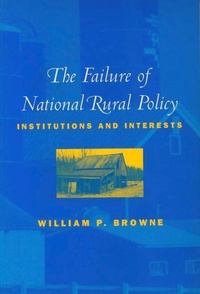
The Failure of National Rural Policy
Institutions and Interests
Will be published approx. on 15. August 2001
Book
Paperback/Softback
224 pages
978-0-87840-858-0 (ISBN)
Description
Modern farm policy emerged in the United States in 1862, leading to an industrialized agriculture that made the farm sector collectively more successful even as many individual farmers failed. Ever since, a healthy farm economy has been seen as the key to flourishing rural communities, and the problems of rural nonfarmers, former farmers, nonfarm residents, and unfarmed regions were ignored by policymakers. In "The Failure of National Rural Policy", William P. Browne blends history, politics, and economics to show that federal government emphasis on farm productivity has failed to meet broader rural needs and actually has increased rural poverty. He explains how strong public institutions, which developed agrarianism, led to narrowed concepts of the public interest. Reviewing past efforts to expand farm policy benefits to other rural residents, Browne documents the fragmentation of farm policy within the agricultural establishment as farm services grew, the evolution of political turf protection, and the resultant difficulties of rural advocacy.
Arguing for an integrated theory of governing institutions and related political interests, he maintains that nonfarm rural society can make a realistic claim for public policy assistance. Written informally, each chapter is followed by comments on the implications of its topics and summaries of key points. This book will serve as a stimulating text for students of public policy, national affairs, rural sociology, and community development - as well as anyone concerned with the future of agrarian America.
Arguing for an integrated theory of governing institutions and related political interests, he maintains that nonfarm rural society can make a realistic claim for public policy assistance. Written informally, each chapter is followed by comments on the implications of its topics and summaries of key points. This book will serve as a stimulating text for students of public policy, national affairs, rural sociology, and community development - as well as anyone concerned with the future of agrarian America.
Reviews / Votes
Browne's criticisms of analytic knowledge provide a users' perspective on policy research that should be read by all those wishing to engage policymakiers with their analytical findings... The book stands as an important case study of the interaction of interests and institutions in national policymaking and is important reading for the rural policy community. Journal of Regional ScienceMore details
Language
English
Place of publication
Washington, DC
United States
Target group
College/higher education
Professional and scholarly
US School Grade: College Graduate Student and over
Product notice
Paperback (trade)
Illustrations
Not illustrated
Dimensions
Height: 228 mm
Width: 162 mm
Thickness: 18 mm
Weight
376 gr
ISBN-13
978-0-87840-858-0 (9780878408580)
Copyright in bibliographic data and cover images is held by Nielsen Book Services Limited or by the publishers or by their respective licensors: all rights reserved.
Schweitzer Classification
Person
William P. Browne is professor of political science at Central MichiganUniversity. His many books include Cultivating Congress: Constituents, Issues, and Interests in Agricultural Policymaking (University Press of Kansas, 1995), Groups, Interests, and U.S. Public Policy (Georgetown University Press, 1998).
Content
Preface 1. A Troubled Rural Society: Misperceptions of Farming 2. Other Social Misperceptions that Miss Rural Problems 3. An Institutional Perspective 4. Rural Policy as Farm Policy 5. The Agragrian Myth as Fundamentalist Vision 6. Collective versus Selective Benefits and Farm Interests 7. Basic Rural Problems Gain Attention-Almost 8. Concentrated but Fragmented Public Institutions 9. The Resulting Fragmentation of Policy 10. The Impossible Task of Rural Advocacy 11. The Rural Poverty Mess 12. Understanding Congressional Anomalies 13. The Environmental Policy Contrast 14. A Final Explanation Notes Index