

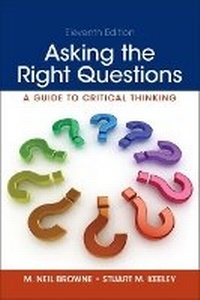
Asking the Right Questions
11th Edition
Published on 19. September 2014
Book
Paperback/Softback
192 pages
978-0-321-90795-0 (ISBN)
Unfortunately, price unknown
Article is exhausted; no reprint
Description
Used in a variety of courses in various disciplines, Asking the Right Questions helps students bridge the gap between simply memorizing or blindly accepting information, and the greater challenge of critical analysis and synthesis. Specifically, this concise text teaches students to think critically by exploring the components of arguments--issues, conclusions, reasons, evidence, assumptions, language--and on how to spot fallacies and manipulations and obstacles to critical thinking in both written and visual communication. It teaches them to respond to alternative points of view and develop a solid foundation for making personal choices about what to accept and what to reject.
More details
Other editions
Previous edition
Book
07/2011
10th Edition
Pearson
€64.56
Article exhausted; check for reprint
Content
Chapter 1: The Benefit and Manner of Asking the Right Questions
Chapter 2: Speed Bumps Interfering with Your Critical Thinking
Chapter 3: What Are the Issue and the Conclusion?
Chapter 4: What Are the Reasons?
Chapter 5: What Words or Phrases Are Ambiguous?
Chapter 6: What Are the Value and Descriptive Assumptions?
Chapter 7: Are There Any Fallacies in the Reasoning?
Chapter 8: How Good Is the Evidence: Intuition, Personal Experience, Case Examples, Testimonials, and Appeals to Authority?
Chapter 9: How Good Is the Evidence: Personal Observation, Research Studies, and Analogies?
Chapter 10: Are There Rival Causes?
Chapter 11: Are the Statistics Deceptive?
Chapter 12 What Significant Information Is Omitted?
Chapter 13: What Reasonable Conclusions Are Possible?
Chapter 2: Speed Bumps Interfering with Your Critical Thinking
Chapter 3: What Are the Issue and the Conclusion?
Chapter 4: What Are the Reasons?
Chapter 5: What Words or Phrases Are Ambiguous?
Chapter 6: What Are the Value and Descriptive Assumptions?
Chapter 7: Are There Any Fallacies in the Reasoning?
Chapter 8: How Good Is the Evidence: Intuition, Personal Experience, Case Examples, Testimonials, and Appeals to Authority?
Chapter 9: How Good Is the Evidence: Personal Observation, Research Studies, and Analogies?
Chapter 10: Are There Rival Causes?
Chapter 11: Are the Statistics Deceptive?
Chapter 12 What Significant Information Is Omitted?
Chapter 13: What Reasonable Conclusions Are Possible?