

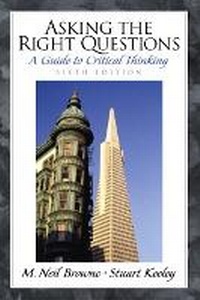
Asking the Right Questions
A Guide to Critical Thinking
6th Edition
Published on 10. August 2000
Book
Paperback/Softback
221 pages
978-0-13-089134-1 (ISBN)
Description
For all level Critical Thinking, Argumentative Writing, and Informal Logic courses in English, Social Science, Philosophy, Education, Journalism, and Mass Communication departments.
This highly popular text helps students bridge the gap between simply memorizing or blindly accepting information, and the greater challenge of critical analysis and synthesis. It teaches them to respond to alternative points of view and develop a solid foundation for making personal choices about what to accept and what to reject.
This highly popular text helps students bridge the gap between simply memorizing or blindly accepting information, and the greater challenge of critical analysis and synthesis. It teaches them to respond to alternative points of view and develop a solid foundation for making personal choices about what to accept and what to reject.
Reviews / Votes
"I have assigned ASKING THE RIGHT QUESTIONS to a wide range of students in a wide range of courses over my fourteen years as a college professor. First-year college students have used the book to analyze and evaluate arguments about contemporary business issues. College juniors and seniors have used the book to analyze and evaluate legal arguments, and issues related to race and gender. ... Many of my students tell me the book has changed the way they read, write, and argue." - Andrea Giampetro-Meyer, J.D., Loyola College in Maryland"I think ASKING THE RIGHT QUESTIONS is one of the most valuable resources currently available for higher education courses as well as for other contexts.... Virtually any course could benefit from the addition of this book and the integration of the authors' approach to critical thinking. I myself have used the book for several years in a variety of courses and know that it has truly enhanced my students' rational thinking processes." - Norrine L. Ostrowski, Ph.D., University of Minnesota-Morris
"As an instructor I like the approach ASKING THE RIGHT QUESTIONS takes. It is practical and uses a cross-disciplinary approach. Asking the "right" questions is a technique that can be used in any discipline at any level."- Valeri Farmer-Dougan, Illinois State University
More details
Edition
6th edition
Language
English
Place of publication
United States
Publishing group
Pearson Education (US)
Target group
Professional and scholarly
Dimensions
Width: 228 mm
Thickness: 12 mm
Weight
294 gr
ISBN-13
978-0-13-089134-1 (9780130891341)
Copyright in bibliographic data and cover images is held by Nielsen Book Services Limited or by the publishers or by their respective licensors: all rights reserved.
Schweitzer Classification
Other editions
New editions
Book
07/2003
7th Edition
Pearson
€23.51
Article exhausted; check for reprint
Previous edition

Book
02/1998
5th Edition
Pearson
€23.51
Article exhausted; check for reprint
Content
1. The Benefit of Asking the Right Questions.
2. What Are the Issue and the Conclusion?
3. What Are the Reasons?
4. What Words or Phrases Are Ambiguous?
5. What Are the Value Conflicts and Assumptions?
6. What Are the Descriptive Assumptions?
7. Are There Any Fallacies in the Reasoning?
8. How Good Is the Evidence: Intuition, Appeals to Authority, and Testimonials?
9. How Good Is the Evidence: Personal Observation, Case Studies, Research Studies, and Analogies?
10. Are There Rival Causes?
11. Are the Statistics Deceptive?
12. What Significant Information Is Omitted?
13. What Reasonable Conclusions Are Possible?
14. Practice and Review.
Final Word.
Index.
2. What Are the Issue and the Conclusion?
3. What Are the Reasons?
4. What Words or Phrases Are Ambiguous?
5. What Are the Value Conflicts and Assumptions?
6. What Are the Descriptive Assumptions?
7. Are There Any Fallacies in the Reasoning?
8. How Good Is the Evidence: Intuition, Appeals to Authority, and Testimonials?
9. How Good Is the Evidence: Personal Observation, Case Studies, Research Studies, and Analogies?
10. Are There Rival Causes?
11. Are the Statistics Deceptive?
12. What Significant Information Is Omitted?
13. What Reasonable Conclusions Are Possible?
14. Practice and Review.
Final Word.
Index.