

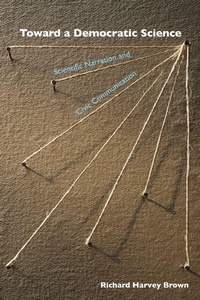
Toward a Democratic Science
Scientific Narration and Civic Communication
Will be published approx. on 24. January 2014
Book
Paperback/Softback
304 pages
978-0-300-20753-8 (ISBN)
Description
In this important book, a leading authority in the field of social theory and communication shows how scientific practice is a rhetorical and narrative activity, a story well told. Richard Harvey Brown develops the idea of science as narration, casts various scientific disciplines as literary genres, and argues that expert knowledge of any kind is a form of power. He then explains how a narrative view of science can help integrate science within a democratic civic discourse.
Brown shows why social science knowledge is as much a rhetorical enterprise as is the social reality that it describes. He construes laboratory science, physics, ethnography, sociology, philosophy, and astronomy as genres, narratives, and other rhetorical practices, and thereby portrays science as a special kind of narrative discourse that generates theories and shapes their validity and significance. He next focuses on the political dimensions of science, including the politics of psychology in the United States, showing how power and knowledge shape, limit, and infuse each other. Brown argues that this linguistically and socially constructed character of knowledge does not undermine its truth value but rather reaffirms the moral status and political responsibilities of its practitioners. In one important chapter, written with Robert Brulle, he explores the movement for environmental justice in the United States, showing how ordinary people can use science as part of a larger civic narration. Brown concludes by discussing how the rationality of science can be preserved even as it is subsumed within a rational and moral civic discourse.
Brown shows why social science knowledge is as much a rhetorical enterprise as is the social reality that it describes. He construes laboratory science, physics, ethnography, sociology, philosophy, and astronomy as genres, narratives, and other rhetorical practices, and thereby portrays science as a special kind of narrative discourse that generates theories and shapes their validity and significance. He next focuses on the political dimensions of science, including the politics of psychology in the United States, showing how power and knowledge shape, limit, and infuse each other. Brown argues that this linguistically and socially constructed character of knowledge does not undermine its truth value but rather reaffirms the moral status and political responsibilities of its practitioners. In one important chapter, written with Robert Brulle, he explores the movement for environmental justice in the United States, showing how ordinary people can use science as part of a larger civic narration. Brown concludes by discussing how the rationality of science can be preserved even as it is subsumed within a rational and moral civic discourse.
Reviews / Votes
"Brown is a gifted theorist and critic. He has a keen sense of scientific discourse as rhetoric and deftly uses dialectical method, represented especially by the joining of science and politics as narration."-Herbert W. Simons, School of Communications and Theater, Temple University"An important book that speaks with great force to key issues in current social theory and sociological thought."-Norman K. Denzin, University of Illinois, Urbana-Champaign
More details
Language
English
Place of publication
United States
Target group
Professional and scholarly
Product notice
Paperback (trade)
Dimensions
Height: 234 mm
Width: 156 mm
Thickness: 17 mm
Weight
468 gr
ISBN-13
978-0-300-20753-8 (9780300207538)
Copyright in bibliographic data and cover images is held by Nielsen Book Services Limited or by the publishers or by their respective licensors: all rights reserved.
Schweitzer Classification
Person
Richard Harvey Brown is professor of sociology at the University of Maryland, College Park.