


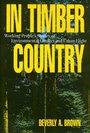
In Timber Country
Published on 28. March 1995
Book
Hardback
1 pages
978-1-56639-272-3 (ISBN)
Description
Southwest Oregon embodies the fast-changing social and environmental trends of the Pacific Northwest: the volatile clash of logging and environmental interests over the fate of old growth forests, an influx of wealthy suburbanites from California, and the effects of national economic trends. Championing neither environmentalists nor timber companies, Beverly A. Brown analyzes the subsequent transformation of the region. Her candid interviews with mostly poor to lower-middle-income people from the Rogue Valley region bring these looming social, cultural, and economic changes into the realm of everyday life. Working-class men and women describe a growing segregation of private forest lands and waterways where people could once move freely, they are now boxed in by fences and No Trespassing signs; where once tranquility and open space was treasured, traffic and tract homes envelop the landscape. Talking openly, they lament the increased presence of drugs, problems with the welfare system, the dearth of non-logging employment opportunities, and family violence.
But, they also share a love of their rural hometowns and a genuine desire to balance preservation of the environment with the economic well-being of their communities. Beverly A. Brown is an independent scholar and activist.
But, they also share a love of their rural hometowns and a genuine desire to balance preservation of the environment with the economic well-being of their communities. Beverly A. Brown is an independent scholar and activist.
Reviews / Votes
"[A] sophisticated attempt to get a handle on the crisis in rural America. The oral histories she has gathered are a primer for anyone interested in learning a more complicated and interesting truth about the Northwest timber wars." --The ProgressiveMore details
Language
English
Place of publication
Philadelphia PA
United States
Target group
Professional and scholarly
Dimensions
Height: 250 mm
Width: 150 mm
Thickness: 15 mm
Weight
666 gr
ISBN-13
978-1-56639-272-3 (9781566392723)
Copyright in bibliographic data is held by Nielsen Book Services Limited or its licensors: all rights reserved.
Schweitzer Classification
Other editions
New editions
Book
03/1995
Temple University Press,U.S.
€35.00
Article not available at the moment
Content
Acknowledgments Preface Note on the Interviews Glossary Introduction: In-migrations, Timber, and Owls: Background to a Transformation Part I: In the Country 1. Peter Alten and Larry Lyon This is not an area to become a millionaire in. It never was. The only difference now is, not only can you not become a millionaire, you cannot have any peace and quiet either. 2. Barbara Roland I felt lonesome, to walk down my city street and not see a face that I recognized. 3. Kevin Sjorn If the environmentalists had grown up the way I did, they wouldn't be environmentalists... That's why they seem so distant. 4. Roslyn Sellers I remember being proud that my dad worked in a mill. 5. Vera and Chuck Carter I don't think it's less community--I think it's more a group of communities. 6. Gary Carter Boy, anymore you try and go back to some of the places where we used to go and fish, or we used to go and swim. Somebody's down there and they're calling the cops. They're sicing the dog on you, they're pulling a gun on you. 7. Theresa Carter Generations are changing from my parents' "Just do what ever you want," to knowing that you can't do whatever you want. 8. Wayne Douglas They didn't want any non-whites spending a night in Grants Pass. Part II: In Our Lives 9. Rhonda Marshall You see all of the people here in the valley going through this withdrawal; they're holding the anger in their houses. 10. Sue Cleary We're all hating each other for no reason. 11. Kathy Dodge I dropped out of school when I was a freshman, and again when I was a sophomore... It was, like, "Well, if you don't want to be in school, then fine." 12. George Thomas My father was never big into supporting the bureaucracy. And I really go right along with that. 13. Dorothy Harris It's a real dangerous occupation... I worried about my husband working in the woods when he was setting chokers...and he did have a couple of real close calls. 14. Henry Dubnik We were probably part of the first wave of Californians...The dreaded Californians. Part III: What Kind of Future 15. Margaret and Stanley Norman What do we all do? Become park rangers? 16. Amy Sturman I think the environmentalists are going to win. Nature has the public sympathy. 17. Ellen Tigart It seems like life has really been kind of a survival test. 18. Nathan Cullenbach We've been confronted with so many personal problems, and nobody knows how to deal with them. 19. Ralph Pendleson They have to drop down to a five-, six-dollar-an-hour job. And they wonder why people are losing their homes. 20. Caroline Coldbrook I don't think anybody else wants to be where women are in the service economy. 21. Conclusion: Language, Complexity, and Power: Life Stories and a Community in Transition 22. An Environmentalist Reflection - Art and Paula Downing Postscript References Index