

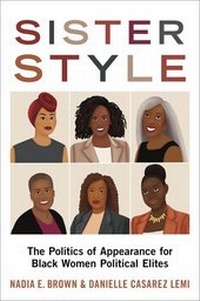
Sister Style
The Politics of Appearance for Black Women Political Elites
Published on 20. August 2021
Book
Hardback
234 pages
978-0-19-754057-2 (ISBN)
Description
"They don't think I'm viable, because I'm a Black woman with natural hair and no husband." This comment was made by Stacey Abrams shortly before the 2018 Democratic primary after she became the first Black woman to win a majory party's nomination for governor. Abrams' sentiment reflects the wider environment for Black women in politics, in which racist and sexist cultural ideas have long led Black women to be demeaned and fetishized for their physical appearance.
In Sister Style, Nadia E. Brown and Danielle Casarez Lemi argue that Black women's political experience and the way that voters evaluate them is shaped overtly by their skin tone and hair texture, with hair being a particular point of scrutiny. They ask what the politics of appearance for Black women mean for Black women politicians and Black voters, and how expectations about self-presentation differ for Black women versus Black men, White men, and White women. Black women running for office face pressure, often from campaign consultants and even close colleagues, to change their style in order to look more like White women. However, as this book shows, Black women candidates and elected officials react differently to these pressures depending on factors like age and incumbency. Moreover, Brown and Lemi delve into the ways in which Black voters react to Black female candidates based on appearance. They base their argument, in part, on focus groups with Black women candidates and elected officials, and show that there are generational differences that determine what sorts of styles Black women choose to adopt and to what extent they change their physical appearance based on external expectations.
In Sister Style, Nadia E. Brown and Danielle Casarez Lemi argue that Black women's political experience and the way that voters evaluate them is shaped overtly by their skin tone and hair texture, with hair being a particular point of scrutiny. They ask what the politics of appearance for Black women mean for Black women politicians and Black voters, and how expectations about self-presentation differ for Black women versus Black men, White men, and White women. Black women running for office face pressure, often from campaign consultants and even close colleagues, to change their style in order to look more like White women. However, as this book shows, Black women candidates and elected officials react differently to these pressures depending on factors like age and incumbency. Moreover, Brown and Lemi delve into the ways in which Black voters react to Black female candidates based on appearance. They base their argument, in part, on focus groups with Black women candidates and elected officials, and show that there are generational differences that determine what sorts of styles Black women choose to adopt and to what extent they change their physical appearance based on external expectations.
Reviews / Votes
Generations of future scholars will cite this text for its agenda-setting analysis on phenotype, hair style, and hair texture of Black women candidates, and for its creative use of tools to evaluate these topics. * Christine M. Slaughter, Postdoctoral Research Associate in the Department of Politics at PrincetonUniversity, Politics and Gender *More details
Language
English
Place of publication
New York
United States
Target group
Professional and scholarly
Dimensions
Height: 159 mm
Width: 241 mm
Thickness: 18 mm
Weight
467 gr
ISBN-13
978-0-19-754057-2 (9780197540572)
Copyright in bibliographic data and cover images is held by Nielsen Book Services Limited or by the publishers or by their respective licensors: all rights reserved.
Schweitzer Classification
Other editions
Additional editions
Nadia E. Brown | Danielle Casarez Lemi
Sister Style
The Politics of Appearance for Black Women Political Elites
Book
08/2021
Oxford University Press Inc
€38.50
Shipment within 15-20 days
Nadia E. Brown | Danielle Casarez Lemi
Sister Style
The Politics of Appearance for Black Women Political Elites
E-Book
01/2021
1st Edition
OUP eBook
€17.49
Available for download
Nadia E. Brown | Danielle Casarez Lemi
Sister Style
The Politics of Appearance for Black Women Political Elites
E-Book
01/2021
1st Edition
OUP eBook
€17.49
Available for download
Persons
Nadia E. Brown is a University Faculty Scholar and an Associate Professor of Political Science and African American Studies at Purdue University. She is the author of Sisters in the Statehouse: Black Women and Legislative Decision Making.
Danielle Casarez Lemi is a Tower Center Fellow at the Tower Center at Southern Methodist University.
Danielle Casarez Lemi is a Tower Center Fellow at the Tower Center at Southern Methodist University.
Content
Chapter One: Introduction
Chapter Two: Afro-textured Hair and the CROWN Act
Chapter Three: What Black Women Political Elites Look Like Matters
Chapter Four: Candid Conversations, Black Women Political Elites, and Appearances
Chapter Five: Sisterly Discussions on Black Women Candidates
Chapter Six: Is there a Black Woman Candidate Prototype?
Chapter Seven: Voter Responses to Black Women Candidates
Chapter Eight: Linked Fate, Black Voters, and Black Women Candidates
Chapter Nine: Conclusion
Chapter Two: Afro-textured Hair and the CROWN Act
Chapter Three: What Black Women Political Elites Look Like Matters
Chapter Four: Candid Conversations, Black Women Political Elites, and Appearances
Chapter Five: Sisterly Discussions on Black Women Candidates
Chapter Six: Is there a Black Woman Candidate Prototype?
Chapter Seven: Voter Responses to Black Women Candidates
Chapter Eight: Linked Fate, Black Voters, and Black Women Candidates
Chapter Nine: Conclusion