

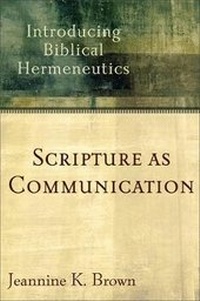
Scripture as Communication
Introducing Biblical Hermeneutics
Published on 1. March 2007
Book
Paperback/Softback
316 pages
978-0-8010-2788-8 (ISBN)
Description
Is the Bible just a book of ancient Israelite and Christian history and practices to be read? Or are we engaging in a more interactive practice when we study God's word? Jeannine K. Brown believes that communication is at the heart of what happens when we open the Bible, that we are actively engaging God in a conversation that can be life changing. By learning about how Scripture communicates, modern readers can extract much more meaning out of the text than they could if simply reading the Bible as though it was a list of rules or a collection of stories. In Scripture as Communication, Brown offers professors, students, church leaders, and laity a basic guide to the theory and practice of biblical interpretation, helping them understand our engagement with Scriptures as primarily a communicative act.
More details
Language
English
Place of publication
Ada, MI
United States
Publishing group
Baker Publishing Group
Target group
College/higher education
Dimensions
Height: 229 mm
Width: 152 mm
Weight
515 gr
ISBN-13
978-0-8010-2788-8 (9780801027888)
Copyright in bibliographic data and cover images is held by Nielsen Book Services Limited or by the publishers or by their respective licensors: all rights reserved.
Schweitzer Classification
Other editions
Additional editions
E-Book
03/2007
Baker Publishing Group
€20.99
Available for download
Person
Jeannine K. Brown (PhD, Luther Seminary) is associate professor of New Testament and associate academic dean at Bethel Seminary in St. Paul, Minnesota. She is the author of The Disciples in Narrative Perspective: The Portrayal and Function of the Matthean Disciples and contributed to The Baker Illustrated Bible Commentary.
Content
Introduction: Scripture as Communicative Act
Part 1: Theoretical Perspectives on Scripture as Communication
1. Terminology and Context for Hermeneutics
2. A Communication Model of Hermeneutics
3. Authors, Texts, Readers: Historical Movements and Reactions
4. Some Affirmations about Meaning from a Communication Model
5. Developing Textual Meaning: Implications, Effects, and Other Ways of Going "Beyond"
6. An Invitation to Active Engagement: The Reader and the Bible
Part 2: Practical Guidance for Interpreting Scripture as Communication
7. Genre and Communication
8. The Language of the Bible
9. The Social World of the Bible 10. Literary Context, Intertextuality, and Canon
11. Conceptualizing Contextualization
12. Contextualization: Understanding Scripture Incarnationally
Appendix A: Exegesis Guidelines Appendix B: Historical Criticism Appendix C: Parallelism in Hebrew Poetry
Appendix D: Epistles: Following an Author's Flow of Thought Appendix E: How to Go about Topical Studies
Bibliography
Part 1: Theoretical Perspectives on Scripture as Communication
1. Terminology and Context for Hermeneutics
2. A Communication Model of Hermeneutics
3. Authors, Texts, Readers: Historical Movements and Reactions
4. Some Affirmations about Meaning from a Communication Model
5. Developing Textual Meaning: Implications, Effects, and Other Ways of Going "Beyond"
6. An Invitation to Active Engagement: The Reader and the Bible
Part 2: Practical Guidance for Interpreting Scripture as Communication
7. Genre and Communication
8. The Language of the Bible
9. The Social World of the Bible 10. Literary Context, Intertextuality, and Canon
11. Conceptualizing Contextualization
12. Contextualization: Understanding Scripture Incarnationally
Appendix A: Exegesis Guidelines Appendix B: Historical Criticism Appendix C: Parallelism in Hebrew Poetry
Appendix D: Epistles: Following an Author's Flow of Thought Appendix E: How to Go about Topical Studies
Bibliography