

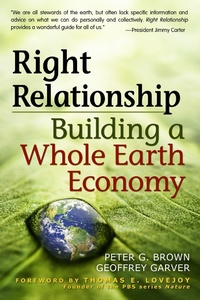
Right Relationship
Description
Peter Brown, Geoffrey Carver and their colleagues at the Quaker Institute for the Future have accepted this challenge. Drawing on the core Quaker principle of "right relationship," they have launched a campaign to bring our economy, our ethics, and our environment into alignment. A handbook for this movement, Right Relationship proposes an alternative economic model that fuses science and ethics with the earth care teachings of the world's great religions. "Wrong relationships" close down trust and cooperative reciprocity at the social, ecological and biotic levels, and they degrade moral integrity and adaptive coherence. "Right relationships," by contrast," are characterized by interactions that satisfy mutually beneficial goals and advance the common good.
Economics and finance have become, in effect, the modern world's established religion, with constant growth and wealth accumulation the religion's unquestioned dogma. This system is obviously unsustainable our resources are not infinite. In contract, Right Relationship not only offers the promise of an equitable, sustainable future but also an opportunity to touch the fullness of human meaning, and, some would say, the presence of the Divine. We now need, for the sake of the human future and the future of the whole community of life, the same wind of moral change that Quakers brought to the economy of slavery. Inspired by this heritage, this guide links minds, hearts, and hands with all those who are rising up in search of ecological integrity, ethical development, and governance for the common good.
More details
Other editions
Additional editions
Persons
and also established the School’s Environmental Policy Programs. He is a graduate of Haverford College, and holds a master’s degree in the philosophy of religion from Union Theological Seminary and Columbia University, and a Ph.D. from Columbia in philosophy.
GEOFFREY GARVER is an environmental con- sultant and lecturer in law in Montreal. From 2000 to 2007, he was a senior official at the North American Commission for Environmental Cooperation (www.cec.org), directing the unit that publishes detailed factual investigations of complaints by North American citizens that one of the NAFTA countries—Mexico, the United States, and Canada—is failing to effectively en-
force its environmental law. At the CEC, he wrote reports on enforcement of laws on water pollution from Canadian pulp and paper mills, harm to fish habitat from logging in British Columbia, and the killing of migratory birds by timber harvesting in the United States. Previously, he spent nine years with the U.S. Justice Department’s Environment and Natural Resources Division, first as a trial attorney and then as an acting assistant chief handling cases dealing with land and natural resource management, water rights, and environmental impact assessment. Some of his major cases concerned the Everglades’ water quality, winter use and bison management in Yellowstone National Park, and water rights in Idaho and Oregon.
Content
Preface
Introduction: Moving from Wrong to Right Relationship
Chapter One: What’s the Economy's For?: A Flourishing Commonwealth of Life
Chapter Two: How Does It Work?: Putting the Economy in Its Place
Chapter Three: How Big Is Too Big?: Boundaries on Consumption and Waste
Chapter Four: What’s Fair?: Sharing Life’s Bounty
Chapter Five: Governance: New Ways to Stay in Bounds and Play Fair
Conclusion: Four Steps to a Whole Earth Economy
Notes
Bibliography
Acknowledgments
Index
About the Moral Economy Project
About the Authors