

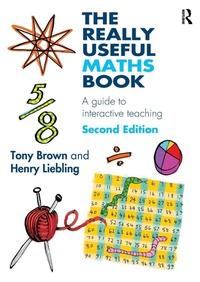
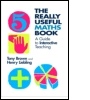
The Really Useful Maths Book
A guide to interactive teaching
2nd Edition
Published on 3. December 2013
Book
Paperback/Softback
326 pages
978-0-415-82949-6 (ISBN)
Description
The Really Useful Maths Book is for all those who want children to enjoy the challenge of learning mathematics. With suggestions about the best ways to use resources and equipment to support learning, it describes in detail how to make learning the easy option for children. An easy-to-follow, comprehensive guide packed with ideas and activities, it is the perfect tool to help teachers who wish to develop their teaching strategies.
The second edition has been fully updated in light of the latest research, as well as in response to the new mathematics curriculum. It includes many more practical activities for each mathematical topic and explores exciting new areas. Key topics covered include:
Numbers and the number system
Operations and calculations
Shape and space
Measures, statistics and data handling
Cross-curricular approaches
Resources and planning for teaching and learning
Contexts for making sense of mathematics
Bridges, strategies and personal qualities
Dialogue and interactive teaching
International perspectives on teaching and learning
Psychology and neuroscience to maximize learning.
The Really Useful Maths Book makes mathematics meaningful, challenging and interesting. It will be invaluable to practicing primary teachers, subject specialists, maths co-ordinators, student teachers, mentors, tutors, home educators and others interested in mathematics education programmes.
Tony Brown was formerly the Director of ESCalate, the UK Centre for Education in HE at the Graduate School of Education, University of Bristol, UK.
Henry Liebling formerly led Primary Mathematics Education at University College Plymouth, Marjon, UK.
The second edition has been fully updated in light of the latest research, as well as in response to the new mathematics curriculum. It includes many more practical activities for each mathematical topic and explores exciting new areas. Key topics covered include:
Numbers and the number system
Operations and calculations
Shape and space
Measures, statistics and data handling
Cross-curricular approaches
Resources and planning for teaching and learning
Contexts for making sense of mathematics
Bridges, strategies and personal qualities
Dialogue and interactive teaching
International perspectives on teaching and learning
Psychology and neuroscience to maximize learning.
The Really Useful Maths Book makes mathematics meaningful, challenging and interesting. It will be invaluable to practicing primary teachers, subject specialists, maths co-ordinators, student teachers, mentors, tutors, home educators and others interested in mathematics education programmes.
Tony Brown was formerly the Director of ESCalate, the UK Centre for Education in HE at the Graduate School of Education, University of Bristol, UK.
Henry Liebling formerly led Primary Mathematics Education at University College Plymouth, Marjon, UK.
More details
Series
Edition
2nd edition
Language
English
Place of publication
London
United Kingdom
Publishing group
Taylor & Francis Ltd
Target group
Professional and scholarly
Professional and Professional Practice & Development
Illustrations
164 s/w Abbildungen, 164 s/w Zeichnungen, 60 s/w Tabellen
60 Tables, black and white; 164 Line drawings, black and white; 164 Illustrations, black and white
Dimensions
Height: 297 mm
Width: 210 mm
Thickness: 18 mm
Weight
849 gr
ISBN-13
978-0-415-82949-6 (9780415829496)
Copyright in bibliographic data and cover images is held by Nielsen Book Services Limited or by the publishers or by their respective licensors: all rights reserved.
Schweitzer Classification
Other editions
Additional editions
Book
12/2015
2nd Edition
Routledge
€215.41
Shipment within 10-20 days
E-Book
01/2014
2nd Edition
Routledge
€52.49
Available for download
E-Book
01/2014
2nd Edition
Routledge
€52.49
Available for download
Previous edition
Book
05/2005
Routledge Falmer
€50.94
Article exhausted; check for reprint
Persons
Tony Brown was formerly the Director of ESCalate, the UK Centre for Education in HE at the Graduate School of Education, University of Bristol, UK.
Henry Liebling formerly led Primary Mathematics Education at University College Plymouth, Marjon, UK.
Henry Liebling formerly led Primary Mathematics Education at University College Plymouth, Marjon, UK.
Content
Part 1: Mathematical Activities and Teaching Strategies Introduction N. Numbers and the number system 1. Counting and counting out 2. Saying and making numbers 3. Arabic and other number systems 4. Working with grids 5. Working with target boards 6. Working with sets 7. Working with square numbers 8. Exploring algebra 9. Taking ideas from 'floor to head' O. Operations and Calculations 1. Number lines 2. The story of 24 3. Arithmetic operations 4. Arithmogons and other puzzles 5. Teaching Multiplication tables 6. Divisibility rules S. Shape and space 1. Visualisation techniques and activities 2. Activities and investigations 3. Working with cloths 4. Unusual and familiar 5. Changing shapes M. Measures, statistics and data handling 1. Measures and measurement 2. Data handling and using the media 3. Statistics and probability 4. Using personal measurement 5. Investigating measurement X. Cross-curricular Approaches 1. Cross-curricular approaches 2. Playing with the language of mathematics 3. Maths in music, dannce and knitting 4. Maths, sustainability and the global dimension 5. Reasoning, logic, proof and programming Part 2: Developing Interactive Teaching Strategies Introduction A. Teaching and Learning From International Perspectives 1. Policy and content 2. Pupil performance 3. Classroom practice 4. Findings from psychology and neuroscience B. Teachers and children interacting 1. Pupil, teacher, mathematics: a dynamic model of interaction 2. Interactive teaching 3. Children talking, teachers listening 4. Questions and questioning 5. Assessment for learning C. Resources and Planning for Teaching and Learning 1. Achieving balance in the mathematics curriculum 2. Using resources to emphasise mathematical attributes 3. Resources for counting and calculation 4. Planning to optimise learning D. Contexts for Making Sense of Mathematics 1. Using different contexts to help make sense of mathematics 2. Practical activities and solving problems E. Bridges, Strategies and Personal Qualities 1. Building bridges for learning 2. The importance of strategy building 3. Eight qualities of successful learners