

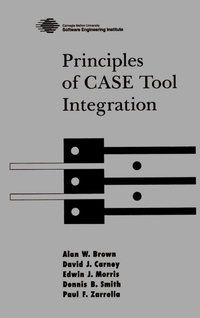
Principles of CASE Tool Integration
Published on 27. October 1994
Book
Hardback
288 pages
978-0-19-509478-7 (ISBN)
Description
Computer Aided Software Engineering tools typically support individual users in the automation of some task within a software development process. Used this way, CASE tools have undoubtedly helped many organisations in their efforts to develop better quality software to budget, within precedented time scales. This book will address the increasing activity within the software engineering community for automated support in the software development process. The authors integrate CASE tools into the overall software life cycle with emphasis on the following factors: scale=size and complexity; lack of maturity=limited expertise; diversity=many classes of users; technology base=extended operating system.
Reviews / Votes
"Experience, experimentation, and theory are nicely blended to provide a well-engineered contribution to the field of software engineering. . .this book should be on the reference shelves of all who claim the field." --Computing Reviews"Experience, experimentation, and theory are nicely blended to provide a well-engineered contribution to the field of software engineering. . .this book should be on the reference shelves of all who claim the field." --Computing Reviews
More details
Language
English
Place of publication
New York
United States
Target group
Professional and scholarly
Illustrations
halftones, line figures, tables
Dimensions
Height: 235 mm
Width: 157 mm
Thickness: 21 mm
Weight
615 gr
ISBN-13
978-0-19-509478-7 (9780195094787)
Copyright in bibliographic data and cover images is held by Nielsen Book Services Limited or by the publishers or by their respective licensors: all rights reserved.
Schweitzer Classification
Other editions
Additional editions
Alan W. Brown | David J. Carney | Edwin J. Morris
Principles of CASE Tool Integration
E-Book
09/1994
1st Edition
OUP eBook
€125.99
Available for download
Persons
Content
Part I: The Problem of Integration in a CASE Environment
1: Introduction
2: Previous Approaches to Understanding CASE Tool Integration
3: Toward a Better Understanding of Integration
Part II: Service, Mechanism, and Process Level Integration
4: A Service-Based Model of a CASE Environment
5: Properties and Types of Integration Mechanisms
6: Data Integration Mechanisms
7: Control Integration Mechanisms
8: The Role of Process in Integrated CASE Environments
Part III: Practical Experiences with CASE Integration
9: Experiments in Environment Integration
10: Replacing the Message Service in a CASE Integration Framework
11: Integration of CASE Tools with CM Systems: Lessons Learned
Part IV: A Review of the Current State of CASE Too Integration
12: CASE Environments in Practice
13: Summary and Conclusions
Appendices
1: Introduction
2: Previous Approaches to Understanding CASE Tool Integration
3: Toward a Better Understanding of Integration
Part II: Service, Mechanism, and Process Level Integration
4: A Service-Based Model of a CASE Environment
5: Properties and Types of Integration Mechanisms
6: Data Integration Mechanisms
7: Control Integration Mechanisms
8: The Role of Process in Integrated CASE Environments
Part III: Practical Experiences with CASE Integration
9: Experiments in Environment Integration
10: Replacing the Message Service in a CASE Integration Framework
11: Integration of CASE Tools with CM Systems: Lessons Learned
Part IV: A Review of the Current State of CASE Too Integration
12: CASE Environments in Practice
13: Summary and Conclusions
Appendices