

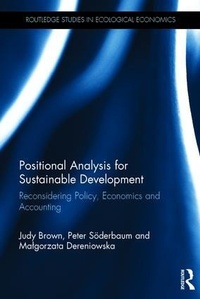
Positional Analysis for Sustainable Development
Reconsidering Policy, Economics and Accounting
1st Edition
Published on 22. May 2017
Book
Hardback
180 pages
978-1-138-63450-3 (ISBN)
Description
Climate change, biodiversity loss, pollution of land and water, land-use changes, lack of equality and other problems at local, national and global levels represent a challenge for economics as a social science. Mainstream neoclassical economics may be able to contribute to a more sustainable society but it has also played a dominant role in a period where problems have been aggravated. A pluralist and democratic view of economics is therefore very much warranted. This book presents a multidimensional and ideologically more open view of economics: understanding economics in multidimensional terms is in accordance with the 17 sustainable development goals recognized by nations at the UN-level in 2015.
Accordingly, approaches to decision making and accounting at the national- and business levels have to be reconsidered. Neoclassical Cost-Benefit Analysis (CBA) with focus on the monetary dimension and an assumed consensus about a specific market ideology to be applied is not compatible with democratic societies where citizen and actors in other roles normally differ with respect to ideological orientation. Environmental Impact Statements and Multi-Criteria methods are used to some extent to broaden approaches to decision-making. In this book, Positional Analysis is advocated as a multidimensional and ideologically open approach. Positional Analysis is based on a political economic conceptual framework (as part of ecological economics) that differs from neoclassical ideas of individuals, firms and markets. And since approaches to decision-making and to accounting are closely connected, a new theoretical perspective in economics similarly raises issues of how national and business accounting can be opened up to meet present demands among various actors in society. This perspective raises also numerous ethical questions at the science and policy interface that need to be properly addressed for sustainability decision making.
Accordingly, approaches to decision making and accounting at the national- and business levels have to be reconsidered. Neoclassical Cost-Benefit Analysis (CBA) with focus on the monetary dimension and an assumed consensus about a specific market ideology to be applied is not compatible with democratic societies where citizen and actors in other roles normally differ with respect to ideological orientation. Environmental Impact Statements and Multi-Criteria methods are used to some extent to broaden approaches to decision-making. In this book, Positional Analysis is advocated as a multidimensional and ideologically open approach. Positional Analysis is based on a political economic conceptual framework (as part of ecological economics) that differs from neoclassical ideas of individuals, firms and markets. And since approaches to decision-making and to accounting are closely connected, a new theoretical perspective in economics similarly raises issues of how national and business accounting can be opened up to meet present demands among various actors in society. This perspective raises also numerous ethical questions at the science and policy interface that need to be properly addressed for sustainability decision making.
More details
Series
Language
English
Place of publication
London
United Kingdom
Publishing group
Taylor & Francis Ltd
Target group
College/higher education
Product notice
sewn/stitched
Cloth over boards
Illustrations
4 s/w Abbildungen, 4 s/w Zeichnungen, 10 s/w Tabellen
10 Tables, black and white; 4 Line drawings, black and white; 4 Illustrations, black and white
Dimensions
Height: 236 mm
Width: 163 mm
Thickness: 15 mm
Weight
431 gr
ISBN-13
978-1-138-63450-3 (9781138634503)
Copyright in bibliographic data and cover images is held by Nielsen Book Services Limited or by the publishers or by their respective licensors: all rights reserved.
Schweitzer Classification
Other editions
Additional editions
Judy Brown | Peter Soderbaum | Malgorzata Dereniowska
Positional Analysis for Sustainable Development
Reconsidering Policy, Economics and Accounting
Book
06/2020
1st Edition
Routledge
€59.80
Shipment within 15-20 days
Judy Brown | Peter Soderbaum | Malgorzata Dereniowska
Positional Analysis for Sustainable Development
Reconsidering Policy, Economics and Accounting
E-Book
05/2017
Routledge
€52.49
Available for download
Judy Brown | Peter Soderbaum | Malgorzata Dereniowska
Positional Analysis for Sustainable Development
Reconsidering Policy, Economics and Accounting
E-Book
05/2017
Routledge
€52.49
Available for download
Persons
Judy Brown is a Professor of Accounting at Victoria University of Wellington, New Zealand.
Peter Soederbaum is Professor Emeritus in Ecological Economics at Maelardalen University, Vaesteras, Sweden.
Malgorzata Dereniowska is an Associated Member of GREQAM-AMSE, Aix-Marseille University, France.
Peter Soederbaum is Professor Emeritus in Ecological Economics at Maelardalen University, Vaesteras, Sweden.
Malgorzata Dereniowska is an Associated Member of GREQAM-AMSE, Aix-Marseille University, France.
Content
Table of Contents:
List of Figures
List of Tables
Foreword
Acknowledgements
Chapter 1: Democracy as a lead concept in dealing with sustainable development (Peter Soederbaum)
Chapter 2: Fundamentals of sustainability economics and positional analysis (Peter Soederbaum)
Chapter 3: Mainstream economics and alternative perspectives in a political power game (Peter Soederbaum)
Chapter 4: Positional analysis as an approach to decision-making, accounting and democracy (Peter Soederbaum)
Chapter 5: On the need for broadening out and opening up accounting (Judy Brown)
Chapter 6: Positional analysis in relation to other pluralistic accounting practices (Judy Brown)
Chapter 7: Sustainability, ethics, and democracy: A pluralistic approach to the navigation of disagreements (Malgorzata Dereniowska)
Chapter 8: Positional analysis and practical ethics (Malgorzata Dereniowska)
Chapter 9: Democracy, sustainability and positional analysis: An interview with Peter Soederbaum (with introduction by Judy Brown)
Chapter 10: Philosophy, ethics and positional analysis: An interview with Peter Soederbaum (with introduction by Malgorzata Dereniowska)
Appendix: The early history of positional analysis (Peter Soederbaum)
Index
List of Figures
List of Tables
Foreword
Acknowledgements
Chapter 1: Democracy as a lead concept in dealing with sustainable development (Peter Soederbaum)
Chapter 2: Fundamentals of sustainability economics and positional analysis (Peter Soederbaum)
Chapter 3: Mainstream economics and alternative perspectives in a political power game (Peter Soederbaum)
Chapter 4: Positional analysis as an approach to decision-making, accounting and democracy (Peter Soederbaum)
Chapter 5: On the need for broadening out and opening up accounting (Judy Brown)
Chapter 6: Positional analysis in relation to other pluralistic accounting practices (Judy Brown)
Chapter 7: Sustainability, ethics, and democracy: A pluralistic approach to the navigation of disagreements (Malgorzata Dereniowska)
Chapter 8: Positional analysis and practical ethics (Malgorzata Dereniowska)
Chapter 9: Democracy, sustainability and positional analysis: An interview with Peter Soederbaum (with introduction by Judy Brown)
Chapter 10: Philosophy, ethics and positional analysis: An interview with Peter Soederbaum (with introduction by Malgorzata Dereniowska)
Appendix: The early history of positional analysis (Peter Soederbaum)
Index