

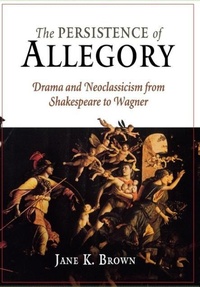
The Persistence of Allegory
Drama and Neoclassicism from Shakespeare to Wagner
Published on 26. December 2006
Book
Hardback
304 pages
978-0-8122-3966-9 (ISBN)
Description
In an impressively comparative work, Jane K. Brown explores the tension in European drama between allegory and neoclassicism from the sixteenth through the nineteenth century. Imitation of nature is generally thought to triumph over religious allegory in the Elizabethan and French classical theater, a shift attributable to the recovery of Aristotle's Poetics in the Renaissance. But if Aristotle's terminology was rapidly assimilated, Brown demonstrates that change in dramatic practice took place only gradually and partially and that allegory was never fully cast off the stage.
The book traces a complex history of neoclassicism in which new allegorical forms flourish and older ones are constantly revitalized. Brown reveals the allegorical survivals in the works of such major figures as Shakespeare, CalderOn, Racine, Vondel, Metastasio, Goethe, and Wagner and reads tragedy, comedy, masque, opera, and school drama together rather than as separate developments. Throughout, she draws illuminating parallels to modes of representation in the visual arts.
A work of broad interest to scholars, teachers, and students of theatrical form, The Persistence of Allegory presents a fundamental rethinking of the history of European drama.
The book traces a complex history of neoclassicism in which new allegorical forms flourish and older ones are constantly revitalized. Brown reveals the allegorical survivals in the works of such major figures as Shakespeare, CalderOn, Racine, Vondel, Metastasio, Goethe, and Wagner and reads tragedy, comedy, masque, opera, and school drama together rather than as separate developments. Throughout, she draws illuminating parallels to modes of representation in the visual arts.
A work of broad interest to scholars, teachers, and students of theatrical form, The Persistence of Allegory presents a fundamental rethinking of the history of European drama.
Reviews / Votes
"An ambitious survey of a great deal of culture, attempting links and connections on a grand scale." (David Bevington, University of Chicago) "A learned, fascinating book." (Choice) "The richness of many of Brown's readings and her remarkable scholarly range fuel her argument and ultimately provide a compelling picture of allegory's afterimages, which appear and recede across the history of Western drama from the sixteenth century." (Modern Philology) "Her approach yields much that is valuable, especially in connection with Shakespeare, Calderon, and the German authors. . . . a healthy reminder of the daunting complexity of the Western tradition of drama." (Comparative Literature Review)More details
Language
English
Place of publication
Pennsylvania
United States
Target group
College/higher education
Product notice
Paper over boards
Illustrations
21 illus.
Dimensions
Height: 231 mm
Width: 152 mm
Thickness: 28 mm
Weight
635 gr
ISBN-13
978-0-8122-3966-9 (9780812239669)
Copyright in bibliographic data and cover images is held by Nielsen Book Services Limited or by the publishers or by their respective licensors: all rights reserved.
Schweitzer Classification
Other editions
Additional editions
E-Book
04/2013
1st Edition
University of Pennsylvania Press
€73.99
Available for download
Person
Jane K. Brown is Professor of Germanics and Comparative Literature at the University of Washington, Seattle. She is the author and editor of several books in English and German, including Goethe's Faust: The German Tragedy and Ironie und Objektivitat: Aufsatze zu Goethe, and is the former President of the Goethe Society of North America.
Content
Preface
1. Introduction
2. Claude's Allegories and Literary Neoclassicism
3. Secular Tragedy: Neoclassicism in the Sixteenth Century
4. Allegory and Passion: Latin Dramatic Forms in the Seventeenth Century
5. The Allegorical Idioms of the Illusionist Stage: Spectacle in the Seventeenth Century
6. Opera and Dance: The Revival of Greek Tragedy
7. The Greek Revival: German Classicism and the Recovery of Spoken Drama
8. Wagner and the Death of Gesamtkunstwerk
Coda: "This insubstantial pageant"
Notes
Works Cited
Index
1. Introduction
2. Claude's Allegories and Literary Neoclassicism
3. Secular Tragedy: Neoclassicism in the Sixteenth Century
4. Allegory and Passion: Latin Dramatic Forms in the Seventeenth Century
5. The Allegorical Idioms of the Illusionist Stage: Spectacle in the Seventeenth Century
6. Opera and Dance: The Revival of Greek Tragedy
7. The Greek Revival: German Classicism and the Recovery of Spoken Drama
8. Wagner and the Death of Gesamtkunstwerk
Coda: "This insubstantial pageant"
Notes
Works Cited
Index