

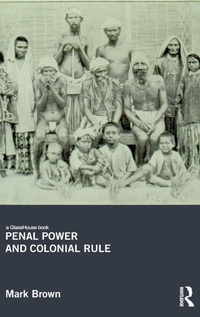
Penal Power and Colonial Rule
1st Edition
Published on 17. January 2014
Book
Hardback
218 pages
978-0-415-45213-7 (ISBN)
Description
This book provides an account of the distinctive way in which penal power developed outside the metropolitan centre. Proposing a radical revision of the Foucauldian thesis that criminological knowledge emerged in the service of a new form of power - discipline - that had inserted itself into the very centre of punishment, it argues that Foucault's alignment of sovereign, disciplinary and governmental power will need to be reread and rebalanced to account for its operation in the colonial sphere. In particular it proposes that colonial penal power in India is best understood as a central element of a liberal colonial governmentality.
To give an account of the emergence of this colonial form of penal power that was distinct from its metropolitan counterpart, this book analyses the British experience in India from the 1820s to the early 1920s. It provides a genealogy of both civil and military spheres of government, illustrating how knowledge of marginal and criminal social orders was tied in crucial ways to the demands of a colonial rule that was neither monolithic nor necessarily coherent. The analysis charts the emergence of a liberal colonial governmentality where power was almost exclusively framed in terms of sovereignty and security and where disciplinary strategies were given only limited and equivocal attention.
Drawing on post-colonial theory, Penal Power and Colonial Rule opens up a new and unduly neglected area of research. An insightful and original exploration of theory and history, this book will appeal to students and scholars of Law, Criminology, History and Post-colonial Studies.
To give an account of the emergence of this colonial form of penal power that was distinct from its metropolitan counterpart, this book analyses the British experience in India from the 1820s to the early 1920s. It provides a genealogy of both civil and military spheres of government, illustrating how knowledge of marginal and criminal social orders was tied in crucial ways to the demands of a colonial rule that was neither monolithic nor necessarily coherent. The analysis charts the emergence of a liberal colonial governmentality where power was almost exclusively framed in terms of sovereignty and security and where disciplinary strategies were given only limited and equivocal attention.
Drawing on post-colonial theory, Penal Power and Colonial Rule opens up a new and unduly neglected area of research. An insightful and original exploration of theory and history, this book will appeal to students and scholars of Law, Criminology, History and Post-colonial Studies.
More details
Language
English
Place of publication
London
United Kingdom
Publishing group
Taylor & Francis Ltd
Target group
College/higher education
Product notice
Paper over boards
Dimensions
Height: 240 mm
Width: 161 mm
Thickness: 17 mm
Weight
517 gr
ISBN-13
978-0-415-45213-7 (9780415452137)
Copyright in bibliographic data and cover images is held by Nielsen Book Services Limited or by the publishers or by their respective licensors: all rights reserved.
Schweitzer Classification
Other editions
Additional editions
Mark Brown
Penal Power and Colonial Rule
Book
07/2015
1st Edition
Routledge
€76.40
Shipment within 10-20 days
Mark Brown
Penal Power and Colonial Rule
E-Book
02/2014
1st Edition
Routledge
€69.99
Available for download
Mark Brown
Penal Power and Colonial Rule
E-Book
02/2014
1st Edition
Routledge
€69.99
Available for download
Person
Dr Mark Brown is a Senior Lecturer in the School of Law, Sheffield University, UK, and an Honorary Senior Fellow in the School of Social and Political Sciences at the University of Melbourne, Australia. Previously based in Geneva, he worked as a law and justice consultant focused on actors in the international sphere. His earlier academic career was spent in Australia where he was in the criminology program at the University of Melbourne. He has also been a visiting professor at the Institute for Criminology and Criminal Law at the University of Lausanne and at Delhi University Law School. He is co-author of Penal Culture and Hyperincarceration (Routledge 2013) and author of Penal Power and Colonial Rule (Routledge 2014) and the forthcoming Remaking Criminology.
Content
Preface 1. Introduction 2. Colonial Governmentality 3. Immanence and Discovery: Thugs and Native Subjectivity 4. Between History and Nature: Visions of Native Crime and Social Marginality 5. The Temptations of Domination: Framing Disorder 6. Liberal Ontologies: Fashioning the Criminal Tribe 7. The State as Practice: Establishing a Modern Milieu 8. Penal Power and Colonial Rule