

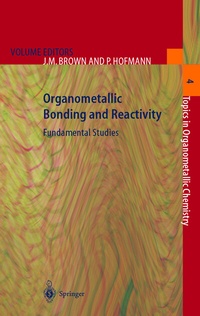
Organometallic Bonding and Reactivity
Fundamental Studies
Published on 20. September 1999
Book
Hardback
XV, 195 pages
978-3-540-64253-4 (ISBN)
Description
General The making and breaking of carbon-metal bonds is fundamental to all the p- cesses of organometallic chemistry and moreover plays a significant role in - mogeneous as well as heterogeneous catalysis. This rather blunt statement - phasises the extent to which a proper understanding of the structure, energetics and reactivity of C-M bonds is at the core of the discipline. In order to accept it, a proper definition of the terms involved is required. Quite simply we define the metal-carbon bond in its broadest sense to embrace carbon linked to transiti- metals, lanthanides and actinides, and main group metals. We do not dist- guish between formally covalent single or multiple bonding on the one hand and q-bonding on the other. In the studies to be described in the following chapters, the emphasis will be on transition metal complexes and insofar as the fun- mentals come under scrutiny, simple metal alkyls or related species (metal al- nyl, alkynyl, aryl, or allyl) will play an emphatic part.
The central role of metal alkyls and their congeners and especially the role of their metal carbon linkage in homogeneous catalysis may be appreciated by considering some key reaction steps leading to their formation or breakdown. There follows a few prominent examples of transition metal mediated stoichiometric or catalytic processes: - In homogeneous hydrogenation of double bonds, the stepwise reaction of an q2-coordinated alkene with dihydrogen gives first an alkyl metal hydride, and then the decoordinated alkane by elimination.
The central role of metal alkyls and their congeners and especially the role of their metal carbon linkage in homogeneous catalysis may be appreciated by considering some key reaction steps leading to their formation or breakdown. There follows a few prominent examples of transition metal mediated stoichiometric or catalytic processes: - In homogeneous hydrogenation of double bonds, the stepwise reaction of an q2-coordinated alkene with dihydrogen gives first an alkyl metal hydride, and then the decoordinated alkane by elimination.
More details
Series
Edition
1999
Language
English
Place of publication
Berlin
Germany
Publishing group
Springer Berlin
Target group
Professional and scholarly
Research
Illustrations
27 s/w Abbildungen
XV, 195 p. 27 illus.
Dimensions
Height: 241 mm
Width: 160 mm
Thickness: 17 mm
Weight
494 gr
ISBN-13
978-3-540-64253-4 (9783540642534)
DOI
10.1007/3-540-69707-1
Schweitzer Classification
Other editions
Additional editions
Book
10/2013
Springer
€213.99
Shipment within 7-9 days
E-Book
07/2003
Springer
€213.99
Available for download
Persons
Content
Gas-Phase Organometallic Chemistry.- Static and Dynamic Structures of Organometallic Molecules and Crystals.- Theoretical Treatment of Organometallic Reaction Mechanisms and Catalysis.- A Critical Assessment of Density Functional Theory with Regard to Applications in Organometallic Chemistry.- Hybrid Quantum Mechanics/Molecular Mechanics Methods in Transition Metal Chemistry.