

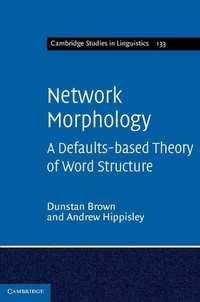
Network Morphology
A Defaults-based Theory of Word Structure
Published on 2. February 2012
Book
Hardback
346 pages
978-1-107-00574-7 (ISBN)
Description
Morphology is particularly challenging, because it is pervaded by irregularity and idiosyncrasy. This book is a study of word structure using a specific theoretical framework known as 'Network Morphology'. It describes the systems of rules which determine the structure of words by construing irregularity as a matter of degree, using examples from a diverse range of languages and phenomena to illustrate. Many languages share common word building strategies and many diverge in interesting ways. These strategies can be understood by distinguishing different notions of 'default'. The Network Morphology philosophy promotes the use of computational implementation to check theories. The accompanying website provides the computer coded version of the Network Morphology model of word structure for readers to test, customize and develop. This book will be a valuable contribution to the fields of linguistic typology and morphology and will be welcomed by researchers and graduate students in these areas.
Reviews / Votes
'... goes a long way towards clarifying many of the outstanding issues in linguistic morphology today.' Mark Aronoff, Trustees Distinguished Professor, Stony Brook University '... covers not only inflections and paradigm structure but also derivational relatedness ... an invaluable survey.' Andrew Spencer, University of EssexMore details
Series
Language
English
Place of publication
Cambridge
United Kingdom
Target group
Professional and scholarly
Illustrations
3 Tables, black and white; 15 Line drawings, unspecified
Dimensions
Height: 235 mm
Width: 157 mm
Thickness: 25 mm
Weight
716 gr
ISBN-13
978-1-107-00574-7 (9781107005747)
Copyright in bibliographic data and cover images is held by Nielsen Book Services Limited or by the publishers or by their respective licensors: all rights reserved.
Schweitzer Classification
Other editions
Additional editions
E-Book
06/2012
1st Edition
Cambridge University Press
€94.99
Available for download
E-Book
02/2012
Cambridge University Press
€79.99
Available for download
Persons
Dunstan Brown investigates autonomous morphology, morphology-syntax interaction, and typology. His recent work has focused on describing and understanding different aspects of morphological complexity. After graduating with a BA in Modern Languages and a Master of Linguistics from the University of Manchester, he completed a PhD in Linguistics at the University of Surrey and worked there for many years before taking up a 50th Anniversary Chair at the University of York in 2012. Andrew Hippisley is Associate Professor of Linguistics in the Department of English at the University of Kentucky.
Content
1. Options in constructing a morphological framework; 2. A framework for morphological defaults; 3. Inflectional classes; 4. Syncretism; 5. Morphological mismatch and extended deponency; 6. Defaults and paradigmatic restructuring; 7. Derivation; 8. Conclusion.