

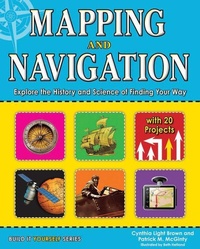
Mapping and Navigation
Description
How did we get from 20-foot-long maps to GPS devices small enough to fit in the palm of our hands? How does GPS work and what can it tell us? How do ancient mapmaking techniques used by the Romans and Greeks influence the satellite technologies we use today? The history of mapmaking is full of remarkable characters who charted the unknown with an ever-changing set of tools. In Mapping and Navigation: The History and Science of Finding Your Way, kids ages 9?12 will learn the history and science behind the evolution of mapmaking, and how much is still out there for discovery.
Readers will explore ideas through hands-on experiments while learning new terminology and interesting facts. Projects include using triangulation to measure distances, creating contour lines on a mini-mountain to understand elevation changes on a map, and inventing a sundial and compass to understand the basics of navigation. Whether mapping the solar system or mapping their own backyard, all readers will be able to understand mapping technologies and see the world in new and exciting ways. Mapping and Navigation meets common core state standards in language arts for reading informational text and literary nonfiction and is aligned with Next Generation Science Standards. Guided Reading Levels and Lexile measurements indicate grade level and text complexity.Reviews / Votes
"This excellent little book about the geology of the Pacific Northwest makes learning Earth science both fun and practical." --National Science Teachers Associations on Geology of the Pacific Northwest "Another in the really informative and engaging Build It Yourself nonfiction activity series. Interesting "did you know" boxes, sidebars, and illustrations complement the 15 thought-provoking activities. Enjoy!" -- DIG magazine on Geology of the Great Plains and Mountain West "Chemistry experiments in the kitchen! From mysterious oobleck to soda rockets, this book is the greatest fun. I can't wait to try some of these experiments. The grandchildren? They will have to wait." --Roald Hoffmann, 1981 Nobel Prize winner in Chemistry on Amazing Kitchen Chemistry Projects You Can Build YourselfMore details
Persons
Cynthia Light Brown is the author of several books for Nomad Press, including Amazing Kitchen Chemistry Projects You Can Build Yourself, Explore Rocks and Minerals!, and Geology of the Pacific Northwest. She has 21 years of experience as an environmental consultant specializing in pollution prevention, toxicology, and using Geographic Information Systems for mapping natural resources and protecting the environment. Cynthia lives in Pittsburgh, Pennsylvania.
Patrick McGinty holds an MFA in Writing from Portland State University and currently teaches in the English department there. He is a regular columnist for Propeller Magazine. Patrick lives in Portland, Oregon. Beth Hetland has an MFA from the Center for Cartoon Studies and has illustrated Backyard Biology: Investigate Habitats Outside Your Door and Native Americans: Discover the History and Cultures of the First Americans. She lives in Chicago, Illinois.