

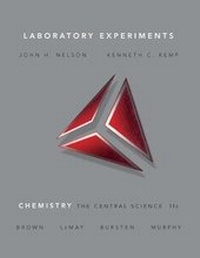
Laboratory Experiments for Chemistry
The Central Science
11th Edition
Published on 19. May 2008
Book
Paperback/Softback
624 pages
978-0-13-600285-7 (ISBN)
Description
This manual contains 43 finely tuned, self-contained experiments chosen to introduce basic lab techniques and to illustrate core chemical principles. The Eleventh Edition has been revised to correlate more tightly with Brown/LeMay/Bursten's Chemistry: The Central Science, 11/e and now features a guide on how to keep a lab report notebook. Safety and waste management are covered in greater detail, and many pre-lab and post-lab questions have been updated. The labs can also be customized through Catalyst, Pearson's custom database program.
KEY TOPICS:
Basic Laboratory Techniques; Identification of Substances by Physical Properties; Separation of the Components of a Mixture; Chemical Reactions; Chemical Formulas; Chemical Reactions of Copper and Percent Yield; Chemicals in Everyday Life: What Are They and How Do We Know? Gravimetric Analysis of a Chloride Salt; Gravimetric Determination of Phosphorus in Plant Food; Paper Chromatography: Separation of Cations and Dyes; Molecular Geometries of Covalent Molecules: Lewis Structures and the VSEPR model; Atomic Spectra and Atomic Structure; Behavior of Gases: Molar Mass of a Vapor; Determination of R: The Gas-Law Constant; Activity Series; Electrolysis, the Faraday, and Avogadro's Number; Electrochemical Cells and Thermodynamics; The Chemistry of Oxygen: Basic and Acidic Oxides and the Periodic Table; Colligative Properties: Freezing-Point Depression and Molar Mass; Titration of Acids and Bases; Reactions in Aqueous Solutions: Metathesis Reactions and Net Ionic Equations; Colorimetric Determination of an Equilibrium Constant in Aqueous Solution; Chemical Equilibrium: LeChatelier's Principle; Hydrolysis of Salts and pH of Buffer Solutions; Determination of the Dissociation Constant of a Weak Acid; Titration Curves of Polyprotic Acids; Determination of the Solubility-Product Constant for a Sparingly Soluble Salt; Heat of Neutralization; Rates of Chemical Reactions I: A Clock Reaction; Rates of Chemical Reactions II: Rate and Order of Decomposition; Introduction to Qualitative Analysis; Abbreviated Qualitative-Analysis Scheme.
MARKET:
A hands-on workbook/CD useful for anyone studying general chemistry.
KEY TOPICS:
Basic Laboratory Techniques; Identification of Substances by Physical Properties; Separation of the Components of a Mixture; Chemical Reactions; Chemical Formulas; Chemical Reactions of Copper and Percent Yield; Chemicals in Everyday Life: What Are They and How Do We Know? Gravimetric Analysis of a Chloride Salt; Gravimetric Determination of Phosphorus in Plant Food; Paper Chromatography: Separation of Cations and Dyes; Molecular Geometries of Covalent Molecules: Lewis Structures and the VSEPR model; Atomic Spectra and Atomic Structure; Behavior of Gases: Molar Mass of a Vapor; Determination of R: The Gas-Law Constant; Activity Series; Electrolysis, the Faraday, and Avogadro's Number; Electrochemical Cells and Thermodynamics; The Chemistry of Oxygen: Basic and Acidic Oxides and the Periodic Table; Colligative Properties: Freezing-Point Depression and Molar Mass; Titration of Acids and Bases; Reactions in Aqueous Solutions: Metathesis Reactions and Net Ionic Equations; Colorimetric Determination of an Equilibrium Constant in Aqueous Solution; Chemical Equilibrium: LeChatelier's Principle; Hydrolysis of Salts and pH of Buffer Solutions; Determination of the Dissociation Constant of a Weak Acid; Titration Curves of Polyprotic Acids; Determination of the Solubility-Product Constant for a Sparingly Soluble Salt; Heat of Neutralization; Rates of Chemical Reactions I: A Clock Reaction; Rates of Chemical Reactions II: Rate and Order of Decomposition; Introduction to Qualitative Analysis; Abbreviated Qualitative-Analysis Scheme.
MARKET:
A hands-on workbook/CD useful for anyone studying general chemistry.
More details
Edition
11th edition
Language
English
Place of publication
United States
Publishing group
Pearson Education (US)
Target group
Professional and scholarly
Dimensions
Height: 234 mm
Width: 273 mm
Thickness: 33 mm
Weight
1408 gr
ISBN-13
978-0-13-600285-7 (9780136002857)
Copyright in bibliographic data and cover images is held by Nielsen Book Services Limited or by the publishers or by their respective licensors: all rights reserved.
Schweitzer Classification
Other editions
New editions
Book
08/2011
12th Edition
Pearson
€121.92
Article exhausted; check for reprint
Previous edition
John H. Nelson | Kenneth C. Kemp
Chemistry the Central Science, Laboratory Experiments
Book
07/2005
10th Edition
Pearson
€110.17
Article exhausted; check for reprint
Content
Basic Laboratory Techniques
Identification of Substances by Physical Properties
Separation of the Components of a Mixture
Chemical Reactions
Chemical Formulas
Chemical Reactions of Copper and Percent Yield
Chemicals in Everyday Life: What Are They and How Do We Know?
Gravimetric Analysis of a Chloride Salt
Gravimetric Determination of Phosphorus in Plant Food
Paper Chromatography: Separation of Cations and Dyes
Molecular Geometries of Covalent Molecules: Lewis Structures and the VSEPR model
Atomic Spectra and Atomic Structure
Behavior of Gases: Molar Mass of a Vapor
Determination of R: The Gas-Law Constant
Activity Series
Electrolysis, the Faraday, and Avogadro's Number
Electrochemical Cells and Thermodynamics
The Chemistry of Oxygen: Basic and Acidic Oxides and the Periodic Table
Colligative Properties: Freezing-Point Depression and Molar Mass
Titration of Acids and Bases
Reactions in Aqueous Solutions: Metathesis Reactions and Net Ionic Equations
Colorimetric Determination of an Equilibrium Constant in Aqueous Solution
Chemical Equilibrium: LeChatelier's Principle
Hydrolysis of Salts and pH of Buffer Solutions
Determination of the Dissociation Constant of a Weak Acid
Titration Curves of Polyprotic Acids
Determination of the Solubility-Product Constant for a Sparingly Soluble Salt
Heat of Neutralization
Rates of Chemical Reactions I: A Clock Reaction
Rates of Chemical Reactions II: Rate and Order of Decomposition
Introduction to Qualitative Analysis
Abbreviated Qualitative-Analysis Scheme
Identification of Substances by Physical Properties
Separation of the Components of a Mixture
Chemical Reactions
Chemical Formulas
Chemical Reactions of Copper and Percent Yield
Chemicals in Everyday Life: What Are They and How Do We Know?
Gravimetric Analysis of a Chloride Salt
Gravimetric Determination of Phosphorus in Plant Food
Paper Chromatography: Separation of Cations and Dyes
Molecular Geometries of Covalent Molecules: Lewis Structures and the VSEPR model
Atomic Spectra and Atomic Structure
Behavior of Gases: Molar Mass of a Vapor
Determination of R: The Gas-Law Constant
Activity Series
Electrolysis, the Faraday, and Avogadro's Number
Electrochemical Cells and Thermodynamics
The Chemistry of Oxygen: Basic and Acidic Oxides and the Periodic Table
Colligative Properties: Freezing-Point Depression and Molar Mass
Titration of Acids and Bases
Reactions in Aqueous Solutions: Metathesis Reactions and Net Ionic Equations
Colorimetric Determination of an Equilibrium Constant in Aqueous Solution
Chemical Equilibrium: LeChatelier's Principle
Hydrolysis of Salts and pH of Buffer Solutions
Determination of the Dissociation Constant of a Weak Acid
Titration Curves of Polyprotic Acids
Determination of the Solubility-Product Constant for a Sparingly Soluble Salt
Heat of Neutralization
Rates of Chemical Reactions I: A Clock Reaction
Rates of Chemical Reactions II: Rate and Order of Decomposition
Introduction to Qualitative Analysis
Abbreviated Qualitative-Analysis Scheme